
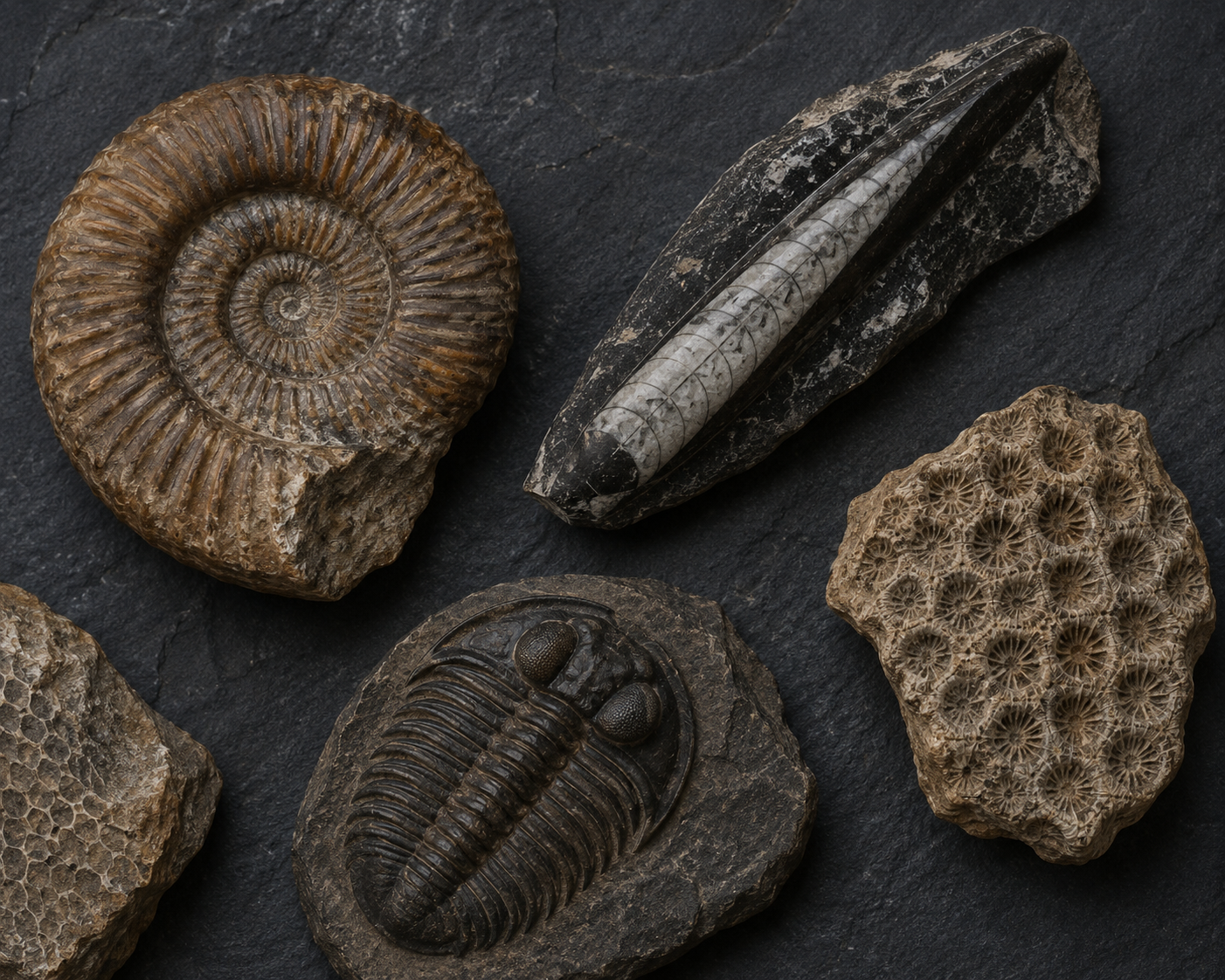
For most of Earth's history, life existed exclusively in the oceans.
Long before forests spread across continents, before birds crossed the skies, and before mammals emerged as a dominant form of life, the seas were already home to astonishingly complex ecosystems. Ancient oceans teemed with creatures that hunted, fed, reproduced, migrated, and adapted through geological ages almost impossible for the human mind to comprehend.
Most of those organisms disappeared without leaving a trace.
A small number became fossils.
Today, these fossils allow us to encounter worlds that vanished hundreds of millions of years ago. Unlike written history, which depends on human memory, fossils preserve events that occurred long before humanity existed. They are not interpretations of the past. They are physical remnants of it.
Every fossilized shell, every preserved coral structure, every imprint left within ancient sedimentary rock represents a direct connection to a living organism that once inhabited an ocean fundamentally different from our own.
For scientists, fossils are records of biological evolution. For collectors, they are rare natural objects shaped by time. For Ampulla Temporis, they are something more: fragments of Earth's memory, preserved through immense spans of geological time and carried into the present.
Long before forests spread across continents, before birds crossed the skies, and before mammals emerged as a dominant form of life, the seas were already home to astonishingly complex ecosystems. Ancient oceans teemed with creatures that hunted, fed, reproduced, migrated, and adapted through geological ages almost impossible for the human mind to comprehend.
Most of those organisms disappeared without leaving a trace.
A small number became fossils.
Today, these fossils allow us to encounter worlds that vanished hundreds of millions of years ago. Unlike written history, which depends on human memory, fossils preserve events that occurred long before humanity existed. They are not interpretations of the past. They are physical remnants of it.
Every fossilized shell, every preserved coral structure, every imprint left within ancient sedimentary rock represents a direct connection to a living organism that once inhabited an ocean fundamentally different from our own.
For scientists, fossils are records of biological evolution. For collectors, they are rare natural objects shaped by time. For Ampulla Temporis, they are something more: fragments of Earth's memory, preserved through immense spans of geological time and carried into the present.
The Oceans Were Earth's First Great Ecosystems
When we imagine prehistoric life, our thoughts often turn immediately to dinosaurs. Yet dinosaurs occupied only a relatively brief chapter in Earth's history.
Life began in the oceans more than 3.5 billion years ago. For billions of years, marine environments served as the primary stage upon which evolution unfolded. Entire lineages of organisms emerged, flourished, and disappeared before complex life ever established itself on land.
The oceans offered stability, resources, and vast ecological opportunities. As a result, many of the most important evolutionary innovations first appeared beneath the surface of ancient seas.
The fossil record reveals this extraordinary history. Marine fossils document the emergence of complex body plans, the development of shells and skeletons, the appearance of predators, and the formation of intricate ecosystems capable of supporting immense biodiversity.
When we hold a marine fossil today, we are often holding evidence of some of the earliest chapters in the story of animal life.
This is one reason marine fossils possess such enduring fascination. They do not simply preserve individual organisms. They preserve entire worlds.
Life began in the oceans more than 3.5 billion years ago. For billions of years, marine environments served as the primary stage upon which evolution unfolded. Entire lineages of organisms emerged, flourished, and disappeared before complex life ever established itself on land.
The oceans offered stability, resources, and vast ecological opportunities. As a result, many of the most important evolutionary innovations first appeared beneath the surface of ancient seas.
The fossil record reveals this extraordinary history. Marine fossils document the emergence of complex body plans, the development of shells and skeletons, the appearance of predators, and the formation of intricate ecosystems capable of supporting immense biodiversity.
When we hold a marine fossil today, we are often holding evidence of some of the earliest chapters in the story of animal life.
This is one reason marine fossils possess such enduring fascination. They do not simply preserve individual organisms. They preserve entire worlds.
How Marine Life Becomes Fossilized
Fossilization is often described as a rare event, and for good reason.
Most organisms disappear completely after death. Scavengers consume soft tissues. Bacteria accelerate decomposition. Waves, currents, and weather erase physical remains. Under normal circumstances, nature leaves very little behind.
For fossilization to occur, a specific sequence of events must unfold.
An organism must be buried relatively quickly, often beneath layers of mud, sand, or fine sediment. This burial protects the remains from physical destruction and slows biological decay. Over time, additional layers accumulate above the original sediment, compressing it into rock.
Meanwhile, mineral-rich groundwater moves through these sediments. Gradually, minerals replace organic structures or fill empty spaces left behind by decomposition. What began as a living organism becomes stone while preserving remarkable anatomical detail.
The process can require millions of years.
What survives at the end is not simply a shell or skeleton. It is a geological record of a life that once existed.
Readers interested in the mechanics of fossilization may wish to explore:
→ How Do Fossils Form? Step-by-Step Process Explained
→ Types of Fossils: A Visual and Scientific Guide
Most organisms disappear completely after death. Scavengers consume soft tissues. Bacteria accelerate decomposition. Waves, currents, and weather erase physical remains. Under normal circumstances, nature leaves very little behind.
For fossilization to occur, a specific sequence of events must unfold.
An organism must be buried relatively quickly, often beneath layers of mud, sand, or fine sediment. This burial protects the remains from physical destruction and slows biological decay. Over time, additional layers accumulate above the original sediment, compressing it into rock.
Meanwhile, mineral-rich groundwater moves through these sediments. Gradually, minerals replace organic structures or fill empty spaces left behind by decomposition. What began as a living organism becomes stone while preserving remarkable anatomical detail.
The process can require millions of years.
What survives at the end is not simply a shell or skeleton. It is a geological record of a life that once existed.
Readers interested in the mechanics of fossilization may wish to explore:
→ How Do Fossils Form? Step-by-Step Process Explained
→ Types of Fossils: A Visual and Scientific Guide
Ammonites and Orthoceras: Survivors from Ancient Seas
Among the most iconic examples of fossilized marine life are ammonites and Orthoceras.
Both belonged to a group of marine animals known as cephalopods, relatives of modern squid, octopuses, and nautiluses. Yet despite their shared ancestry, they evolved dramatically different forms that continue to captivate scientists, collectors, and jewellery enthusiasts alike.
Ammonites are instantly recognizable for their spiral shells. Their geometry follows a logarithmic pattern closely related to the golden ratio, a structure that appears throughout nature in galaxies, hurricanes, plants, and countless biological systems. Their shells expanded chamber by chamber throughout life, creating a visual record of growth through time.
Orthoceras followed a different evolutionary path. Rather than developing a spiral shell, it evolved a long, straight structure divided into chambers. These chambers regulated buoyancy, allowing the animal to navigate ancient seas with remarkable efficiency. Some Orthoceras fossils are more than 400 million years old, making them among the oldest fossils commonly incorporated into jewellery today.
Although separated by form, both fossils share something profound: they are evidence of marine ecosystems that disappeared hundreds of millions of years before the appearance of humanity.
→ What Is an Ammonite? Fossil Age, Meaning and Jewellery
→ Orthoceras Fossil: Meaning, History and Why People Wear It
→ Ammonite vs Orthoceras: Which Fossil Speaks to You?
Both belonged to a group of marine animals known as cephalopods, relatives of modern squid, octopuses, and nautiluses. Yet despite their shared ancestry, they evolved dramatically different forms that continue to captivate scientists, collectors, and jewellery enthusiasts alike.
Ammonites are instantly recognizable for their spiral shells. Their geometry follows a logarithmic pattern closely related to the golden ratio, a structure that appears throughout nature in galaxies, hurricanes, plants, and countless biological systems. Their shells expanded chamber by chamber throughout life, creating a visual record of growth through time.
Orthoceras followed a different evolutionary path. Rather than developing a spiral shell, it evolved a long, straight structure divided into chambers. These chambers regulated buoyancy, allowing the animal to navigate ancient seas with remarkable efficiency. Some Orthoceras fossils are more than 400 million years old, making them among the oldest fossils commonly incorporated into jewellery today.
Although separated by form, both fossils share something profound: they are evidence of marine ecosystems that disappeared hundreds of millions of years before the appearance of humanity.
→ What Is an Ammonite? Fossil Age, Meaning and Jewellery
→ Orthoceras Fossil: Meaning, History and Why People Wear It
→ Ammonite vs Orthoceras: Which Fossil Speaks to You?
Ancient Oceans Beneath the Sahara
One of the most surprising facts about fossilized marine life is where it is often discovered.
Many of the fossils used by Ampulla Temporis originate in Morocco, within regions now dominated by the Sahara Desert. To modern observers, this seems paradoxical. How could marine fossils be found in one of the driest environments on Earth?
The answer lies in the immense scale of geological time.
Hundreds of millions of years ago, large portions of North Africa lay beneath warm, shallow seas. These waters supported diverse ecosystems populated by ammonites, Orthoceras, trilobites, brachiopods, and countless other marine organisms.
As continents shifted and sea levels changed, these oceans gradually disappeared. The seabeds remained. Over time, erosion exposed ancient sedimentary layers rich in fossils.
What is now desert was once ocean.
This transformation serves as a powerful reminder that the landscapes we consider permanent are often temporary expressions of much longer geological processes.
→ Why Are There Fossils in the Sahara Desert?
→ How Fossils Are Found in the Sahara: One Day in the Desert
Many of the fossils used by Ampulla Temporis originate in Morocco, within regions now dominated by the Sahara Desert. To modern observers, this seems paradoxical. How could marine fossils be found in one of the driest environments on Earth?
The answer lies in the immense scale of geological time.
Hundreds of millions of years ago, large portions of North Africa lay beneath warm, shallow seas. These waters supported diverse ecosystems populated by ammonites, Orthoceras, trilobites, brachiopods, and countless other marine organisms.
As continents shifted and sea levels changed, these oceans gradually disappeared. The seabeds remained. Over time, erosion exposed ancient sedimentary layers rich in fossils.
What is now desert was once ocean.
This transformation serves as a powerful reminder that the landscapes we consider permanent are often temporary expressions of much longer geological processes.
→ Why Are There Fossils in the Sahara Desert?
→ How Fossils Are Found in the Sahara: One Day in the Desert
What Marine Fossils Reveal About Earth
Fossils are often admired for their beauty, but their scientific significance extends far beyond aesthetics.
Every fossil contains information.
The shape of a shell may reveal evolutionary relationships between species. The chemical composition of fossilized material can provide clues about ancient ocean temperatures. Fossil distributions help scientists reconstruct prehistoric coastlines, migration patterns, extinction events, and environmental change.
Through marine fossils, researchers have reconstructed entire ecosystems that vanished hundreds of millions of years ago.
They have identified periods of mass extinction and subsequent recovery. They have tracked evolutionary innovations across vast stretches of time. They have learned how life responds to environmental disruption, adaptation, and opportunity.
In this sense, fossils function as one of the most important archives on Earth.
Unlike human archives, they cannot be edited, rewritten, or forgotten.
They simply endure.
Every fossil contains information.
The shape of a shell may reveal evolutionary relationships between species. The chemical composition of fossilized material can provide clues about ancient ocean temperatures. Fossil distributions help scientists reconstruct prehistoric coastlines, migration patterns, extinction events, and environmental change.
Through marine fossils, researchers have reconstructed entire ecosystems that vanished hundreds of millions of years ago.
They have identified periods of mass extinction and subsequent recovery. They have tracked evolutionary innovations across vast stretches of time. They have learned how life responds to environmental disruption, adaptation, and opportunity.
In this sense, fossils function as one of the most important archives on Earth.
Unlike human archives, they cannot be edited, rewritten, or forgotten.
They simply endure.
Why Marine Fossils Continue to Fascinate Us
The enduring appeal of fossilized marine life cannot be explained by science alone.
There is also an emotional dimension.
Marine fossils confront us with a scale of time far beyond ordinary human experience. They remind us that countless worlds existed before our own and that the present moment occupies only a small place within a much larger history.
A fossilized ammonite is not merely beautiful because of its spiral.
An Orthoceras fossil is not remarkable solely because of its age.
What captivates us is the realization that these objects once belonged to living organisms moving through oceans that no longer exist.
Their survival creates perspective.
In a world increasingly defined by speed, novelty, and constant change, fossils offer something different: continuity.
They remind us that life has persisted through upheaval, extinction, transformation, and renewal for hundreds of millions of years.
Perhaps this is why so many people feel drawn to them.
Not because fossils promise answers, but because they expand the questions.
→ Why Humans Are Drawn to Ancient Jewellery and Fossils Older Than Civilization
There is also an emotional dimension.
Marine fossils confront us with a scale of time far beyond ordinary human experience. They remind us that countless worlds existed before our own and that the present moment occupies only a small place within a much larger history.
A fossilized ammonite is not merely beautiful because of its spiral.
An Orthoceras fossil is not remarkable solely because of its age.
What captivates us is the realization that these objects once belonged to living organisms moving through oceans that no longer exist.
Their survival creates perspective.
In a world increasingly defined by speed, novelty, and constant change, fossils offer something different: continuity.
They remind us that life has persisted through upheaval, extinction, transformation, and renewal for hundreds of millions of years.
Perhaps this is why so many people feel drawn to them.
Not because fossils promise answers, but because they expand the questions.
→ Why Humans Are Drawn to Ancient Jewellery and Fossils Older Than Civilization
Fossils as Carriers of Deep Time
At Ampulla Temporis, fossils are not treated as decorative curiosities.
They are material forms shaped by geological processes operating across incomprehensible spans of time. Each fossil represents continuity preserved against extraordinary odds. The organism disappeared. The ocean vanished. Entire ecosystems collapsed. Yet something remained.
That remaining structure carries a kind of memory.
Not memory in the human sense, but memory embedded within matter itself.
To wear a fossil is therefore to carry a fragment of Earth's history—not as an abstract concept, but as a tangible reality.
A reality formed long before our own story began.
They are material forms shaped by geological processes operating across incomprehensible spans of time. Each fossil represents continuity preserved against extraordinary odds. The organism disappeared. The ocean vanished. Entire ecosystems collapsed. Yet something remained.
That remaining structure carries a kind of memory.
Not memory in the human sense, but memory embedded within matter itself.
To wear a fossil is therefore to carry a fragment of Earth's history—not as an abstract concept, but as a tangible reality.
A reality formed long before our own story began.
Frequently Asked Questions
What is fossilized marine life?
Fossilized marine life refers to the preserved remains, impressions, or traces of organisms that once lived in oceans and seas, including ammonites, Orthoceras, trilobites, corals, and other marine animals.
Why are marine fossils so common?
Marine environments often provide ideal conditions for rapid burial and long-term preservation, making fossilization more likely than in many terrestrial environments.
How old are marine fossils?
Marine fossils range in age from thousands to hundreds of millions of years. Some Orthoceras fossils exceed 400 million years in age.
Why are marine fossils found in deserts?
Many modern deserts, including parts of the Sahara, were once covered by ancient seas. Fossils remain preserved within those former seabeds.
What can fossils tell us about ancient oceans?
Fossils help scientists reconstruct prehistoric ecosystems, climate conditions, evolutionary relationships, and major events in Earth's history.
Why are marine fossils used in jewellery?
Marine fossils combine natural beauty, scientific significance, rarity, and a direct connection to Earth's deep history.
