
There is a moment in the desert just before sunrise when the world feels untouched.
The air is cold.
The sand still holds the night.
And time — for a brief while — feels suspended.
This is where the journey begins.
Fossils in the Sahara are not simply found — they are revealed.
And to understand how fossils are found in the Sahara, you have to step into the rhythm of the desert itself.
If you are just beginning to explore these ancient forms, you can start with our guide to what an ammonite is and how it became a fossil.
The air is cold.
The sand still holds the night.
And time — for a brief while — feels suspended.
This is where the journey begins.
Fossils in the Sahara are not simply found — they are revealed.
And to understand how fossils are found in the Sahara, you have to step into the rhythm of the desert itself.
If you are just beginning to explore these ancient forms, you can start with our guide to what an ammonite is and how it became a fossil.
How Are Fossils Found in the Sahara?
Fossils in the Sahara are found in sedimentary rock layers that were once ancient seabeds. Over millions of years, marine life was buried, preserved, and slowly turned into stone.
Today, wind erosion exposes these fossils at the surface.
Fossil hunters do not dig blindly.
They observe, recognize patterns, and carefully extract fossils by hand using simple tools.
This is how fossils are found in the Sahara — slowly, attentively, and with deep knowledge of the land.
Today, wind erosion exposes these fossils at the surface.
Fossil hunters do not dig blindly.
They observe, recognize patterns, and carefully extract fossils by hand using simple tools.
This is how fossils are found in the Sahara — slowly, attentively, and with deep knowledge of the land.
Morning: before the heat
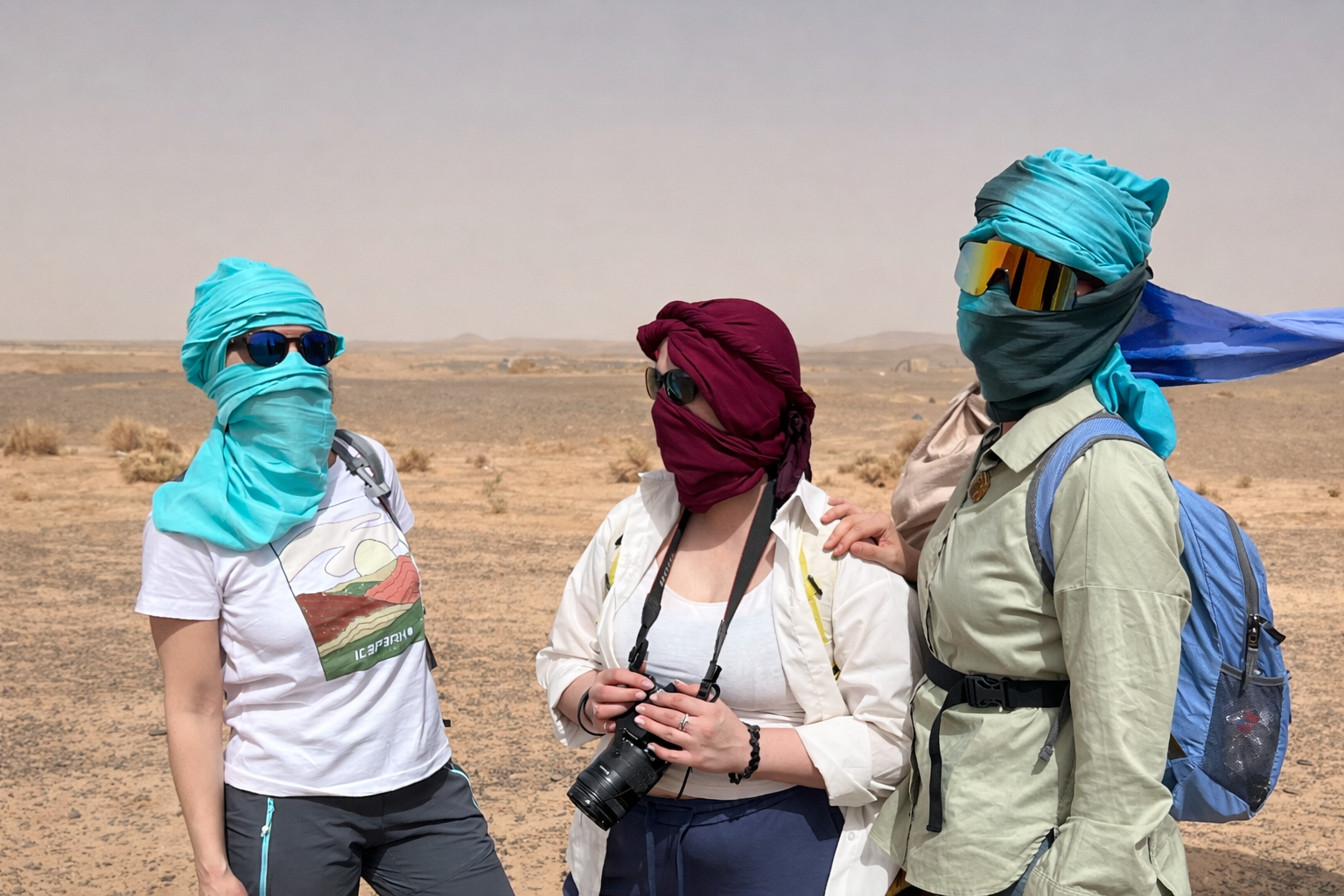
No one speaks loudly.
A small group gathers in the half-light — people who have come from different parts of the world.
Not for comfort. Not for spectacle.
But to enter the desert and learn how to find what it hides.
Moha Mezane is already there.
He was born in Merzouga, on the edge of the Sahara. His father was a fossil digger.
And since childhood, he has walked these lands not as a guest — but as someone who knows how to listen.
Today, he leads the way.
Not like a guide.
Like someone who opens a different way of seeing.
A small group gathers in the half-light — people who have come from different parts of the world.
Not for comfort. Not for spectacle.
But to enter the desert and learn how to find what it hides.
Moha Mezane is already there.
He was born in Merzouga, on the edge of the Sahara. His father was a fossil digger.
And since childhood, he has walked these lands not as a guest — but as someone who knows how to listen.
Today, he leads the way.
Not like a guide.
Like someone who opens a different way of seeing.
Why the Sahara Holds Marine Fossils
The landscape does not look like water.
It is dry. Endless. Still.
But beneath your feet lies the Tafilalt Basin — one of the richest fossil regions in the world.
Hundreds of millions of years ago, this was an ocean.
Ammonites drifted here.
Orthoceras moved through ancient currents.
This process begins long before the desert — in ancient seas where life was preserved and transformed.
It is dry. Endless. Still.
But beneath your feet lies the Tafilalt Basin — one of the richest fossil regions in the world.
Hundreds of millions of years ago, this was an ocean.
Ammonites drifted here.
Orthoceras moved through ancient currents.
This process begins long before the desert — in ancient seas where life was preserved and transformed.
How Fossils Are Found in the Sahara
At first, the search feels random.
People walk, look down, scan the surface.
But Moha stops. “Slow down.”
He points to a subtle curve in the stone.
A line that does not belong.
Finding fossils in the Sahara is not about luck.
It is about recognition.
Understanding how fossils are found in the Sahara means learning to see what others overlook.
People walk, look down, scan the surface.
But Moha stops. “Slow down.”
He points to a subtle curve in the stone.
A line that does not belong.
Finding fossils in the Sahara is not about luck.
It is about recognition.
Understanding how fossils are found in the Sahara means learning to see what others overlook.
The moment of discovery
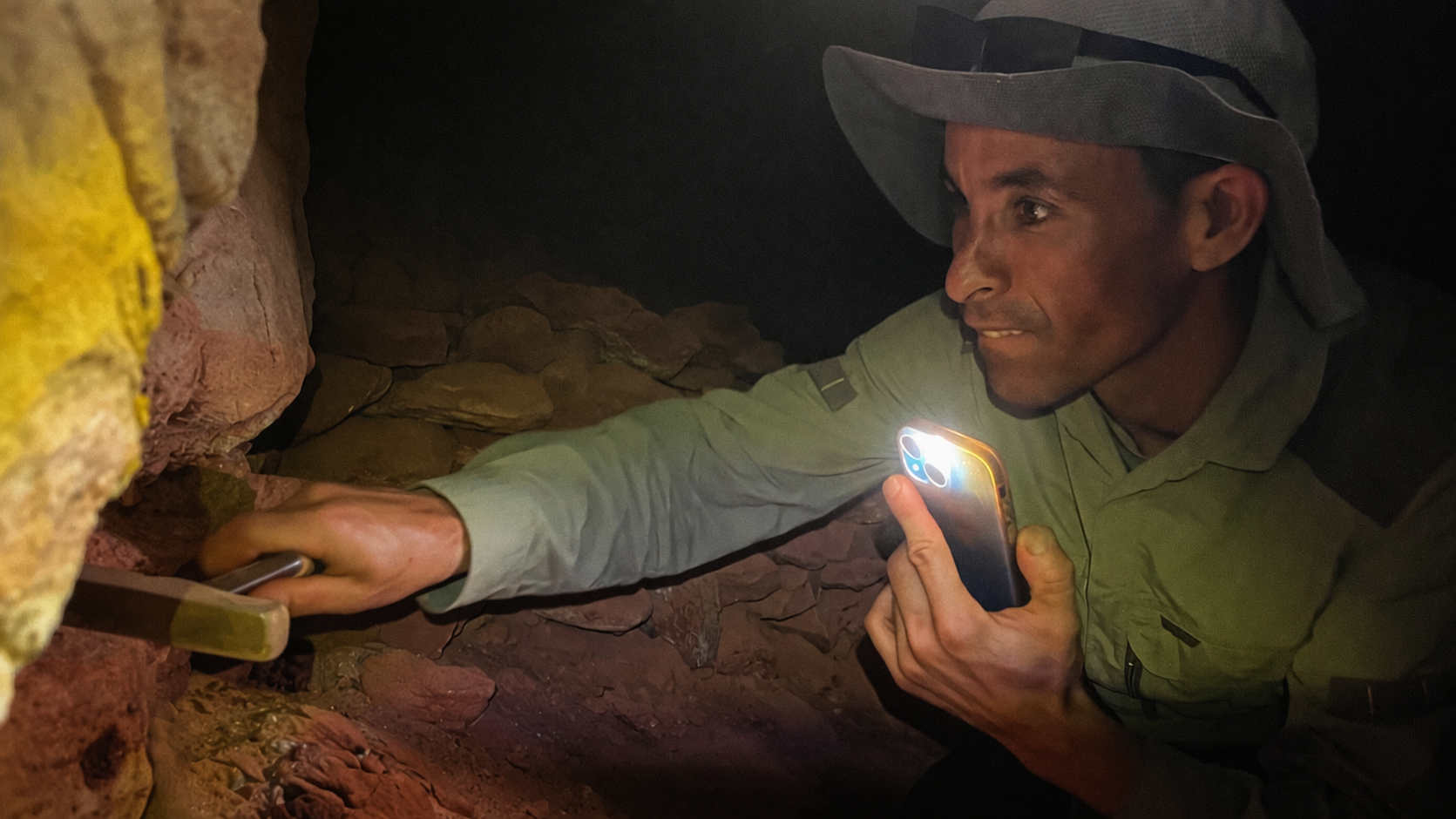
It happens without noise.
Someone calls softly.
Moha comes closer. He does not take the fossil. He guides the hands that found it.
“Here… slowly.”
Sand is brushed away. Stone separates from stone.
And then — a spiral.
An ammonite begins to emerge, unchanged for hundreds of millions of years.
There is no rush.
No excitement in the usual sense.
Only stillness.
As if something long hidden has simply returned.
For the one who uncovers it, this moment does not pass.
Someone calls softly.
Moha comes closer. He does not take the fossil. He guides the hands that found it.
“Here… slowly.”
Sand is brushed away. Stone separates from stone.
And then — a spiral.
An ammonite begins to emerge, unchanged for hundreds of millions of years.
There is no rush.
No excitement in the usual sense.
Only stillness.
As if something long hidden has simply returned.
For the one who uncovers it, this moment does not pass.
The Work of Fossil Hunters
Fossils are never forced out. They are released.
Each movement is careful. Each action deliberate.
Most fossils in the Sahara are found by local Amazigh fossil hunters — people who know the land through generations of experience.
This is not theory.
This is how fossils are found in the Sahara today — through real fieldwork, real hands, and time-tested knowledge.
Each movement is careful. Each action deliberate.
Most fossils in the Sahara are found by local Amazigh fossil hunters — people who know the land through generations of experience.
This is not theory.
This is how fossils are found in the Sahara today — through real fieldwork, real hands, and time-tested knowledge.
Midday: the weight of the sun
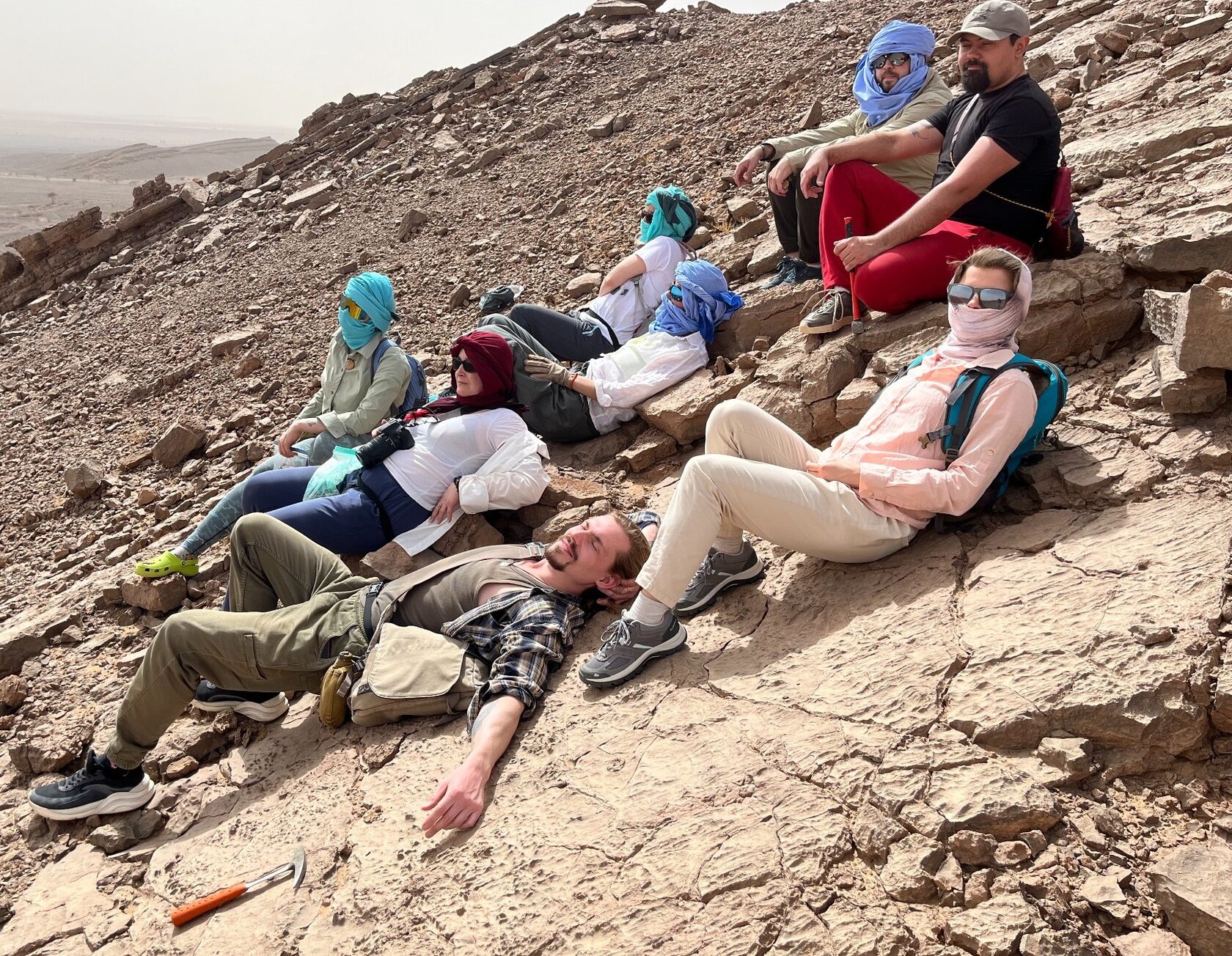
The light sharpens. The air grows heavy.
Work slows.
The fossils are wrapped — protected from damage, from haste.
These journeys are not tours.
There is no performance here.
Only silence... attention... and the gradual understanding that this place was once inhabited with amazing creatures.
Work slows.
The fossils are wrapped — protected from damage, from haste.
These journeys are not tours.
There is no performance here.
Only silence... attention... and the gradual understanding that this place was once inhabited with amazing creatures.
A man between science and desert
Moha is not only a desert guide.
He is a paleonthologist.
He studied the land he grew up in, learning to read its layers with scientific precision.
In 2020, he discovered a new species of ancient shark — Maghreboselache mohamezanei, dating back more than 350 million years.
A discovery that expanded scientific understanding of early marine life and sensory evolution.
And yet, nothing in his presence feels distant.
He still works the same way he did as a child: close to the ground, close to the stone, close to time.
Through these expeditions, he does not only find fossils.
He passes on the ability to see them.
He is a paleonthologist.
He studied the land he grew up in, learning to read its layers with scientific precision.
In 2020, he discovered a new species of ancient shark — Maghreboselache mohamezanei, dating back more than 350 million years.
A discovery that expanded scientific understanding of early marine life and sensory evolution.
And yet, nothing in his presence feels distant.
He still works the same way he did as a child: close to the ground, close to the stone, close to time.
Through these expeditions, he does not only find fossils.
He passes on the ability to see them.
Return: silence again
By evening, the desert softens.
The same stillness returns.
But something has changed.
A form that rested in the earth for millions of years is now moving through the world again.
Carried carefully.
Remembered.
The same stillness returns.
But something has changed.
A form that rested in the earth for millions of years is now moving through the world again.
Carried carefully.
Remembered.
From desert to form
Much later, far from the Sahara, this fossil may become part of a piece of jewellery.
Not to transform it.
But to preserve its presence.
Nothing essential is added. Nothing is taken away.
Because its value is not in what we make.
It is in where it comes from.
Not to transform it.
But to preserve its presence.
Nothing essential is added. Nothing is taken away.
Because its value is not in what we make.
It is in where it comes from.
Why this matters
When you hold such a piece, you are not holding a stone.
You are holding:
— an ancient ocean
— a moment of discovery
— the hands that revealed it
— and time itself.
You are holding:
— an ancient ocean
— a moment of discovery
— the hands that revealed it
— and time itself.
Sometimes, what you wear has already lived longer than anything you know.
And sometimes, it reaches you through a journey across the desert.
And sometimes, it reaches you through a journey across the desert.
FAQ
Why are there fossils in the Sahara desert?
Because the Sahara was once covered by ancient seas where marine life lived and was preserved in sediment.
Are fossils easy to find in the Sahara?
No. Even in fossil-rich areas, finding a complete fossil requires experience and knowledge of the terrain.
Who finds fossils in the Sahara?
Most fossils are found by local Amazigh fossil hunters who know the land and its geology.
Because the Sahara was once covered by ancient seas where marine life lived and was preserved in sediment.
Are fossils easy to find in the Sahara?
No. Even in fossil-rich areas, finding a complete fossil requires experience and knowledge of the terrain.
Who finds fossils in the Sahara?
Most fossils are found by local Amazigh fossil hunters who know the land and its geology.
