
Not all fossils tell the same story.
Some speak of movement. Others speak of stability.
Some invite transformation. Others offer orientation.
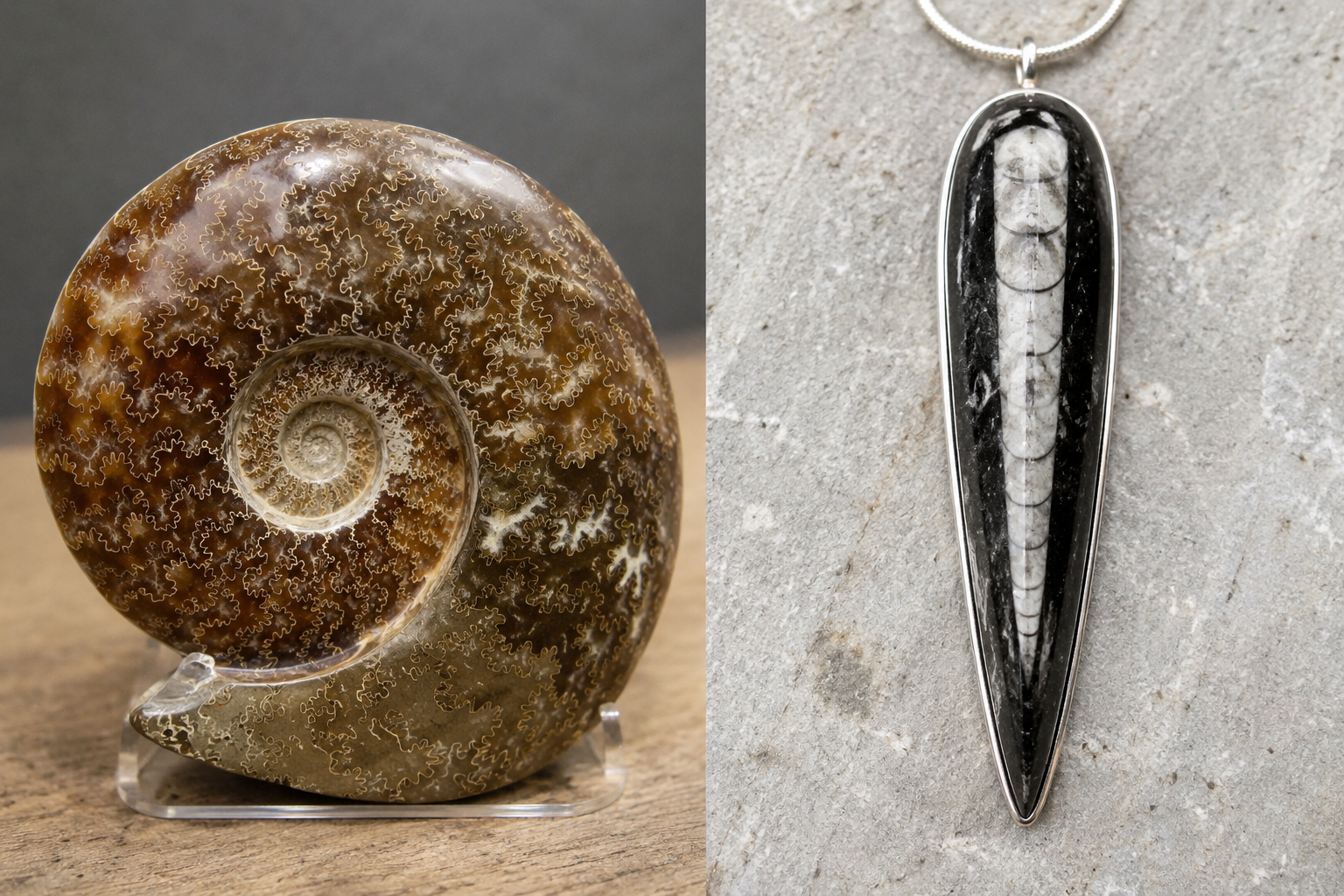
At first glance, ammonites and orthoceras appear to belong to the same ancient world. Both are marine cephalopods that lived hundreds of millions of years ago. Both survived in Earth's oceans long before humanity existed. Both are preserved today as remarkable fossils that can be worn as jewellery.
Yet their forms are fundamentally different.
One spirals outward.
The other points forward.
And this difference shapes not only how we perceive them, but also why people are drawn to one fossil rather than the other.
If you are considering a piece of fossil jewellery and wondering which fossil speaks more closely to your current chapter of life, this guide will help you understand both.
Some speak of movement. Others speak of stability.
Some invite transformation. Others offer orientation.
At first glance, ammonites and orthoceras appear to belong to the same ancient world. Both are marine cephalopods that lived hundreds of millions of years ago. Both survived in Earth's oceans long before humanity existed. Both are preserved today as remarkable fossils that can be worn as jewellery.
Yet their forms are fundamentally different.
One spirals outward.
The other points forward.
And this difference shapes not only how we perceive them, but also why people are drawn to one fossil rather than the other.
If you are considering a piece of fossil jewellery and wondering which fossil speaks more closely to your current chapter of life, this guide will help you understand both.
What Is an Ammonite?
An ammonite was an extinct marine mollusc that lived in Earth's oceans for hundreds of millions of years.
Its most distinctive feature is its spiral shell, which grew chamber by chamber throughout the creature's life.
Today, ammonites are among the world's most recognisable fossils and are admired both for their scientific significance and their extraordinary geometry.
If you're new to ammonites, start with our complete guide:
→ What Is an Ammonite? Fossil Age, Meaning and Jewellery
The spiral structure of the ammonite records growth itself. Each chamber marks a completed stage, while the animal continued moving forward into a new one.
In this sense, the ammonite becomes a natural symbol of evolution through time.
Its most distinctive feature is its spiral shell, which grew chamber by chamber throughout the creature's life.
Today, ammonites are among the world's most recognisable fossils and are admired both for their scientific significance and their extraordinary geometry.
If you're new to ammonites, start with our complete guide:
→ What Is an Ammonite? Fossil Age, Meaning and Jewellery
The spiral structure of the ammonite records growth itself. Each chamber marks a completed stage, while the animal continued moving forward into a new one.
In this sense, the ammonite becomes a natural symbol of evolution through time.
What Is Orthoceras?
Orthoceras was also an extinct marine cephalopod, but unlike the ammonite, its shell grew in a straight line.
Instead of expanding outward through a spiral, Orthoceras developed a long vertical structure divided into chambers.
Most Orthoceras fossils are between 400 and 480 million years old and are among the oldest fossils commonly used in jewellery.
To learn more, read:
→ Orthoceras Fossil: Meaning, History and Why People Wear It
The living animal occupied only the outermost chamber. Previous chambers remained behind as support, creating buoyancy and balance.
This structure transformed time into architecture.
The past was not abandoned. It became the foundation.
Instead of expanding outward through a spiral, Orthoceras developed a long vertical structure divided into chambers.
Most Orthoceras fossils are between 400 and 480 million years old and are among the oldest fossils commonly used in jewellery.
To learn more, read:
→ Orthoceras Fossil: Meaning, History and Why People Wear It
The living animal occupied only the outermost chamber. Previous chambers remained behind as support, creating buoyancy and balance.
This structure transformed time into architecture.
The past was not abandoned. It became the foundation.
Ammonite vs Orthoceras: The Geological Difference
Although ammonites and Orthoceras are often grouped together as ancient marine fossils, they evolved very different forms.
Shell Shape
The most obvious difference is their shape.
An ammonite grows in a spiral, expanding outward chamber by chamber throughout its life. This spiral creates one of nature's most recognizable geometric forms and is often associated with growth and continuous development.
Orthoceras, by contrast, grows in a straight line. Its long, cone-shaped shell forms a clear vertical axis, giving it a more directional and structured appearance.
An ammonite grows in a spiral, expanding outward chamber by chamber throughout its life. This spiral creates one of nature's most recognizable geometric forms and is often associated with growth and continuous development.
Orthoceras, by contrast, grows in a straight line. Its long, cone-shaped shell forms a clear vertical axis, giving it a more directional and structured appearance.
How They Represent Time
The ammonite records time through expansion. Each new chamber extends the spiral, preserving earlier stages while creating space for future growth.
Orthoceras records time through sequence. The animal occupied only the outermost chamber, while all previous chambers remained behind as support. Its structure demonstrates how the past can provide stability without demanding attention.
Orthoceras records time through sequence. The animal occupied only the outermost chamber, while all previous chambers remained behind as support. Its structure demonstrates how the past can provide stability without demanding attention.
Visual Impression
Ammonites tend to feel dynamic and fluid. The eye naturally follows the spiral inward and outward, creating a sense of movement.
Orthoceras feels stable and grounded. Its straight form creates a sense of direction, focus, and alignment.
Orthoceras feels stable and grounded. Its straight form creates a sense of direction, focus, and alignment.
The Symbolism of the Ammonite
At Ampulla Temporis, the ammonite represents movement structured by time.
Its spiral follows a logarithmic pattern found throughout nature—from galaxies and hurricanes to shells and flowering plants.
Because of this, many people see ammonites as symbols of:
The ammonite does not rush.
It expands.
Each chamber represents a completed chapter while making room for the next.
This is why ammonite jewellery is often chosen during periods of transition.
You may also enjoy:
→ Ammonite Meaning: Symbolism, History and Why People Wear It
→ How to Choose an Ammonite That Feels Like Yours
Its spiral follows a logarithmic pattern found throughout nature—from galaxies and hurricanes to shells and flowering plants.
Because of this, many people see ammonites as symbols of:
- Personal growth
- Transformation
- New beginnings
- Evolution
- Trusting the process
The ammonite does not rush.
It expands.
Each chamber represents a completed chapter while making room for the next.
This is why ammonite jewellery is often chosen during periods of transition.
You may also enjoy:
→ Ammonite Meaning: Symbolism, History and Why People Wear It
→ How to Choose an Ammonite That Feels Like Yours
The Symbolism of Orthoceras
Where the ammonite expands, Orthoceras aligns.
The Codex describes Orthoceras as the Axis of Time—a structure that embodies orientation rather than movement.
Its straight geometry naturally evokes:
The chambers of Orthoceras create a powerful metaphor.
You live in the present chamber.
Everything behind you remains as support.
Nothing needs to be carried forward except its lesson.
Many people choose Orthoceras jewellery when life feels scattered and they seek a stronger sense of direction.
The Codex describes Orthoceras as the Axis of Time—a structure that embodies orientation rather than movement.
Its straight geometry naturally evokes:
- Focus
- Clarity
- Stability
- Grounding
- Inner structure
The chambers of Orthoceras create a powerful metaphor.
You live in the present chamber.
Everything behind you remains as support.
Nothing needs to be carried forward except its lesson.
Many people choose Orthoceras jewellery when life feels scattered and they seek a stronger sense of direction.
Which Fossil Is Older?
This question often surprises people.
While both fossils are ancient, Orthoceras is generally older.
Orthoceras
Ammonites
This means some Orthoceras fossils predate many ammonites by tens of millions of years.
If deep geological time is important to you, Orthoceras offers one of the oldest tangible connections available in jewellery.
For more context:
→ Are Ammonites Older Than Dinosaurs?
→ Ammonite Fossil Age: How Old Are Ammonites?
While both fossils are ancient, Orthoceras is generally older.
Orthoceras
- Approximately 400–480 million years old
Ammonites
- Approximately 66–400 million years old depending on species
This means some Orthoceras fossils predate many ammonites by tens of millions of years.
If deep geological time is important to you, Orthoceras offers one of the oldest tangible connections available in jewellery.
For more context:
→ Are Ammonites Older Than Dinosaurs?
→ Ammonite Fossil Age: How Old Are Ammonites?
Ammonite or Orthoceras: Which One Resonates With You?
There is no correct answer.
The question is not which fossil is better.
The question is which conversation with time feels most relevant right now.
The question is not which fossil is better.
The question is which conversation with time feels most relevant right now.
Choose Ammonite If...
You are:
The ammonite reminds us that life unfolds through sequence.
You do not need to know the entire path.
Only the next chamber.
- Entering a new chapter
- Navigating change
- Starting a project
- Rebuilding after transition
- Looking for a symbol of growth
The ammonite reminds us that life unfolds through sequence.
You do not need to know the entire path.
Only the next chamber.
Choose Orthoceras If...
You are:
Orthoceras reminds us that the past exists to support us, not to occupy us.
- Seeking clarity
- Making important decisions
- Building long-term foundations
- Reclaiming focus
- Looking for grounding
Orthoceras reminds us that the past exists to support us, not to occupy us.
Why Many Collectors Choose Both
Interestingly, many Ampulla Temporis clients are drawn to both fossils.
Together they form a complete dialogue.
Ammonite represents movement. Orthoceras represents orientation.
Ammonite asks: Where are you going?
Orthoceras asks: From where do you stand?
One supports becoming.
The other supports presence.
Together, they mirror two essential dimensions of human experience.
Together they form a complete dialogue.
Ammonite represents movement. Orthoceras represents orientation.
Ammonite asks: Where are you going?
Orthoceras asks: From where do you stand?
One supports becoming.
The other supports presence.
Together, they mirror two essential dimensions of human experience.
Fossils as Jewellery: More Than Decoration
At Ampulla Temporis, we do not see fossils as decorative objects.
We see them as fragments of Earth's memory.
Every ammonite and every Orthoceras fossil represents a life that existed hundreds of millions of years before our own.
No laboratory can reproduce that history. No gemstone can replicate that timescale.
This is why fossil jewellery feels different from traditional jewellery.
→ What Makes Fossil Jewellery Different from Traditional Jewellery?
For many wearers, these pieces offer something increasingly rare: Perspective.
We see them as fragments of Earth's memory.
Every ammonite and every Orthoceras fossil represents a life that existed hundreds of millions of years before our own.
No laboratory can reproduce that history. No gemstone can replicate that timescale.
This is why fossil jewellery feels different from traditional jewellery.
→ What Makes Fossil Jewellery Different from Traditional Jewellery?
For many wearers, these pieces offer something increasingly rare: Perspective.
Frequently Asked Questions
Is Orthoceras related to ammonites?
Yes. Both were marine cephalopods, related to modern squid and nautiluses. However, they developed very different shell structures.
Which fossil is older: ammonite or Orthoceras?
Orthoceras is generally older, with most specimens dating between 400 and 480 million years ago.
What does an ammonite symbolize?
Ammonites are commonly associated with growth, transformation, continuity, and movement through life's transitions.
What does Orthoceras symbolize?
Orthoceras is associated with focus, grounding, clarity, alignment, and stability.
Why do people wear fossil jewellery?
People wear fossil jewellery because it connects them to Earth's ancient history while offering unique natural beauty and symbolic meaning.
Are ammonite and Orthoceras fossils real?
Authentic jewellery uses genuine fossil specimens that formed over hundreds of millions of years through natural geological processes.
Final Thoughts
The ammonite and Orthoceras tell two different stories about time. The ammonite speaks of becoming. The Orthoceras speaks of being.
One reminds us that growth unfolds chamber by chamber. The other reminds us that every completed chamber becomes support.
Neither fossil promises transformation. Neither claims power.
They simply embody forms that have endured for hundreds of millions of years and continue to resonate with those who encounter them.
The question is not which fossil is superior.
The question is: Which conversation with time do you need today?
One reminds us that growth unfolds chamber by chamber. The other reminds us that every completed chamber becomes support.
Neither fossil promises transformation. Neither claims power.
They simply embody forms that have endured for hundreds of millions of years and continue to resonate with those who encounter them.
The question is not which fossil is superior.
The question is: Which conversation with time do you need today?
