
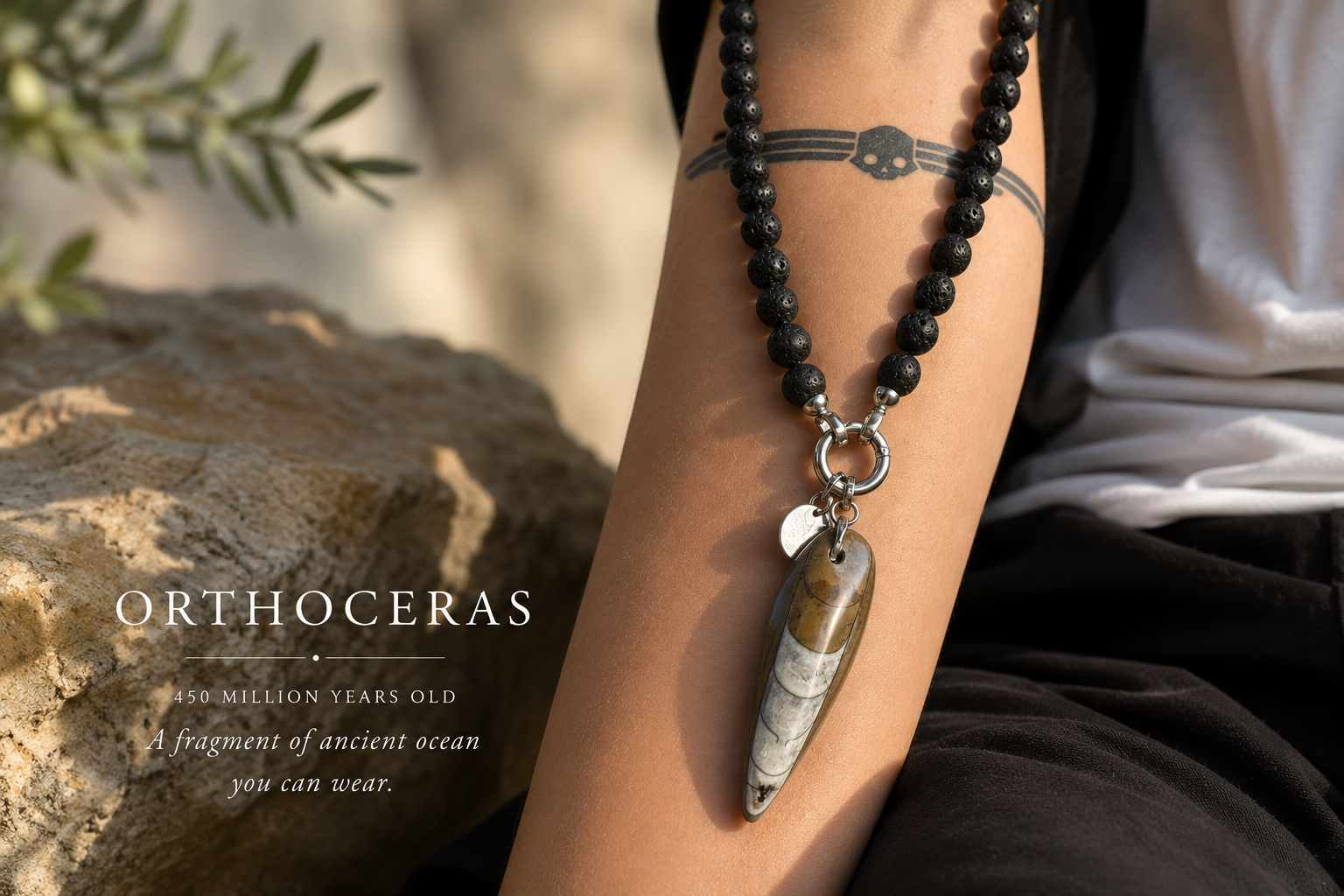
Some treasures are valued because they are rare. Others because they are beautiful.
An Orthoceras fossil is valued for a different reason entirely: it is a fragment of life that existed more than 400 million years ago.
Long before dinosaurs walked the Earth, before forests covered the continents, and long before humanity appeared, Orthoceras moved through ancient oceans. Today, their fossilized remains allow us to hold a tangible piece of deep time in our hands.
For many people, wearing Orthoceras jewellery is not simply about adornment. It is about carrying a connection to Earth's ancient history, a reminder of continuity, resilience, and perspective.
An Orthoceras fossil is valued for a different reason entirely: it is a fragment of life that existed more than 400 million years ago.
Long before dinosaurs walked the Earth, before forests covered the continents, and long before humanity appeared, Orthoceras moved through ancient oceans. Today, their fossilized remains allow us to hold a tangible piece of deep time in our hands.
For many people, wearing Orthoceras jewellery is not simply about adornment. It is about carrying a connection to Earth's ancient history, a reminder of continuity, resilience, and perspective.
What Is an Orthoceras Fossil?
Orthoceras was an extinct marine cephalopod that lived approximately 400–480 million years ago during the Ordovician period.
It belonged to a group of ancient ocean predators related to modern squid and nautiluses. Unlike its spiral-shelled relatives, Orthoceras possessed a long, straight, cone-shaped shell divided into internal chambers.
These chambers helped regulate buoyancy, allowing the animal to move through prehistoric seas with remarkable efficiency.
Today, Orthoceras fossils are found primarily in Morocco, where ancient marine sediments have preserved these extraordinary creatures for hundreds of millions of years.
It belonged to a group of ancient ocean predators related to modern squid and nautiluses. Unlike its spiral-shelled relatives, Orthoceras possessed a long, straight, cone-shaped shell divided into internal chambers.
These chambers helped regulate buoyancy, allowing the animal to move through prehistoric seas with remarkable efficiency.
Today, Orthoceras fossils are found primarily in Morocco, where ancient marine sediments have preserved these extraordinary creatures for hundreds of millions of years.
How Old Is Orthoceras?
One of the most fascinating aspects of Orthoceras is its age.
Most Orthoceras fossils are between 400 and 480 million years old, making them significantly older than dinosaurs.
To put this into perspective:
When you hold an Orthoceras fossil, you are touching a structure that predates almost every familiar form of life on Earth.
Preserving an organism for hundreds of millions of years requires an extraordinary combination of geological conditions and fossilisation processes.
Most Orthoceras fossils are between 400 and 480 million years old, making them significantly older than dinosaurs.
To put this into perspective:
- Tyrannosaurus rex lived about 68 million years ago
- The first humans appeared roughly 2 million years ago
- Orthoceras lived more than 400 million years ago
When you hold an Orthoceras fossil, you are touching a structure that predates almost every familiar form of life on Earth.
Preserving an organism for hundreds of millions of years requires an extraordinary combination of geological conditions and fossilisation processes.
What Does Orthoceras Mean?
Throughout history, fossils have inspired symbolic interpretations.
The straight, vertical form of Orthoceras naturally evokes ideas of direction, alignment, and stability.
At Ampulla Temporis, Orthoceras is understood as the Axis of Time—a structure shaped by hundreds of millions of years that embodies orientation rather than movement.
Its shell was divided into chambers. The living creature occupied only the newest chamber, while previous chambers remained behind as support.
This structure offers a powerful metaphor:
The past supports us, but it does not need to occupy our attention.
Unlike the spiral movement represented by ammonites, Orthoceras symbolizes clarity, focus, and grounded presence.
Readers interested in the symbolic language of fossils may also enjoy exploring the meaning behind the ammonite, Orthoceras's more widely known relative.
The straight, vertical form of Orthoceras naturally evokes ideas of direction, alignment, and stability.
At Ampulla Temporis, Orthoceras is understood as the Axis of Time—a structure shaped by hundreds of millions of years that embodies orientation rather than movement.
Its shell was divided into chambers. The living creature occupied only the newest chamber, while previous chambers remained behind as support.
This structure offers a powerful metaphor:
The past supports us, but it does not need to occupy our attention.
Unlike the spiral movement represented by ammonites, Orthoceras symbolizes clarity, focus, and grounded presence.
Readers interested in the symbolic language of fossils may also enjoy exploring the meaning behind the ammonite, Orthoceras's more widely known relative.
Orthoceras Symbolism Through History
Many cultures attributed special significance to ancient fossils.
While Orthoceras was not as widely known as ammonites, its unusual shape has long inspired associations with:
Modern interpretations often see Orthoceras as a reminder to remain centered during periods of uncertainty.
Its form suggests standing firmly in the present while allowing the past to serve as a foundation rather than a burden.
While Orthoceras was not as widely known as ammonites, its unusual shape has long inspired associations with:
- Stability
- Endurance
- Wisdom gained through experience
- Connection to ancient knowledge
- Personal grounding
Modern interpretations often see Orthoceras as a reminder to remain centered during periods of uncertainty.
Its form suggests standing firmly in the present while allowing the past to serve as a foundation rather than a burden.
Why People Wear Orthoceras Jewellery
People choose Orthoceras jewellery for many reasons.
1. A Piece of Earth's Ancient History
An Orthoceras fossil is not a gemstone created in a laboratory.
It is the preserved remains of an organism that lived hundreds of millions of years ago.
For those who love natural history, science, and geology, wearing Orthoceras is a way to carry a genuine piece of Earth's story.
It is the preserved remains of an organism that lived hundreds of millions of years ago.
For those who love natural history, science, and geology, wearing Orthoceras is a way to carry a genuine piece of Earth's story.
2. A Symbol of Focus and Clarity
The straight geometry of Orthoceras differs dramatically from the spirals found throughout nature.
Its visual simplicity often resonates with people seeking structure, direction, and concentration.
Many wearers describe Orthoceras as representing:
Its visual simplicity often resonates with people seeking structure, direction, and concentration.
Many wearers describe Orthoceras as representing:
- Clear thinking
- Decisiveness
- Inner stability
- Personal alignment
3. A Reminder of Perspective
Modern life often feels urgent.
A fossil that has survived for over 400 million years offers a different perspective.
Orthoceras reminds us that time is larger than any single challenge, decision, or moment.
A fossil that has survived for over 400 million years offers a different perspective.
Orthoceras reminds us that time is larger than any single challenge, decision, or moment.
4. A Truly Unique Object
No two fossils are identical.
Each Orthoceras fossil bears unique patterns, textures, and mineralization created through geological processes spanning hundreds of millions of years.
Every piece carries its own story.
Each Orthoceras fossil bears unique patterns, textures, and mineralization created through geological processes spanning hundreds of millions of years.
Every piece carries its own story.
Orthoceras vs Ammonite: What's the Difference?
Orthoceras and ammonites are often grouped together because both are ancient marine fossils.
However, they represent very different forms and symbolic qualities.
Orthoceras: straight shell, focus and alignment, vertical structure, grounding presence
Ammonite: spiral shell, movement and transition, expanding geometry, evolution and growth
Many collectors are drawn to both fossils because they represent complementary aspects of time:
Together, they create a dialogue between direction and movement.
However, they represent very different forms and symbolic qualities.
Orthoceras: straight shell, focus and alignment, vertical structure, grounding presence
Ammonite: spiral shell, movement and transition, expanding geometry, evolution and growth
Many collectors are drawn to both fossils because they represent complementary aspects of time:
- Orthoceras represents orientation.
- Ammonite represents transformation.
Together, they create a dialogue between direction and movement.
Where Are Orthoceras Fossils Found?
Some of the world's finest Orthoceras fossils come from Morocco.
Millions of years ago, this region was covered by shallow seas rich in marine life.
As sediments accumulated and oceans receded, ancient organisms became preserved within limestone formations.
Today, skilled fossil hunters and artisans recover these fossils from the Sahara region, where they continue to reveal stories from one of Earth's earliest oceans.
To understand this remarkable landscape, explore our articles about fossil hunting in the Sahara and why marine fossils are found in the desert at all.
Millions of years ago, this region was covered by shallow seas rich in marine life.
As sediments accumulated and oceans receded, ancient organisms became preserved within limestone formations.
Today, skilled fossil hunters and artisans recover these fossils from the Sahara region, where they continue to reveal stories from one of Earth's earliest oceans.
To understand this remarkable landscape, explore our articles about fossil hunting in the Sahara and why marine fossils are found in the desert at all.
Orthoceras in Jewellery
At Ampulla Temporis, we believe jewellery can be more than decoration.
Every Orthoceras fossil carries a history that no gemstone can replicate.
When combined with carefully selected natural materials such as pearls, amber, volcanic lava, or agate, Orthoceras becomes part of a larger conversation about time, memory, and presence.
The result is jewellery that does not merely adorn the body—it connects the wearer to a scale of time far beyond human experience.
Every Orthoceras fossil carries a history that no gemstone can replicate.
When combined with carefully selected natural materials such as pearls, amber, volcanic lava, or agate, Orthoceras becomes part of a larger conversation about time, memory, and presence.
The result is jewellery that does not merely adorn the body—it connects the wearer to a scale of time far beyond human experience.
Frequently Asked Questions About Orthoceras Fossils
What is an Orthoceras fossil?
An Orthoceras fossil is the preserved shell of an extinct marine cephalopod that lived approximately 400–480 million years ago. It is one of the oldest fossils commonly used in jewellery and collecting.
How old are Orthoceras fossils?
Most Orthoceras fossils are between 400 and 480 million years old, making them significantly older than dinosaurs.
Where are Orthoceras fossils found?
Many of the finest Orthoceras fossils are found in Morocco, where ancient seabeds preserved marine life in limestone deposits that are now exposed in the Sahara region.
Is Orthoceras related to ammonites?
Yes. Both Orthoceras and ammonites are extinct marine cephalopods. The main difference is that Orthoceras had a straight shell, while ammonites developed a spiral shell.
What does Orthoceras symbolize?
Orthoceras is often associated with focus, grounding, clarity, stability, and the ability to move forward while remaining connected to past experience.
Why do people wear Orthoceras jewellery?
People wear Orthoceras jewellery because it combines natural history, unique fossil beauty, and symbolic meaning. Each fossil represents a tangible connection to Earth's ancient oceans.
Is every Orthoceras fossil unique?
Yes. Like fingerprints, no two Orthoceras fossils are identical. Natural mineralization, preservation, and fossilization create unique patterns and structures in every specimen.
Is Orthoceras jewellery made from real fossils?
Authentic Orthoceras jewellery uses genuine fossilized remains that formed over hundreds of millions of years. Reputable brands provide provenance and authenticity information about their fossils.
Final Thoughts
Orthoceras is more than an ancient fossil.
It is evidence that life existed, adapted, and endured hundreds of millions of years before our own story began.
Whether viewed through the lens of science, history, symbolism, or design, Orthoceras offers something increasingly rare in the modern world: perspective.
To learn how to identify authentic fossils before buying, we recommend reading:
How to Identify Real Fossil Jewellery: 7 Ways to Spot Authentic Fossils vs Fakes
To wear an Orthoceras fossil is to carry a fragment of Earth's memory—a reminder that the past can support us without defining us, and that true stability often comes from understanding our place within a much larger story.
It is evidence that life existed, adapted, and endured hundreds of millions of years before our own story began.
Whether viewed through the lens of science, history, symbolism, or design, Orthoceras offers something increasingly rare in the modern world: perspective.
To learn how to identify authentic fossils before buying, we recommend reading:
How to Identify Real Fossil Jewellery: 7 Ways to Spot Authentic Fossils vs Fakes
To wear an Orthoceras fossil is to carry a fragment of Earth's memory—a reminder that the past can support us without defining us, and that true stability often comes from understanding our place within a much larger story.
Explore Orthoceras Jewellery by Ampulla Temporis
Wear a piece of Earth's ancient history and discover the quiet strength of a fossil that has endured for more than 400 million years.
