
Short answer
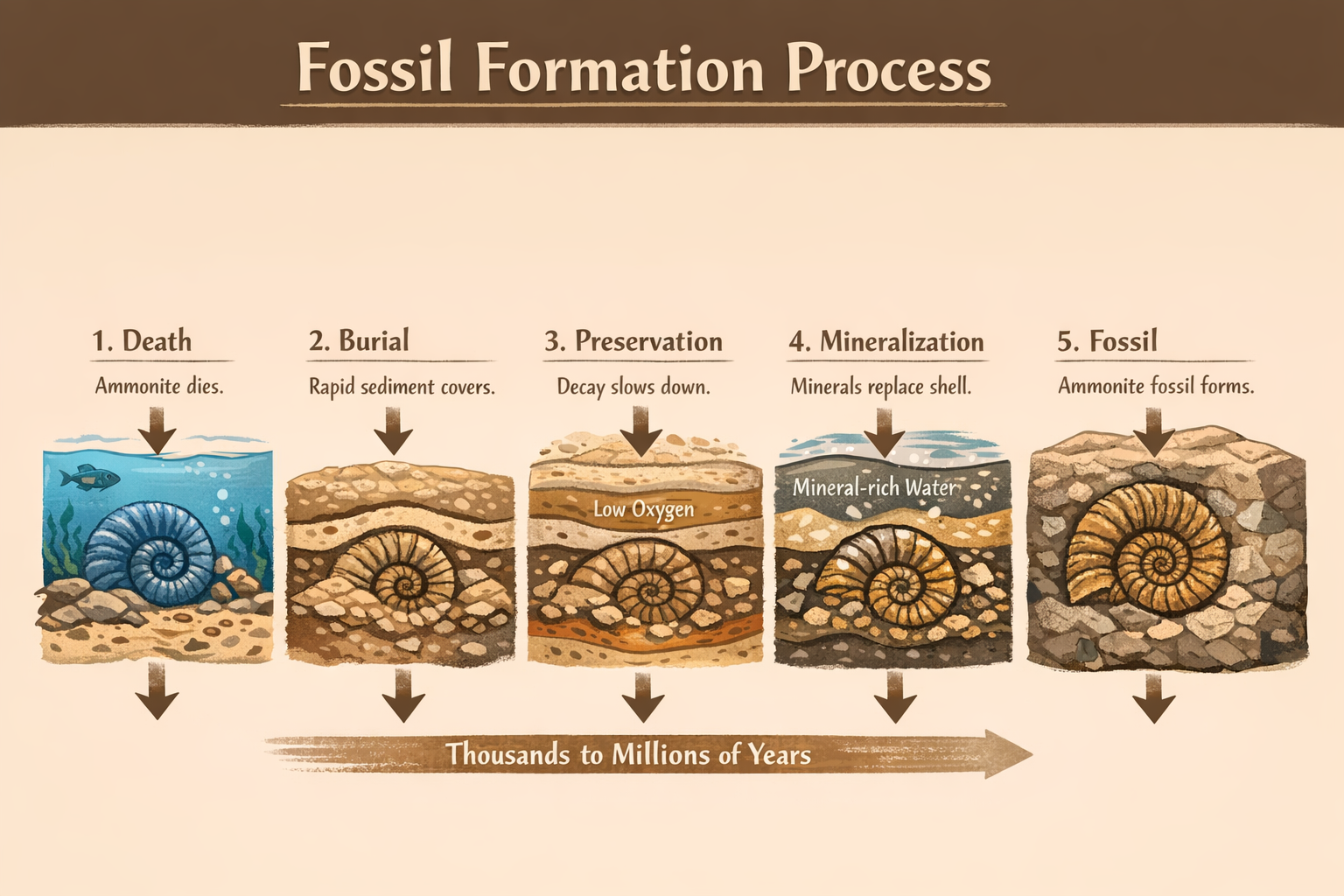
Fossils form when a living organism is rapidly buried under sediment, protected from decay, and gradually replaced or preserved by minerals over millions of years.
Introduction
Most life disappears without a trace.
A body decays.
A shell dissolves.
A movement leaves no memory.
Fossils are rare not because life was rare — but because preservation is.
To understand how fossils form, we need to follow a process that is both precise and fragile — a sequence where time, pressure, and environment align.
If you are just beginning to explore this topic, start with our guide:
→ What Is a Fossil? Definition, Types and Examples
A body decays.
A shell dissolves.
A movement leaves no memory.
Fossils are rare not because life was rare — but because preservation is.
To understand how fossils form, we need to follow a process that is both precise and fragile — a sequence where time, pressure, and environment align.
If you are just beginning to explore this topic, start with our guide:
→ What Is a Fossil? Definition, Types and Examples
Step 1: Death in the Right Environment
Everything begins with the end of a living organism.
But not every death leads to a fossil.
For fossilization to even be possible, the organism must be in a suitable environment:
Marine environments are ideal.
This is why so many fossils come from ancient seas.
But not every death leads to a fossil.
For fossilization to even be possible, the organism must be in a suitable environment:
- near water (oceans, lakes, rivers)
- in areas where sediment is actively deposited
- away from strong currents and scavengers
Marine environments are ideal.
This is why so many fossils come from ancient seas.
Step 2: Rapid Burial Under Sediment
Speed matters.
If the organism is quickly covered by:
it becomes protected from:
Without rapid burial, decomposition happens too fast — and nothing remains.
This is the moment where chance begins to turn into preservation.
If the organism is quickly covered by:
- sand
- mud
- silt
it becomes protected from:
- oxygen
- bacteria
- scavengers
Without rapid burial, decomposition happens too fast — and nothing remains.
This is the moment where chance begins to turn into preservation.
Step 3: Protection From Decay
Even after burial, decay does not stop immediately.
But conditions change.
Low oxygen levels slow down:
Hard parts — shells, bones, teeth — survive longer than soft tissue.
This is why most fossils preserve structure, not flesh.
But conditions change.
Low oxygen levels slow down:
- bacterial activity
- chemical breakdown
Hard parts — shells, bones, teeth — survive longer than soft tissue.
This is why most fossils preserve structure, not flesh.
Step 4: Mineral Replacement (Permineralization)
Now begins the slow transformation.
Groundwater rich in dissolved minerals moves through the sediment.
These minerals:
Over time, the original material is either:
The form remains.
The substance changes.
Groundwater rich in dissolved minerals moves through the sediment.
These minerals:
- fill tiny pores
- replace organic material
- crystallize inside the structure
Over time, the original material is either:
- partially preserved
- or fully replaced by minerals
The form remains.
The substance changes.
Step 5: Compaction and Lithification
As more layers of sediment accumulate above, pressure increases.
The lower layers:
This process is called lithification.
The fossil becomes locked inside the rock — part of the Earth's structure itself.
The lower layers:
- compress
- lose water
- turn into solid rock
This process is called lithification.
The fossil becomes locked inside the rock — part of the Earth's structure itself.
Step 6: Exposure Through Geological Change
A fossil can remain hidden for millions of years.
To be discovered, something must happen:
Only then does the fossil return to the surface.
Not as life — but as a preserved form of it.
To be discovered, something must happen:
- erosion
- tectonic uplift
- wind or water removal of upper layers
Only then does the fossil return to the surface.
Not as life — but as a preserved form of it.
Main Types of Fossil Formation
Fossilization does not follow a single path.
There are several ways in which fossils form.
Permineralization
Minerals fill the internal structure (common in bones and wood)
Replacement
Original material is fully replaced by minerals
Mold and Cast Formation
The organism dissolves, leaving a shape in the rock
Carbonization
Only a thin carbon film remains (often in plants)
Amber Preservation
Organisms are trapped in tree resin and preserved in detail
There are several ways in which fossils form.
Permineralization
Minerals fill the internal structure (common in bones and wood)
Replacement
Original material is fully replaced by minerals
Mold and Cast Formation
The organism dissolves, leaving a shape in the rock
Carbonization
Only a thin carbon film remains (often in plants)
Amber Preservation
Organisms are trapped in tree resin and preserved in detail
Why Fossilization Is Rare
Fossilization requires a precise combination of conditions:
If even one factor is missing, the process fails.
This is why the fossil record is incomplete — and why every fossil matters.
- rapid burial
- low oxygen
- mineral-rich water
- stable environment over long periods
If even one factor is missing, the process fails.
This is why the fossil record is incomplete — and why every fossil matters.
Where Fossils Form Most Easily
Fossils are most likely to form in:
These environments continuously deposit sediment — creating the conditions needed for preservation.
- seabeds
- river deltas
- lake bottoms
- floodplains
These environments continuously deposit sediment — creating the conditions needed for preservation.
How Long Does It Take for Fossils to Form?
Fossilization is not instant.
The initial stages can happen relatively quickly, but full mineral transformation takes:
Time is not just a factor — it is the medium of transformation.
Now that you understand how fossils form, you can explore what they are in more depth:
→ What Is a Fossil? Definition, Types and Examples
The initial stages can happen relatively quickly, but full mineral transformation takes:
- tens of thousands
- millions of years
Time is not just a factor — it is the medium of transformation.
Now that you understand how fossils form, you can explore what they are in more depth:
→ What Is a Fossil? Definition, Types and Examples
Conclusion
Fossils do not form because something survived.
They form because something was protected, transformed, and held in place long enough for time to complete its work.
What we see today is not the organism itself, but the result of a process in which life and Earth became inseparable.
They form because something was protected, transformed, and held in place long enough for time to complete its work.
What we see today is not the organism itself, but the result of a process in which life and Earth became inseparable.
FAQ (People Also Ask)
How long does it take for a fossil to form?
It can take thousands to millions of years, depending on conditions and the type of fossilization.
Do all organisms become fossils?
No, most organisms decay completely and leave no trace.
What is the most common way fossils form?
The most common process is permineralization, where minerals fill and preserve internal structures.
Why are fossils mostly found in sedimentary rock?
Because sedimentary rock forms from layers of material that can bury and preserve organisms.
