
Many people associate ammonite fossils with the age of dinosaurs. Their spiral shells often appear in rocks formed during the same geological eras. If you are new to these ancient marine creatures, you can start with our guide What Is an Ammonite? Fossil Age, Meaning and Jewellery.
But the history of ammonites actually begins long before dinosaurs existed.
These ancient marine animals had already been living in Earth's oceans for millions of years before the first dinosaurs appeared on land.
But the history of ammonites actually begins long before dinosaurs existed.
These ancient marine animals had already been living in Earth's oceans for millions of years before the first dinosaurs appeared on land.
When Did Ammonites First Appear?
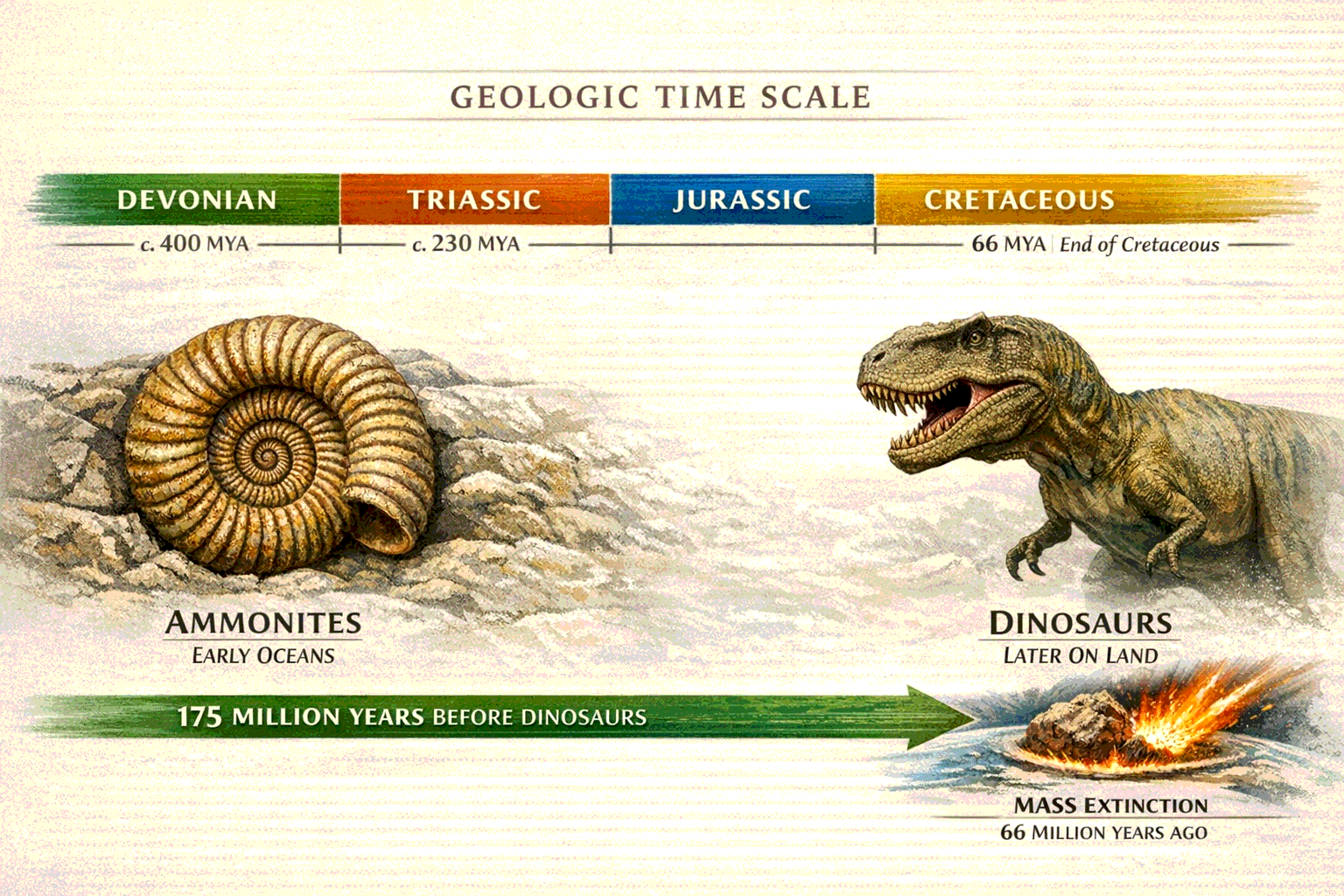
Ammonites evolved during the Devonian period, around 400 million years ago.
They developed from earlier shelled cephalopods and quickly spread through the ancient seas.
Their distinctive coiled shells allowed them to regulate buoyancy and move efficiently through marine environments.
Over time, ammonites became one of the most diverse and widespread groups of marine animals.
They developed from earlier shelled cephalopods and quickly spread through the ancient seas.
Their distinctive coiled shells allowed them to regulate buoyancy and move efficiently through marine environments.
Over time, ammonites became one of the most diverse and widespread groups of marine animals.
When Did Dinosaurs Appear?
Dinosaurs appeared much later in Earth's history.
The earliest dinosaurs evolved during the Triassic period, approximately 230 million years ago.
By this time ammonites had already been evolving in the oceans for more than 150 million years.
While dinosaurs were beginning to dominate the continents, ammonites were already well-established inhabitants of marine ecosystems.
The earliest dinosaurs evolved during the Triassic period, approximately 230 million years ago.
By this time ammonites had already been evolving in the oceans for more than 150 million years.
While dinosaurs were beginning to dominate the continents, ammonites were already well-established inhabitants of marine ecosystems.
Oceans and Continents: Two Different Worlds
Although ammonites and dinosaurs lived during some of the same geological periods, they belonged to very different worlds.
Ammonites were marine cephalopods, related to modern squid and nautilus. They lived in the oceans and moved using jet propulsion.
Dinosaurs were terrestrial reptiles, adapted to life on land.
For tens of millions of years, Earth's oceans and continents were inhabited by these two remarkable groups at the same time.
Ammonites were marine cephalopods, related to modern squid and nautilus. They lived in the oceans and moved using jet propulsion.
Dinosaurs were terrestrial reptiles, adapted to life on land.
For tens of millions of years, Earth's oceans and continents were inhabited by these two remarkable groups at the same time.
Why Did Ammonites and Dinosaurs Disappear at the End of the Cretaceous?
Around 66 million years ago, Earth experienced one of the most significant biological crises in its history — the Cretaceous–Paleogene mass extinction event.
During this period many species disappeared, including ammonites and most groups of dinosaurs. However, dinosaurs did not vanish entirely. A lineage of small feathered dinosaurs survived this extinction and eventually evolved into modern birds.
Scientists continue to investigate what caused the Cretaceous–Paleogene extinction. One widely supported explanation is the impact of a large asteroid that triggered global environmental changes, affecting climate, oceans, and ecosystems.
At the same time, researchers also consider additional factors such as intense volcanic activity, long-term climate shifts, and changes in ecosystems in which early mammals may have played a role.
The extinction of ammonites therefore appears to have been part of a complex global transformation that reshaped life on Earth at the boundary between the Cretaceous and Paleogene periods, approximately 66 million years ago.
During this period many species disappeared, including ammonites and most groups of dinosaurs. However, dinosaurs did not vanish entirely. A lineage of small feathered dinosaurs survived this extinction and eventually evolved into modern birds.
Scientists continue to investigate what caused the Cretaceous–Paleogene extinction. One widely supported explanation is the impact of a large asteroid that triggered global environmental changes, affecting climate, oceans, and ecosystems.
At the same time, researchers also consider additional factors such as intense volcanic activity, long-term climate shifts, and changes in ecosystems in which early mammals may have played a role.
The extinction of ammonites therefore appears to have been part of a complex global transformation that reshaped life on Earth at the boundary between the Cretaceous and Paleogene periods, approximately 66 million years ago.
Fossils From a World Before Dinosaurs
Because ammonites appeared so early in Earth's history, some of their fossils come from rocks that formed long before dinosaurs evolved.
These fossils provide important clues about ancient marine ecosystems and the long evolutionary history of life in the oceans.
Scientists often use ammonite fossils to understand the geological past and reconstruct ancient environments.
You can learn more about the geological age of ammonites in our article Ammonite Fossil Age: How Old Are Ammonites?
These fossils provide important clues about ancient marine ecosystems and the long evolutionary history of life in the oceans.
Scientists often use ammonite fossils to understand the geological past and reconstruct ancient environments.
You can learn more about the geological age of ammonites in our article Ammonite Fossil Age: How Old Are Ammonites?
A Spiral From Deep Geological Time
When an ammonite fossil is cut and polished, its spiral structure becomes clearly visible.
That spiral formed in ancient seas hundreds of millions of years ago. Long before the age of dinosaurs, before mammals, and long before humans.
It is a quiet fragment of Earth's deep past — preserved in stone and carried forward through time.
Today ammonite fossils are discovered in many parts of the world where ancient seas once existed. Explore the main fossil regions in our article Where Ammonites Are Found.
That spiral formed in ancient seas hundreds of millions of years ago. Long before the age of dinosaurs, before mammals, and long before humans.
It is a quiet fragment of Earth's deep past — preserved in stone and carried forward through time.
Today ammonite fossils are discovered in many parts of the world where ancient seas once existed. Explore the main fossil regions in our article Where Ammonites Are Found.
