
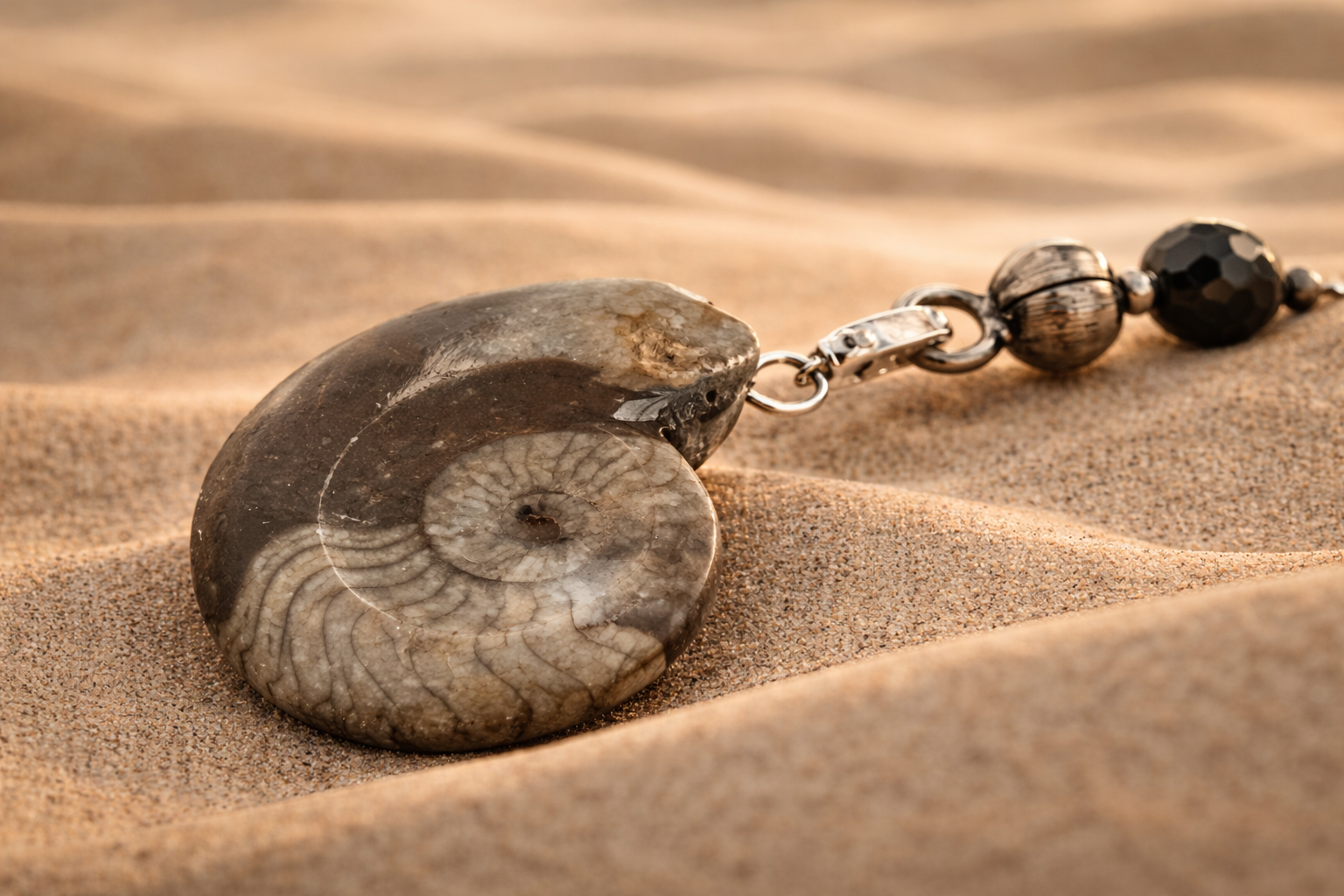
Ammonite meaning in short:
Ammonites symbolise continuity, natural order and the passage of time. Scientifically, they are fossilised marine animals that lived millions of years ago.
Ammonites symbolise continuity, natural order and the passage of time. Scientifically, they are fossilised marine animals that lived millions of years ago.
What Is the Meaning of an Ammonite?
An ammonite is more than a fossil.
It is a form shaped by life, preserved by time, and revealed long after its origin.
For some, it represents natural history — a direct connection to the ancient oceans of Earth.
For others, it carries symbolic meaning — something quieter, less defined, but deeply felt.
Its meaning does not come from a single interpretation.
It emerges at the intersection of science, form, and human perception.
It is a form shaped by life, preserved by time, and revealed long after its origin.
For some, it represents natural history — a direct connection to the ancient oceans of Earth.
For others, it carries symbolic meaning — something quieter, less defined, but deeply felt.
Its meaning does not come from a single interpretation.
It emerges at the intersection of science, form, and human perception.
A Form That Repeats Across Nature
The spiral of the ammonite is not accidental.
It follows a logarithmic pattern — a structure that appears throughout nature: in galaxies, storms, shells, and plant growth.
Because of this, ammonites are often associated with:
— continuity
— evolution
— natural order
— movement through time
The spiral does not close.
It expands.
And in that expansion, many see a reflection of growth itself.
It follows a logarithmic pattern — a structure that appears throughout nature: in galaxies, storms, shells, and plant growth.
Because of this, ammonites are often associated with:
— continuity
— evolution
— natural order
— movement through time
The spiral does not close.
It expands.
And in that expansion, many see a reflection of growth itself.
Historical and Cultural Symbolism
Across different cultures and periods, ammonites have been given meaning long before they were understood scientifically.
They were seen as:
— symbols of cycles and renewal
— objects connected to water and life
— protective forms carrying natural energy
In medieval Europe, ammonites were known as “snake stones” and were believed to offer protection.
These interpretations were not based on science — but they reveal something important:
Humans have always tried to translate ancient forms into meaning.
They were seen as:
— symbols of cycles and renewal
— objects connected to water and life
— protective forms carrying natural energy
In medieval Europe, ammonites were known as “snake stones” and were believed to offer protection.
These interpretations were not based on science — but they reveal something important:
Humans have always tried to translate ancient forms into meaning.
Scientific Perspective
From a scientific point of view, ammonites are extinct marine cephalopods.
They lived between approximately 400 and 66 million years ago and are related to modern squid, octopus, and nautilus.
Their shells were divided into chambers, allowing them to control buoyancy in prehistoric oceans.
This knowledge does not replace meaning.
It deepens it.
Because what you are looking at is not only a symbol — but the preserved structure of a once-living organism.
They lived between approximately 400 and 66 million years ago and are related to modern squid, octopus, and nautilus.
Their shells were divided into chambers, allowing them to control buoyancy in prehistoric oceans.
This knowledge does not replace meaning.
It deepens it.
Because what you are looking at is not only a symbol — but the preserved structure of a once-living organism.
Why People Wear Ammonite Jewellery
People choose ammonite jewellery for different reasons.
Some are drawn to:
— its age and connection to Earth’s history
— its unique, unrepeatable form
— its visual balance and natural geometry
Others are drawn to something less tangible.
A sense of grounding.
A quiet continuity.
A reminder that time is not only linear, but layered.
In jewellery, the ammonite is not reshaped into perfection.
It is left as it is — a fragment of ancient life, carried into the present.
Some are drawn to:
— its age and connection to Earth’s history
— its unique, unrepeatable form
— its visual balance and natural geometry
Others are drawn to something less tangible.
A sense of grounding.
A quiet continuity.
A reminder that time is not only linear, but layered.
In jewellery, the ammonite is not reshaped into perfection.
It is left as it is — a fragment of ancient life, carried into the present.
Ammonite as a Personal Object
Unlike gemstones or manufactured materials, no two ammonites are identical.
Each fossil carries:
— its own spiral
— its own internal structure
— its own geological path
Because of this, choosing one often feels less like selecting an object and more like recognising something already familiar.
If you are new to ammonites, you may want to start here:
→ What Is an Ammonite? Fossil Age, Meaning and Jewellery
Each fossil carries:
— its own spiral
— its own internal structure
— its own geological path
Because of this, choosing one often feels less like selecting an object and more like recognising something already familiar.
If you are new to ammonites, you may want to start here:
→ What Is an Ammonite? Fossil Age, Meaning and Jewellery
From Fossil to Jewellery
In its natural state, an ammonite rests in stone.
But when carefully revealed and preserved, it can take on a different role — not as decoration, but as presence.
If you want to understand how these fossils are found and brought to the surface, you can begin here:
→ How Fossils Are Found in the Sahara
But when carefully revealed and preserved, it can take on a different role — not as decoration, but as presence.
If you want to understand how these fossils are found and brought to the surface, you can begin here:
→ How Fossils Are Found in the Sahara
Closing Thought
The meaning of an ammonite is not fixed.
For some, it is evidence of ancient life.
For others, it is a symbol of movement and change.
And sometimes, it is simply a form that feels right to carry — quietly, without explanation.
Some choose to study ammonites.
Others choose to keep them close — as objects that carry both form and time.
→ Discover ammonite jewellery
For some, it is evidence of ancient life.
For others, it is a symbol of movement and change.
And sometimes, it is simply a form that feels right to carry — quietly, without explanation.
Some choose to study ammonites.
Others choose to keep them close — as objects that carry both form and time.
→ Discover ammonite jewellery
