
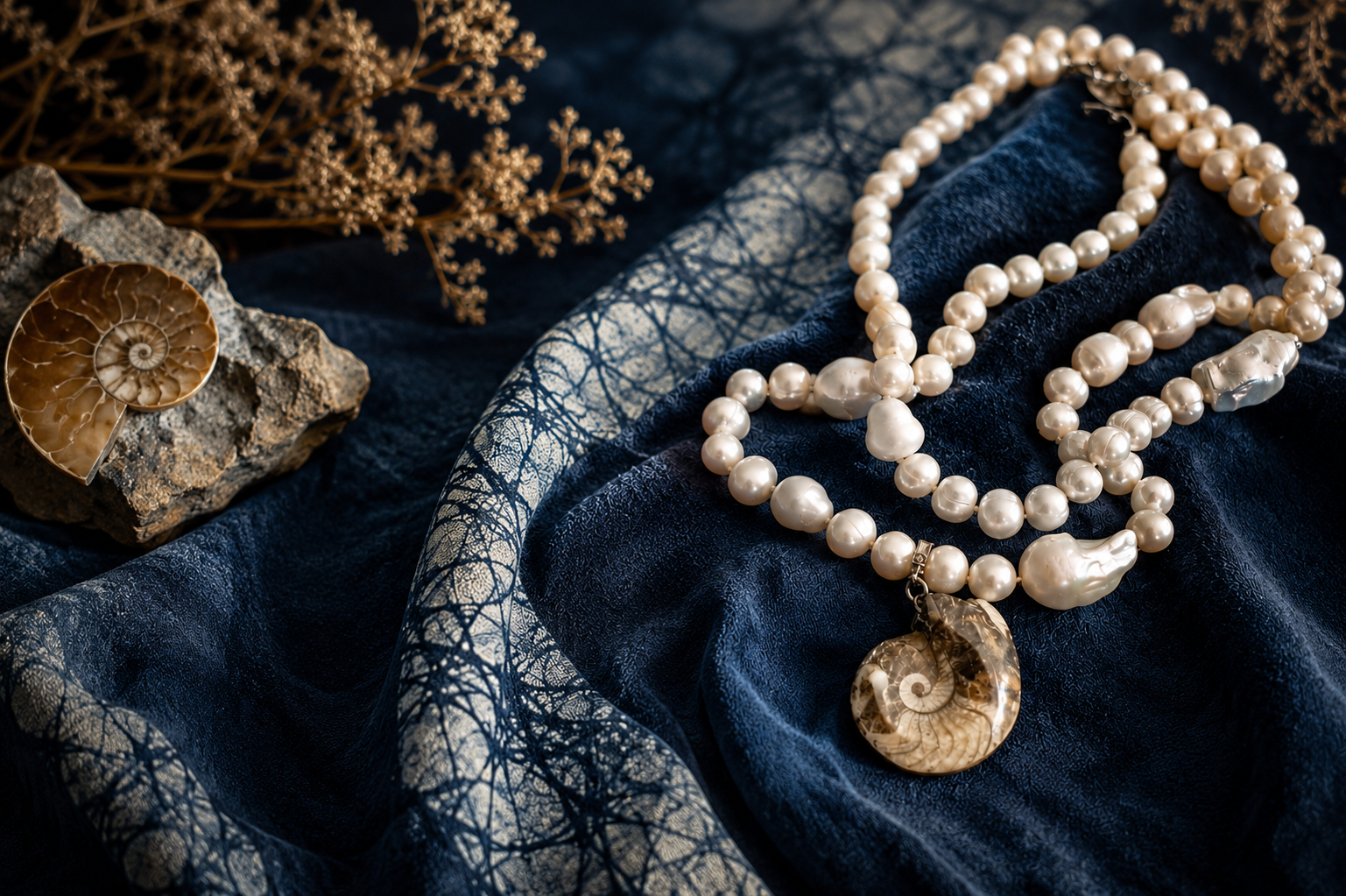
Most jewellery is designed to symbolize beauty, status, or personal style. Fossil jewellery offers something rarer: a connection to deep geological time.
An ammonite pendant is not simply inspired by nature — it is nature. Long before human civilization existed, these ancient marine creatures lived in prehistoric oceans. Over hundreds of millions of years, their shells transformed into stone, preserving the memory of another Earth entirely.
That transformation is what makes fossil jewellery fundamentally different from traditional jewellery. It is not only crafted by artisans, but also shaped by geology, pressure, mineralization, and time itself.
Ampulla Temporis positions this philosophy at the center of its brand: wearable objects that preserve ancient Earth history through contemporary craftsmanship.
An ammonite pendant is not simply inspired by nature — it is nature. Long before human civilization existed, these ancient marine creatures lived in prehistoric oceans. Over hundreds of millions of years, their shells transformed into stone, preserving the memory of another Earth entirely.
That transformation is what makes fossil jewellery fundamentally different from traditional jewellery. It is not only crafted by artisans, but also shaped by geology, pressure, mineralization, and time itself.
Ampulla Temporis positions this philosophy at the center of its brand: wearable objects that preserve ancient Earth history through contemporary craftsmanship.
What Is Fossil Jewelry?
Fossil jewellery is jewellery created using authentic prehistoric fossils, often combined with precious metals and natural gemstones.
Popular fossils used in jewellery include:
Unlike synthetic materials or decorative replicas, real fossil jewelry contains preserved remains of organisms that lived millions of years ago.
Because every fossil forms differently, each piece becomes naturally unique.
You can also explore how fossilization transforms ancient marine life into stone in our guide to how fossils are formed.
Popular fossils used in jewellery include:
- Ammonites
- Orthoceras fossils
- Trilobites
- Coral fossils
- Dinosaur bone fragments
Unlike synthetic materials or decorative replicas, real fossil jewelry contains preserved remains of organisms that lived millions of years ago.
Because every fossil forms differently, each piece becomes naturally unique.
You can also explore how fossilization transforms ancient marine life into stone in our guide to how fossils are formed.
Why Fossil Jewellery Is Different From Traditional Jewellery
1. Every Piece Is Naturally One of a Kind
Traditional jewellery can often be reproduced in identical designs. Fossils cannot.
Every ammonite shell develops differently during fossilization:
This makes every handmade fossil jewellery piece impossible to replicate exactly.
The Ampulla Temporis positioning document emphasizes this uniqueness:
“Your jewellery is unique, inimitable, and timeless because it was created by the Earth itself over hundreds of millions of years.”
Every ammonite shell develops differently during fossilization:
- mineral patterns vary
- textures remain irregular
- colours change based on geological conditions
- natural asymmetry is preserved
This makes every handmade fossil jewellery piece impossible to replicate exactly.
The Ampulla Temporis positioning document emphasizes this uniqueness:
“Your jewellery is unique, inimitable, and timeless because it was created by the Earth itself over hundreds of millions of years.”
2. Fossil Jewellery Carries Real Geological History
Traditional luxury jewellery is often valued for rarity and craftsmanship.
Natural history jewellery adds another dimension: time.
An ammonite fossil may be over 100 million years old. That means an ammonite necklace contains:
Very few luxury objects can offer that level of historical depth.
For many collectors, wearing wearable fossils feels closer to owning a preserved piece of Earth’s memory than simply wearing an accessory.
Readers interested in prehistoric marine life can continue with our article on the history and symbolism of ammonites.
Natural history jewellery adds another dimension: time.
An ammonite fossil may be over 100 million years old. That means an ammonite necklace contains:
- prehistoric biological structures
- ancient ocean history
- natural mineral transformation
- evidence of Earth’s evolution
Very few luxury objects can offer that level of historical depth.
For many collectors, wearing wearable fossils feels closer to owning a preserved piece of Earth’s memory than simply wearing an accessory.
Readers interested in prehistoric marine life can continue with our article on the history and symbolism of ammonites.
3. Fossil Jewelry Has Meaning Beyond Fashion
People are increasingly drawn toward meaningful luxury — objects with provenance, symbolism, and individuality.
Fossil jewellery resonates because it naturally represents:
Ampulla Temporis identifies both scientific and philosophical audiences as core customer groups attracted to fossils for their historical and symbolic value.
This emotional depth separates luxury fossil jewellery from trend-driven accessories.
Fossil jewellery resonates because it naturally represents:
- continuity
- transformation
- endurance
- preservation
- connection to nature
- deep time
Ampulla Temporis identifies both scientific and philosophical audiences as core customer groups attracted to fossils for their historical and symbolic value.
This emotional depth separates luxury fossil jewellery from trend-driven accessories.
The Beauty of Natural Imperfection
Modern jewellery often prioritizes flawless symmetry and polished perfection.
Fossils are different.
Their beauty comes from:
These imperfections are not flaws — they are proof of authenticity.
An authentic fossil pendant may preserve details formed long before mammals or flowering plants existed. No jeweller can artificially recreate that history.
The Ampulla Temporis editorial strategy repeatedly emphasizes themes like authenticity, preservation, and geological memory as core brand pillars.
Fossils are different.
Their beauty comes from:
- preserved fractures
- mineral veins
- irregular textures
- ancient structural details
- visible traces of geological transformation
These imperfections are not flaws — they are proof of authenticity.
An authentic fossil pendant may preserve details formed long before mammals or flowering plants existed. No jeweller can artificially recreate that history.
The Ampulla Temporis editorial strategy repeatedly emphasizes themes like authenticity, preservation, and geological memory as core brand pillars.
How Ammonite Jewellery Combines Science and Craftsmanship
Although fossils form naturally, exceptional craftsmanship is still essential.
Creating high-end ammonite jewellery requires:
Ampulla Temporis highlights this approach by combining fossils with carefully selected precious and semi-precious stones that enhance the fossil’s natural beauty.
The result feels both ancient and contemporary at the same time.
Creating high-end ammonite jewellery requires:
- stabilizing ancient fossil material
- preserving delicate structures
- designing settings around natural asymmetry
- pairing fossils with complementary gemstones and metals
Ampulla Temporis highlights this approach by combining fossils with carefully selected precious and semi-precious stones that enhance the fossil’s natural beauty.
The result feels both ancient and contemporary at the same time.
Why People Are Drawn to Wearable Fossils
Many buyers today are moving away from mass-produced luxury toward objects with individuality and story.
People choose real fossil jewellery because it offers:
This explains why fossil jewellery appeals to:
Unlike conventional jewellery, fossil jewellery often becomes deeply personal.
People choose real fossil jewellery because it offers:
- rarity
- authenticity
- natural origin
- craftsmanship
- emotional meaning
- connection to Earth’s history
This explains why fossil jewellery appeals to:
- collectors
- geology enthusiasts
- artists and designers
- spiritually minded buyers
- lovers of natural materials
- people searching for meaningful gifts
Unlike conventional jewellery, fossil jewellery often becomes deeply personal.
Fossil Jewellery and the Future of Luxury
Luxury is changing.
Modern consumers increasingly value:
Luxury fossil jewellery reflects this evolution naturally.
Each fossil forms through millions of years of geological chance. No factory can manufacture that process. No machine can reproduce the exact structure of a prehistoric ammonite.
That makes fossil jewellery not only rare — but fundamentally unrepeatable.
Modern consumers increasingly value:
- meaning over branding
- rarity over mass production
- provenance over perfection
- authenticity over uniformity
Luxury fossil jewellery reflects this evolution naturally.
Each fossil forms through millions of years of geological chance. No factory can manufacture that process. No machine can reproduce the exact structure of a prehistoric ammonite.
That makes fossil jewellery not only rare — but fundamentally unrepeatable.
Final Thoughts
Traditional jewellery often celebrates human craftsmanship.
Fossil jewellery celebrates both human craftsmanship and the unimaginable artistry of geological time.
It reminds us that beauty existed long before humanity and will continue long after us. In a world saturated with disposable objects and fleeting trends, fossil jewellery offers something enduring: a tangible connection to the ancient history of Earth itself.
Fossil jewellery celebrates both human craftsmanship and the unimaginable artistry of geological time.
It reminds us that beauty existed long before humanity and will continue long after us. In a world saturated with disposable objects and fleeting trends, fossil jewellery offers something enduring: a tangible connection to the ancient history of Earth itself.
Explore Authentic Fossil Jewelry
Discover one-of-a-kind:
crafted from authentic prehistoric materials at Ampulla Temporis.
Go to Catalogue
- ammonite pendants
- fossil necklaces
- wearable fossils
- handmade fossil jewelry
- natural history jewelry
crafted from authentic prehistoric materials at Ampulla Temporis.
Go to Catalogue
