
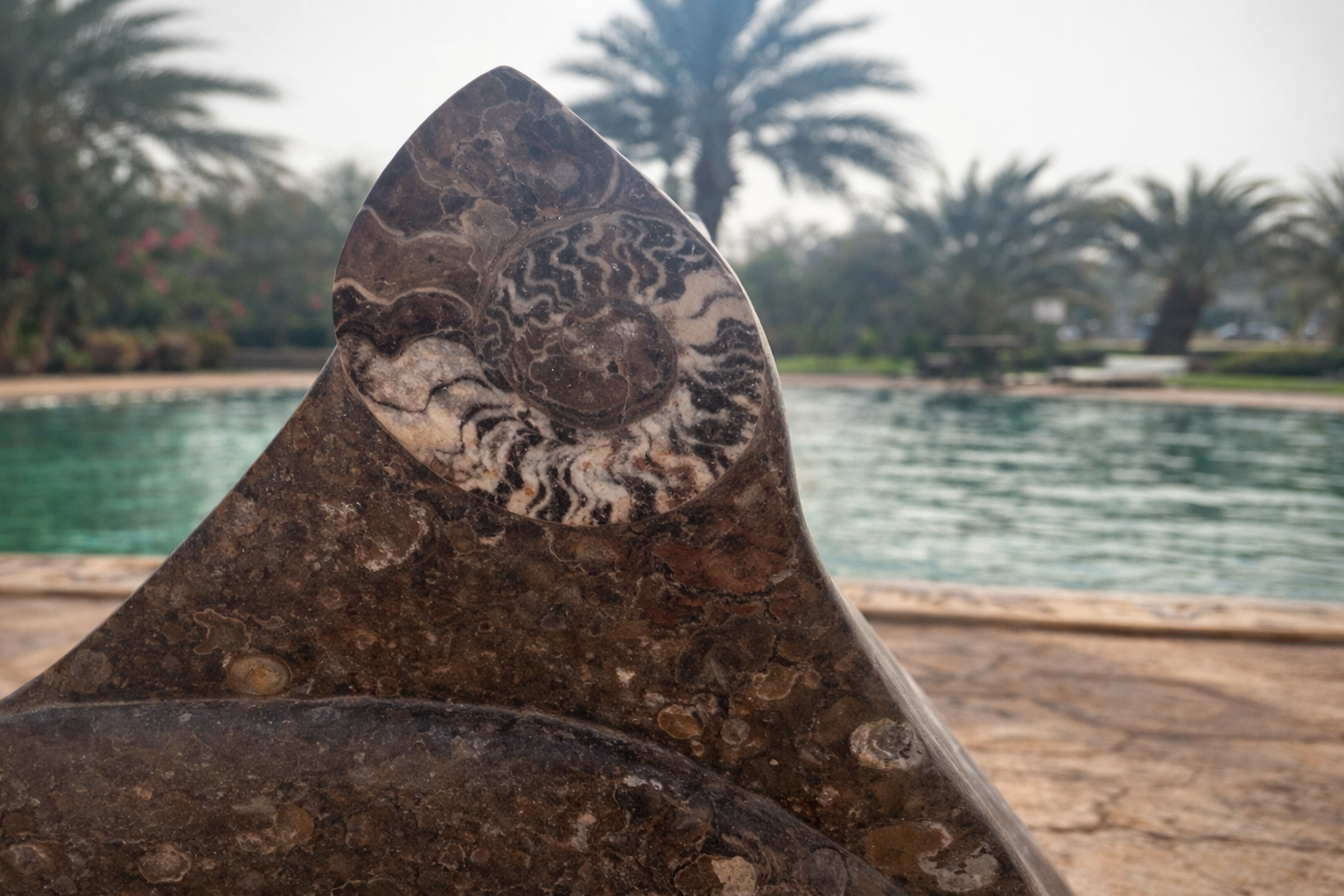
Ammonites lived in Earth's oceans for hundreds of millions of years, leaving behind fossils that today help scientists understand the deep history of life on our planet.
Creatures From Deep Geological Time
Ammonites lived in the world's oceans for an extraordinarily long period of Earth's history. These marine animals first appeared during the Devonian period, roughly around 400 million years ago, and continued to evolve for hundreds of millions of years.
Their long history ended during the mass extinction event at the end of the Cretaceous period about 66 million years ago — the same event that caused the disappearance of the dinosaurs.
If you want to learn more about these ancient marine creatures, read our guide What Is an Ammonite? Fossil Age, Meaning and Jewellery.
Because ammonites existed for such a vast span of time, their fossils can come from many different geological periods.
Some ammonites preserved in stone today may be nearly 400 million years old, while others formed closer to 70 million years ago.
Each fossil therefore represents a different moment in the long history of life in the oceans.
Their long history ended during the mass extinction event at the end of the Cretaceous period about 66 million years ago — the same event that caused the disappearance of the dinosaurs.
If you want to learn more about these ancient marine creatures, read our guide What Is an Ammonite? Fossil Age, Meaning and Jewellery.
Because ammonites existed for such a vast span of time, their fossils can come from many different geological periods.
Some ammonites preserved in stone today may be nearly 400 million years old, while others formed closer to 70 million years ago.
Each fossil therefore represents a different moment in the long history of life in the oceans.
The Geological Timeline of Ammonites
The story of ammonites stretches across several major geological eras.
Devonian Period (about 419–359 million years ago)
The earliest ammonites appeared in the Devonian seas. These early forms evolved from earlier shelled cephalopods and quickly developed the spiral shells that would define the group.
Carboniferous and Permian Periods (about 359–252 million years ago)
Ammonites diversified and spread widely across the oceans. Their shells developed increasingly complex internal structures.
Triassic Period (about 252–201 million years ago)
After a major extinction event at the end of the Permian, ammonites rapidly evolved again and became common in many marine ecosystems.
Jurassic Period (about 201–145 million years ago)
This was one of the most flourishing periods for ammonites. Many of the beautifully preserved spiral fossils found in Europe come from Jurassic rocks.
Cretaceous Period (about 145–66 million years ago)
Ammonites continued to thrive until the end-Cretaceous extinction event that marked the end of their long evolutionary history.
Devonian Period (about 419–359 million years ago)
The earliest ammonites appeared in the Devonian seas. These early forms evolved from earlier shelled cephalopods and quickly developed the spiral shells that would define the group.
Carboniferous and Permian Periods (about 359–252 million years ago)
Ammonites diversified and spread widely across the oceans. Their shells developed increasingly complex internal structures.
Triassic Period (about 252–201 million years ago)
After a major extinction event at the end of the Permian, ammonites rapidly evolved again and became common in many marine ecosystems.
Jurassic Period (about 201–145 million years ago)
This was one of the most flourishing periods for ammonites. Many of the beautifully preserved spiral fossils found in Europe come from Jurassic rocks.
Cretaceous Period (about 145–66 million years ago)
Ammonites continued to thrive until the end-Cretaceous extinction event that marked the end of their long evolutionary history.
Why Ammonite Fossils Are Important for Dating Rocks
Ammonites are extremely valuable to geologists because they evolved quickly and produced many distinct species.
This means that particular ammonite species existed only during relatively short periods of geological time.
When paleontologists find a specific ammonite fossil in a rock layer, they can often estimate the age of that rock layer very precisely.
For this reason, ammonites are known as index fossils — fossils that help scientists determine the age of sedimentary rocks.
Across many parts of the world, entire geological timelines have been reconstructed using ammonite fossils.
You can learn more about the fossilization process in our article How Ammonite Fossils Form.
This means that particular ammonite species existed only during relatively short periods of geological time.
When paleontologists find a specific ammonite fossil in a rock layer, they can often estimate the age of that rock layer very precisely.
For this reason, ammonites are known as index fossils — fossils that help scientists determine the age of sedimentary rocks.
Across many parts of the world, entire geological timelines have been reconstructed using ammonite fossils.
You can learn more about the fossilization process in our article How Ammonite Fossils Form.
The Age of Ammonites Used in Jewellery
Many ammonites used in scientific collections and jewellery come from rocks formed during the Devonian and Jurassic periods.
In regions such as southern Morocco, Devonian marine sediments contain ammonites that are approximately 350–400 million years old.
Other ammonites, particularly those found in Jurassic limestone formations in Europe, are typically around 150–180 million years old.
When an ammonite fossil is cut and polished, the spiral that appears in the stone may therefore be hundreds of millions of years older than any human artifact.
It is not simply a decorative form — it is a preserved structure from deep geological time.
In regions such as southern Morocco, Devonian marine sediments contain ammonites that are approximately 350–400 million years old.
Other ammonites, particularly those found in Jurassic limestone formations in Europe, are typically around 150–180 million years old.
When an ammonite fossil is cut and polished, the spiral that appears in the stone may therefore be hundreds of millions of years older than any human artifact.
It is not simply a decorative form — it is a preserved structure from deep geological time.
A Spiral That Survived Millions of Years
For millions of years, the shells of ammonites rested on the ocean floor, buried slowly beneath layers of sediment.
Pressure transformed those sediments into rock, sealing the spiral shapes inside stone.
Long after the oceans disappeared and landscapes changed, erosion revealed them again.
When we hold an ammonite fossil today, we are looking at a form that began its journey in ancient seas hundreds of millions of years ago.
It is a fragment of the Earth's deep past — preserved in stone and carried forward through time.
Today ammonite fossils are discovered in many parts of the world where ancient seas once existed. Explore the main fossil regions in our article Where Ammonites Are Found.
Pressure transformed those sediments into rock, sealing the spiral shapes inside stone.
Long after the oceans disappeared and landscapes changed, erosion revealed them again.
When we hold an ammonite fossil today, we are looking at a form that began its journey in ancient seas hundreds of millions of years ago.
It is a fragment of the Earth's deep past — preserved in stone and carried forward through time.
Today ammonite fossils are discovered in many parts of the world where ancient seas once existed. Explore the main fossil regions in our article Where Ammonites Are Found.
