
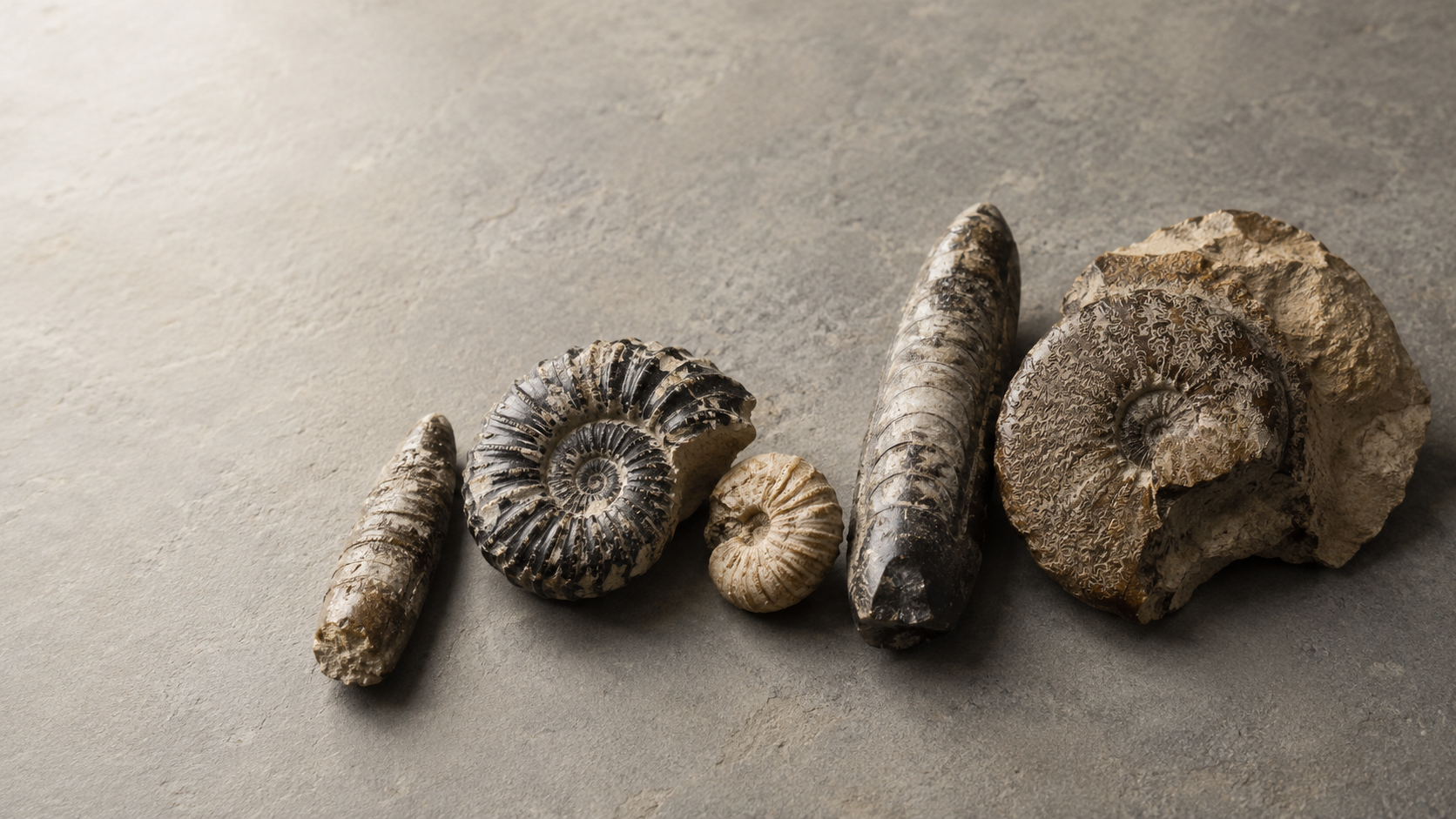
Place two ammonites of the same species side by side and, at first glance, they may appear remarkably similar. Both may show the same coiled shell, the same sequence of chambers, and the same general pattern of ribs or sutures. Yet closer inspection almost always reveals differences. One specimen may be darker because of the minerals that entered the surrounding sediment after burial; another may preserve the shell surface more clearly. One may contain calcite-filled chambers, while another bears fine fractures produced by later geological stress. Even specimens formed in the same environment can develop distinctive combinations of colour, texture, preservation and mineral replacement.
These differences are not simply decorative variations. They are the visible result of a unique geological history. Every fossil began as an individual organism living in a particular environment, and every specimen subsequently passed through a different sequence of burial, chemical alteration, compaction, mineralisation, erosion and exposure. Fossils are therefore not identical copies of extinct organisms but individual records of biological and geological events. Their uniqueness comes from the interaction between life and deep time.
For this reason, the concept of unique fossils is scientifically meaningful. Fossils preserve more than the shape of an organism: they often preserve traces of the conditions under which it lived, died and became incorporated into rock. In some cases, they also record later events that took place millions of years after fossilisation began. A mineral vein crossing a shell, for example, may represent a fracture that formed long after burial and was later filled by mineral-rich groundwater. What might appear to be an imperfection can therefore be evidence of a separate geological episode.
Fossils begin as individual organisms
Before fossilisation becomes a geological process, it begins with biology. An ammonite shell, for example, was produced gradually during the life of a single marine animal. Ammonites were extinct cephalopods that occupied the oceans for hundreds of millions of years, and their shells grew by adding new material as the animal increased in size. Although members of the same species shared characteristic shell proportions, ornamentation and suture patterns, individual variation still existed. Growth rate, physical damage and environmental conditions could all influence the final form of the shell.
This biological individuality is the first reason no two fossils are exactly alike. Even before burial, two organisms of the same species would not have been perfect replicas. Their shells recorded slightly different life histories. In some fossils, researchers can identify interruptions in growth or evidence of shell repair, suggesting that the living animal survived injury before continuing to develop. Fossilisation then adds a second layer of variation, often more dramatic than the first.
The relationship between ammonites and straight-shelled cephalopods is explored further in Ammonite vs Orthoceras: Which Fossil Speaks to You?, where differences in shell architecture and evolutionary history can be compared in greater detail.
Fossilisation is selective and relatively rare
The fossil record represents only a small fraction of the organisms that have lived on Earth. Most plants and animals disappear without leaving recognisable remains because biological material is normally recycled rapidly after death. Soft tissues decay, scavengers break apart carcasses, currents transport shells and bones, and chemical weathering can dissolve hard structures before they are permanently buried.
For a fossil to form, preservation must interrupt some of these destructive processes. Rapid burial by sediment is particularly important because it can reduce exposure to scavengers, oxygen and physical disturbance. The exact conditions of burial influence what survives. Fine-grained sediments may preserve delicate external details, while high-energy environments can fragment or abrade shells before they are covered. Even specimens deposited only a short distance apart may therefore experience very different preservation.
Once burial occurs, the remains become part of a changing sedimentary environment. Additional layers accumulate above them, pressure increases, and groundwater moves through pores in the sediment. Over time, loose sediment may become rock, while the remains of the organism may undergo chemical alteration. The route from organism to fossil is therefore not a single event but a prolonged sequence of processes.
This broader transformation is discussed in From Sahara Desert to Jewellery: The Extraordinary Journey of a Fossil.
Fossilisation can preserve, replace or reproduce biological structures
The word “fossilisation” is often used as though it describes one mechanism, but several different processes can produce fossils. In some cases, part of the original shell or skeleton remains. In others, the original material dissolves and leaves a mould in the surrounding sediment. Minerals may later fill that space and form a cast. Biological material can also be replaced gradually by new minerals while the original shape remains visible.
The chemistry of groundwater is especially important. Water moving through rock carries dissolved minerals that may precipitate inside cavities or replace existing material. Calcite, silica, iron-bearing minerals and other compounds can alter the fossil’s colour and texture, sometimes producing striking contrasts between the fossil and the surrounding matrix.
For this reason, the appearance of a fossil is partly biological and partly geological. The organism determines the initial structure, but subsequent mineralisation determines how that structure is preserved and what it looks like today. Two ammonites with similar original shells can therefore acquire very different colours, densities and internal textures during fossilisation.
Mineralisation creates visual individuality
Many of the colours seen in fossils today were not present in the living organism. Dark brown, black, red, yellow or cream tones may result from minerals introduced during burial and diagenesis, the set of physical and chemical changes that convert sediment into sedimentary rock. Iron oxides can produce reddish or brown colours, calcite may fill internal chambers, and silica can replace original shell material. Under particular conditions, pyrite can form and give a fossil a metallic appearance.
Mineralisation can also highlight structures that were not externally visible during the animal’s life. When fossil-bearing material is cut and polished, internal chambers, mineral-filled voids and fractures can become exposed. This is especially striking in ammonites and straight-shelled cephalopods, where a polished cross-section may reveal the geometry of the shell’s internal architecture.
Such variation is central to the visual character of fossil material. It also explains why natural fossils resist perfect standardisation. Even when two specimens belong to the same species and come from the same geological formation, their mineral history will rarely be identical.
Ammonites and the individuality of the spiral
Ammonites provide one of the clearest examples of how biological form and geological preservation interact. Their shells were divided internally by walls known as septa, and the lines where these walls met the outer shell formed patterns called sutures. These patterns are highly important in ammonite classification and vary among different evolutionary groups.
The shell itself could also vary in overall shape, ribbing, keel development and degree of coiling. After death, preservation introduced further differences. One ammonite may retain the external shell surface, while another may preserve mostly the internal mould. One specimen may be flattened by pressure, while another remains three-dimensional. Mineral-filled chambers may be exposed in one fossil but remain concealed in another.
Popular descriptions sometimes associate ammonite shells with the golden ratio. A more accurate scientific description is that many shells approximate forms of logarithmic growth, in which the shape remains broadly similar while increasing in size. This relationship between natural spirals and mathematical proportion is examined more carefully in What Is an Ammonite? Fossil Age, Meaning and Jewellery.
Straight-shelled cephalopods reveal variation through geometry
The fossils commonly sold under the commercial name “Orthoceras” offer a different type of visual structure. These fossils usually show elongated, chambered shells of extinct straight-shelled cephalopods. In strict palaeontological usage, Orthoceras refers to a particular genus, so the name is often used more broadly in the decorative fossil trade than it would be in scientific classification.
Their internal chambering becomes especially visible when fossil-bearing rock is cut and polished. Because a three-dimensional shell can intersect a flat polished surface at different angles, the appearance of each specimen depends partly on the orientation of the cut. A section through the centre of the shell may look very different from an oblique section through the same type of organism.
This means that even fossils preserved in the same slab can produce different visible patterns. Biological structure, burial orientation and later cutting all contribute to the appearance of the final surface. More detail on these fossils is available in Orthoceras Fossil: Meaning, History and Why People Wear It.
Fossils from Morocco and the record of vanished seas
Morocco is particularly well known for fossil-bearing rocks that preserve ancient marine organisms from several major intervals of Earth history. Many regions that are arid today contain sedimentary rocks formed in marine environments hundreds of millions of years ago. The presence of fossil cephalopods in desert landscapes is therefore an important reminder that modern geography is temporary.
Over geological time, sea levels rise and fall, tectonic plates move, sedimentary basins are uplifted, and erosion exposes rocks that once formed far below sea level. Fossils preserved in these rocks allow geologists to reconstruct environments that no longer exist. A marine shell found in a desert is not an anomaly but evidence of how extensively Earth’s surface has changed.
Ampulla Temporis works with fossil material sourced from Morocco and places this geological origin at the centre of its natural-history narrative. A more detailed account of the region can be developed in Why Morocco Produces Some of the World’s Finest Fossils.
Deep time amplifies small differences
The geological processes that modify fossils are often extremely slow, but their effects become substantial over millions of years. Groundwater moving through microscopic pores can alter minerals gradually. Sediments deposited grain by grain can eventually become thick rock formations. Tectonic plates moving only a few centimetres each year can relocate continents and raise mountain belts over geological time.
This scale is difficult to visualise because it exceeds ordinary human experience. Yet fossils make deep time physically accessible. A specimen small enough to hold in one hand may contain evidence of events separated by tens or hundreds of millions of years.
The fossil itself therefore becomes a condensed record of time. Its shell reflects the life of the original organism, its mineral composition reflects burial and chemical alteration, and its present location reflects later geological change. The uniqueness of the object comes from this entire sequence rather than from appearance alone.
Preparation reveals geological structures rather than creating them
When fossil-bearing material is cut, cleaned or polished, human intervention changes how the specimen is presented but does not create its underlying natural architecture. Preparation can reveal chambers, growth lines, mineral veins or internal boundaries that were previously hidden within the rock.
This distinction is particularly important in fossil jewellery. The designer can choose orientation, scale and accompanying materials, but the central fossil cannot be standardised in the same way as an industrial component. A rib, fracture, mineral vein or chamber appears where geological history placed it.
For that reason, two jewellery pieces may follow the same design while remaining visibly different because their fossils are different. The reproducible element is the design; the irreproducible element is the specimen.
Fossils are scientific records as well as aesthetic objects
Fossils are visually compelling, but their scientific significance extends far beyond appearance. They are used to reconstruct extinct ecosystems, study evolutionary change, identify ancient environments and correlate rock layers of similar age. Ammonites are particularly useful in biostratigraphy because many species were geographically widespread and evolved relatively rapidly, allowing geologists to use them as indicators of geological age.
A single fossil therefore has two identities. It is an individual object with a particular preservation history, and it is also part of a wider biological and geological record. Its shell can be studied as evidence of one extinct animal, while its species may help researchers interpret an entire interval of geological time.
This scientific context is explored further in Fossilized Marine Life: Ancient Creatures Preserved in Stone.
Why no fossil can ever be truly duplicated
A fossil can be copied in appearance. Modern casting, moulding and three-dimensional scanning can reproduce the shape of a specimen with impressive accuracy. Such replicas are valuable in museums, education and research because they allow rare specimens to be studied without damaging the originals.
What cannot be reproduced is the specimen’s history.
To duplicate a fossil completely would require reproducing the life of the original organism, its exact place of death, its burial conditions, sediment chemistry, mineral replacement, later deformation, erosion and eventual exposure. The visual form can be imitated, but the sequence of events that produced the original cannot.
This is why a genuine fossil is unique in a deeper sense than most manufactured objects. Its individuality is historical rather than merely visual.
A natural history recorded in matter
Every fossil is the result of several histories layered together. There is the biological history of the organism, the sedimentary history of its burial, the chemical history of mineralisation and the geological history of the rock in which it was preserved. Later, there is also a human history of discovery, preparation, study or use.
What appears to be a small difference in colour, texture or structure may therefore correspond to a real difference in geological events. For scientists, those differences can contain information. For collectors and designers, they also explain why natural fossil material cannot be reduced to a perfectly repeatable pattern.
This is ultimately what makes every fossil unique. Its individuality does not come from rarity alone, and it does not depend on symbolic interpretation. It comes from the fact that every specimen is the surviving product of a sequence of events that occurred only once.
A fossil is not simply an image of ancient life. It is part of that history, preserved in matter.
Explore the Ampulla Temporis Collection
A genuine fossil is never merely a repeated motif. It is the surviving record of one organism, one environment and one sequence of geological events that can never occur in exactly the same way again.
The Ampulla Temporis collection is built around this individuality. Each piece begins with a real fossil formed by Earth over immense spans of time, then places it in dialogue with carefully selected natural materials. The design may belong to a collection, but the fossil at its centre belongs only to that particular piece.
Explore the Ampulla Temporis collection and discover a piece of Earth’s ancient history that exists only once.
Explore the Collection →
Frequently Asked Questions
Are all fossils unique?
Yes. Each fossil comes from an individual organism and has its own history of burial, mineralisation and geological change.
Why do fossils of the same species look different?
Differences in growth, sediment, minerals, pressure and preservation create variations in colour, texture and visible structure.
Are cracks in fossils defects?
Not always. Some cracks formed naturally during geological processes and were later filled with minerals, becoming part of the fossil’s history.
What makes ammonites unique?
Ammonites differ in shell form, ribs, sutures, mineralisation and preservation, so no two specimens are exactly alike.
Can two pieces of fossil jewellery be identical?
The design can be repeated, but the fossil cannot. Each genuine fossil has its own natural pattern and geological history.
