
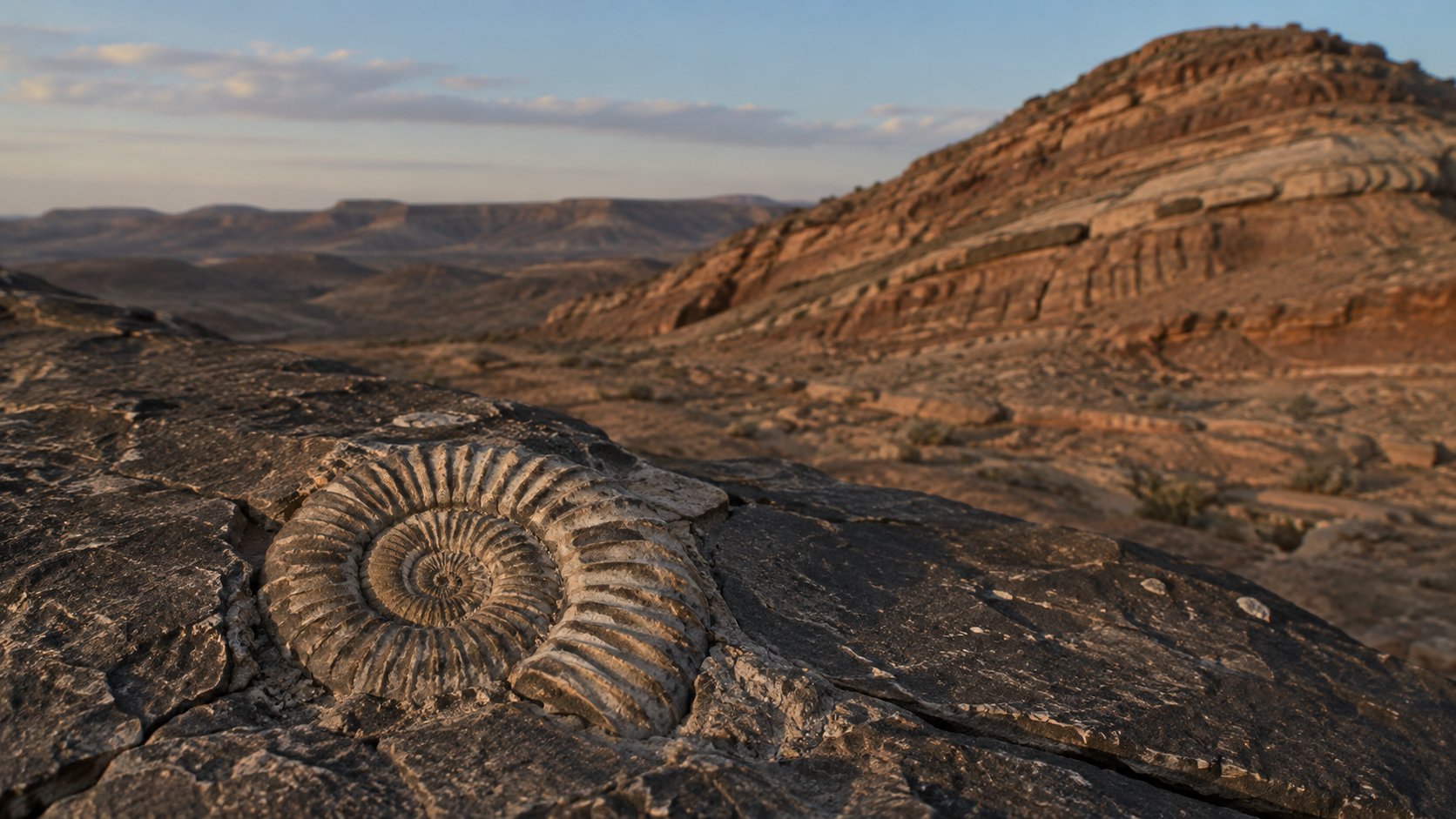
A polished ammonite may appear almost architectural: a precise spiral divided into chambers, its surface crossed by lines that once strengthened the shell of a living animal.
An orthoceras fossil looks entirely different. Its long, pale form lies within dark stone like a line drawn across the night.
Both may come from Morocco.
For palaeontologists, museums and collectors, Morocco is one of the most remarkable fossil-producing countries on Earth. Its mountains, plateaus and desert landscapes preserve evidence of vanished oceans, changing continents and ancient ecosystems extending across hundreds of millions of years.
Morocco’s fossil abundance is not the result of a single exceptional site. It comes from a rare combination of circumstances: long periods beneath ancient seas, rapid burial beneath sediment, mineral-rich groundwater, later uplift of the land and an arid modern climate that leaves fossil-bearing rock exposed.
The result is a landscape in which deep time becomes unusually visible.
In the Anti-Atlas, trilobites emerge from rocks formed long before the first forests. Devonian limestones preserve chambered cephalopods that lived more than 350 million years ago. Elsewhere, phosphate beds contain the teeth and bones of sharks, marine reptiles and other animals from the final chapters of the age of dinosaurs.
To understand why Morocco fossils are so abundant and so beautifully preserved, we must first look beyond the modern desert.
The Morocco we see today is only the latest version of a landscape that has been transformed many times.
An orthoceras fossil looks entirely different. Its long, pale form lies within dark stone like a line drawn across the night.
Both may come from Morocco.
For palaeontologists, museums and collectors, Morocco is one of the most remarkable fossil-producing countries on Earth. Its mountains, plateaus and desert landscapes preserve evidence of vanished oceans, changing continents and ancient ecosystems extending across hundreds of millions of years.
Morocco’s fossil abundance is not the result of a single exceptional site. It comes from a rare combination of circumstances: long periods beneath ancient seas, rapid burial beneath sediment, mineral-rich groundwater, later uplift of the land and an arid modern climate that leaves fossil-bearing rock exposed.
The result is a landscape in which deep time becomes unusually visible.
In the Anti-Atlas, trilobites emerge from rocks formed long before the first forests. Devonian limestones preserve chambered cephalopods that lived more than 350 million years ago. Elsewhere, phosphate beds contain the teeth and bones of sharks, marine reptiles and other animals from the final chapters of the age of dinosaurs.
To understand why Morocco fossils are so abundant and so beautifully preserved, we must first look beyond the modern desert.
The Morocco we see today is only the latest version of a landscape that has been transformed many times.
Morocco Was Once Beneath Ancient Seas
Modern Morocco occupies the northwestern edge of Africa, bordered by the Atlantic Ocean, the Mediterranean Sea and the Sahara.
Beneath this familiar geography lies a much older arrangement of rocks.
Across geological time, different parts of the region were submerged beneath shallow tropical seas, deeper marine basins, river systems and coastal plains. Continents moved. Oceans opened and closed. Mountain chains rose as tectonic plates collided.
Each environment left sediment behind.
Sand became sandstone. Lime-rich mud became limestone. Fine marine particles became shale. The remains of organisms were sometimes buried within these accumulating layers before waves, scavengers or decay could destroy them.
This rapid burial was essential.
Most organisms that have lived on Earth left no fossil record. Soft tissue decomposes. Shells dissolve. Bones are scattered, broken or consumed. Fossilisation can begin only when biological remains escape these ordinary processes of destruction long enough to become incorporated into sediment.
Morocco repeatedly offered environments in which this could happen.
Ancient waters supported abundant life, while continuing sedimentation covered shells and skeletons. Over time, the weight of additional layers compacted the sediment. Minerals moved through the buried remains, filling cavities or replacing original biological structures.
What had once been shell, bone or organic tissue gradually became part of the rock.
A fossil is therefore not simply an organism that became old. It is the result of a sequence of geological processes that may continue for millions of years.
Beneath this familiar geography lies a much older arrangement of rocks.
Across geological time, different parts of the region were submerged beneath shallow tropical seas, deeper marine basins, river systems and coastal plains. Continents moved. Oceans opened and closed. Mountain chains rose as tectonic plates collided.
Each environment left sediment behind.
Sand became sandstone. Lime-rich mud became limestone. Fine marine particles became shale. The remains of organisms were sometimes buried within these accumulating layers before waves, scavengers or decay could destroy them.
This rapid burial was essential.
Most organisms that have lived on Earth left no fossil record. Soft tissue decomposes. Shells dissolve. Bones are scattered, broken or consumed. Fossilisation can begin only when biological remains escape these ordinary processes of destruction long enough to become incorporated into sediment.
Morocco repeatedly offered environments in which this could happen.
Ancient waters supported abundant life, while continuing sedimentation covered shells and skeletons. Over time, the weight of additional layers compacted the sediment. Minerals moved through the buried remains, filling cavities or replacing original biological structures.
What had once been shell, bone or organic tissue gradually became part of the rock.
A fossil is therefore not simply an organism that became old. It is the result of a sequence of geological processes that may continue for millions of years.
The Anti-Atlas: A Window into Early Animal Life
Among Morocco’s most important fossil regions is the Anti-Atlas, a mountain system extending across the south of the country.
Although described as mountains, the Anti-Atlas is also a vast natural archive. Erosion has exposed rock formations representing several major periods in Earth’s history, including the Cambrian, Ordovician, Silurian and Devonian.
These names may seem abstract, but they describe worlds profoundly different from our own.
During the early Palaeozoic Era, much of the land that would become Morocco lay beneath marine waters. There were no flowering plants, no birds and no mammals. For much of this interval, there were not even forests on land.
Life was concentrated in the oceans.
The fossil record of the Anti-Atlas includes trilobites, brachiopods, crinoids, early cephalopods and many other marine organisms. Together, they reveal ecosystems that developed during one of the most important stages in the history of animal life.
Trilobites are among the region’s best-known fossils. These extinct marine arthropods possessed segmented bodies, jointed limbs and hard external skeletons. They survived for approximately 270 million years, diversifying into thousands of species before disappearing during the mass extinction at the end of the Permian Period.
Moroccan trilobites are especially admired because some specimens preserve remarkably fine anatomical detail. Depending on the species and conditions of preservation, the fossil may show compound eyes, delicate spines, overlapping body segments or the defensive posture of an animal curled into a ball.
Such preservation is not merely aesthetically impressive. It can provide evidence about how the organism moved, protected itself and interacted with its environment.
The rocks of the Anti-Atlas also preserve traces of behaviour. Trackways and burrows record the movement of animals across or beneath the ancient seafloor. These structures are known as trace fossils. They do not preserve the organism itself, but they capture an action: crawling, feeding, resting or excavating.
A body fossil shows us what an animal was. A trace fossil shows us something it did.
For a wider view of the creatures preserved in ancient marine rocks, read Fossilised Marine Life: Ancient Creatures Preserved in Stone.
Although described as mountains, the Anti-Atlas is also a vast natural archive. Erosion has exposed rock formations representing several major periods in Earth’s history, including the Cambrian, Ordovician, Silurian and Devonian.
These names may seem abstract, but they describe worlds profoundly different from our own.
During the early Palaeozoic Era, much of the land that would become Morocco lay beneath marine waters. There were no flowering plants, no birds and no mammals. For much of this interval, there were not even forests on land.
Life was concentrated in the oceans.
The fossil record of the Anti-Atlas includes trilobites, brachiopods, crinoids, early cephalopods and many other marine organisms. Together, they reveal ecosystems that developed during one of the most important stages in the history of animal life.
Trilobites are among the region’s best-known fossils. These extinct marine arthropods possessed segmented bodies, jointed limbs and hard external skeletons. They survived for approximately 270 million years, diversifying into thousands of species before disappearing during the mass extinction at the end of the Permian Period.
Moroccan trilobites are especially admired because some specimens preserve remarkably fine anatomical detail. Depending on the species and conditions of preservation, the fossil may show compound eyes, delicate spines, overlapping body segments or the defensive posture of an animal curled into a ball.
Such preservation is not merely aesthetically impressive. It can provide evidence about how the organism moved, protected itself and interacted with its environment.
The rocks of the Anti-Atlas also preserve traces of behaviour. Trackways and burrows record the movement of animals across or beneath the ancient seafloor. These structures are known as trace fossils. They do not preserve the organism itself, but they capture an action: crawling, feeding, resting or excavating.
A body fossil shows us what an animal was. A trace fossil shows us something it did.
For a wider view of the creatures preserved in ancient marine rocks, read Fossilised Marine Life: Ancient Creatures Preserved in Stone.
Morocco’s Devonian Seas
Many of the fossils most closely associated with Moroccan natural-history objects come from the Devonian Period, approximately 419 to 359 million years ago.
The Devonian is often called the Age of Fishes because vertebrate life diversified dramatically in its seas and rivers. Yet its oceans were also inhabited by a rich variety of invertebrates, including corals, brachiopods, trilobites and cephalopods.
Cephalopods belong to the same larger group as living octopuses, squid, cuttlefish and nautiluses. During the Palaeozoic seas, many cephalopods possessed external chambered shells.
Among them were straight-shelled forms commonly represented in the fossil trade under the name orthoceras.
Strictly speaking, “Orthoceras” originally refers to a particular genus. In decorative and commercial contexts, however, the term is often used more broadly for several kinds of straight-shelled nautiloid cephalopods.
Their shells were divided into internal chambers. The living animal occupied the final and largest chamber, while the older chambers formed a buoyancy system connected by a tube called the siphuncle. By regulating fluids and gases within the shell, the animal could maintain its position in the water.
In cross-section, these chambers create the repeated geometric pattern that makes Moroccan orthoceras-bearing limestone so recognisable.
The pale fossil structures are often surrounded by dark stone, producing a dramatic contrast. Yet this appearance is not simply ornamental. It is a slice through an ancient marine community, transformed into rock and later cut to reveal its internal architecture.
Every chamber represents growth. As the animal became larger, it constructed a new living chamber and sealed the previous one behind it.
The result is a biological structure that also functions as a record of time.
To explore this ancient cephalopod in more detail, see Orthoceras Fossil: Meaning, History and Why People Wear It.
The Devonian is often called the Age of Fishes because vertebrate life diversified dramatically in its seas and rivers. Yet its oceans were also inhabited by a rich variety of invertebrates, including corals, brachiopods, trilobites and cephalopods.
Cephalopods belong to the same larger group as living octopuses, squid, cuttlefish and nautiluses. During the Palaeozoic seas, many cephalopods possessed external chambered shells.
Among them were straight-shelled forms commonly represented in the fossil trade under the name orthoceras.
Strictly speaking, “Orthoceras” originally refers to a particular genus. In decorative and commercial contexts, however, the term is often used more broadly for several kinds of straight-shelled nautiloid cephalopods.
Their shells were divided into internal chambers. The living animal occupied the final and largest chamber, while the older chambers formed a buoyancy system connected by a tube called the siphuncle. By regulating fluids and gases within the shell, the animal could maintain its position in the water.
In cross-section, these chambers create the repeated geometric pattern that makes Moroccan orthoceras-bearing limestone so recognisable.
The pale fossil structures are often surrounded by dark stone, producing a dramatic contrast. Yet this appearance is not simply ornamental. It is a slice through an ancient marine community, transformed into rock and later cut to reveal its internal architecture.
Every chamber represents growth. As the animal became larger, it constructed a new living chamber and sealed the previous one behind it.
The result is a biological structure that also functions as a record of time.
To explore this ancient cephalopod in more detail, see Orthoceras Fossil: Meaning, History and Why People Wear It.
Ammonites: The Geometry of an Extinct Ocean
Ammonites are another celebrated group found in Morocco.
They were marine cephalopods with coiled, chambered shells. Although their shells may resemble those of the living nautilus, ammonites belonged to a different evolutionary branch and are more closely related to modern coleoids—the group containing squid, octopuses and cuttlefish.
Ammonites appeared during the Palaeozoic Era and became especially diverse during the Mesozoic, the age of reptiles. They survived several major environmental crises before disappearing in the mass extinction at the end of the Cretaceous Period, approximately 66 million years ago.
Their shells grew outward in a spiral. New chambers were added as the animal matured, allowing the shell to increase in size while retaining its general form.
This geometry has helped make ammonites universal emblems of deep time. A spiral naturally leads the eye from the centre outward, giving visible form to growth and duration.
However, ammonites are scientifically valuable for more than their beauty.
Many ammonite species evolved rapidly and were distributed across wide marine areas. When palaeontologists identify a particular species within a rock layer, they can compare it with the same species found elsewhere. Ammonites therefore serve as important index fossils—organisms used to correlate and date sedimentary rocks.
A single ammonite can consequently operate on several levels. It is the remains of an individual animal, evidence of a vanished ecosystem, an example of natural geometry and a tool for reading geological time.
Ammonites and orthoceras represent two very different forms of chambered shell. Their contrasts are explored in Ammonite vs Orthoceras: Which Fossil Speaks to You?.
They were marine cephalopods with coiled, chambered shells. Although their shells may resemble those of the living nautilus, ammonites belonged to a different evolutionary branch and are more closely related to modern coleoids—the group containing squid, octopuses and cuttlefish.
Ammonites appeared during the Palaeozoic Era and became especially diverse during the Mesozoic, the age of reptiles. They survived several major environmental crises before disappearing in the mass extinction at the end of the Cretaceous Period, approximately 66 million years ago.
Their shells grew outward in a spiral. New chambers were added as the animal matured, allowing the shell to increase in size while retaining its general form.
This geometry has helped make ammonites universal emblems of deep time. A spiral naturally leads the eye from the centre outward, giving visible form to growth and duration.
However, ammonites are scientifically valuable for more than their beauty.
Many ammonite species evolved rapidly and were distributed across wide marine areas. When palaeontologists identify a particular species within a rock layer, they can compare it with the same species found elsewhere. Ammonites therefore serve as important index fossils—organisms used to correlate and date sedimentary rocks.
A single ammonite can consequently operate on several levels. It is the remains of an individual animal, evidence of a vanished ecosystem, an example of natural geometry and a tool for reading geological time.
Ammonites and orthoceras represent two very different forms of chambered shell. Their contrasts are explored in Ammonite vs Orthoceras: Which Fossil Speaks to You?.
The Kem Kem Beds: Rivers, Predators and the Age of Dinosaurs
Not all of Morocco’s famous fossils come from ancient marine limestones.
The Kem Kem region of southeastern Morocco preserves rocks dating to the Cretaceous Period, when dinosaurs lived alongside giant fishes, crocodile-like reptiles and flying pterosaurs.
The environment represented by the Kem Kem beds was dominated by river systems and coastal influences. Fossils from these deposits include the remains of large predatory dinosaurs such as Spinosaurus, as well as theropod teeth, fish remains, turtles, pterosaurs and crocodyliforms.
Spinosaurus has attracted particular attention because it was unlike the familiar image of a purely land-dwelling predatory dinosaur. Its anatomy shows strong associations with aquatic environments, and its fossils have played an important role in debates about how some large dinosaurs adapted to life around rivers and waterways.
The Kem Kem fossil record is often fragmentary. Teeth are more common than complete skeletons because they are hard, frequently shed and more likely to survive transportation through river systems. Bones may be broken, dispersed or mixed before burial.
Yet fragmentary evidence still carries scientific meaning.
A tooth can reveal the presence of a predator. Its shape may suggest how it fed. Wear patterns can indicate use. Chemical signatures preserved in fossil tissues may provide information about diet or environment.
Palaeontology often advances not through perfect skeletons, but through careful interpretation of incomplete remains.
The Kem Kem region of southeastern Morocco preserves rocks dating to the Cretaceous Period, when dinosaurs lived alongside giant fishes, crocodile-like reptiles and flying pterosaurs.
The environment represented by the Kem Kem beds was dominated by river systems and coastal influences. Fossils from these deposits include the remains of large predatory dinosaurs such as Spinosaurus, as well as theropod teeth, fish remains, turtles, pterosaurs and crocodyliforms.
Spinosaurus has attracted particular attention because it was unlike the familiar image of a purely land-dwelling predatory dinosaur. Its anatomy shows strong associations with aquatic environments, and its fossils have played an important role in debates about how some large dinosaurs adapted to life around rivers and waterways.
The Kem Kem fossil record is often fragmentary. Teeth are more common than complete skeletons because they are hard, frequently shed and more likely to survive transportation through river systems. Bones may be broken, dispersed or mixed before burial.
Yet fragmentary evidence still carries scientific meaning.
A tooth can reveal the presence of a predator. Its shape may suggest how it fed. Wear patterns can indicate use. Chemical signatures preserved in fossil tissues may provide information about diet or environment.
Palaeontology often advances not through perfect skeletons, but through careful interpretation of incomplete remains.
Morocco’s Phosphate Basins
Another important chapter in Morocco’s fossil history is preserved within its phosphate deposits.
Phosphate-rich sedimentary rocks formed in marine environments where biological productivity, ocean chemistry and sedimentation allowed phosphorus to accumulate. Morocco contains some of the world’s most extensive phosphate reserves, and mining has exposed fossil-bearing layers that might otherwise have remained hidden underground.
These deposits preserve remains from the Late Cretaceous and early Cenozoic, including shark teeth, fish, turtles, crocodilians and marine reptiles such as mosasaurs.
Mosasaurs were large predatory marine reptiles that lived during the final part of the Cretaceous Period. They were not dinosaurs, although they shared the oceans with dinosaurs living on land. Their elongated bodies, powerful tails and tooth-lined jaws made them formidable marine hunters.
Fossils from the phosphate basins document an important transition in Earth’s history. Some layers were formed before the mass extinction 66 million years ago, while younger deposits record ecosystems that developed afterward.
This boundary marks the disappearance of non-avian dinosaurs, ammonites, mosasaurs and many other groups. Above it, new marine and terrestrial communities emerged.
Morocco’s rocks therefore preserve not only individual organisms, but evidence of biological loss and recovery on a planetary scale.
Phosphate-rich sedimentary rocks formed in marine environments where biological productivity, ocean chemistry and sedimentation allowed phosphorus to accumulate. Morocco contains some of the world’s most extensive phosphate reserves, and mining has exposed fossil-bearing layers that might otherwise have remained hidden underground.
These deposits preserve remains from the Late Cretaceous and early Cenozoic, including shark teeth, fish, turtles, crocodilians and marine reptiles such as mosasaurs.
Mosasaurs were large predatory marine reptiles that lived during the final part of the Cretaceous Period. They were not dinosaurs, although they shared the oceans with dinosaurs living on land. Their elongated bodies, powerful tails and tooth-lined jaws made them formidable marine hunters.
Fossils from the phosphate basins document an important transition in Earth’s history. Some layers were formed before the mass extinction 66 million years ago, while younger deposits record ecosystems that developed afterward.
This boundary marks the disappearance of non-avian dinosaurs, ammonites, mosasaurs and many other groups. Above it, new marine and terrestrial communities emerged.
Morocco’s rocks therefore preserve not only individual organisms, but evidence of biological loss and recovery on a planetary scale.
Why Desert Conditions Help Fossils Emerge
Fossilisation explains how ancient organisms became part of the rock. It does not explain why so many fossils can be found in Morocco today.
For that, the modern climate matters.
In humid regions, soil, forests and dense vegetation may cover fossil-bearing formations. Chemical weathering can also break down exposed rock rapidly. Morocco’s arid and semi-arid landscapes often provide a different situation.
Vegetation is sparse. Bedrock is visible. Wind and occasional rainfall remove loose sediment, gradually exposing harder structures. Mountain uplift has tilted and raised formerly buried layers, while erosion has cut through them.
The desert does not create fossils. It reveals them.
This distinction is essential. The fossils formed in ancient seas, rivers and sediments. The desert is the most recent stage in their story—the environment that makes geological layers accessible to human observation.
A person walking through part of the Anti-Atlas may therefore cross a landscape that appears empty while moving over the remains of ancient seafloors.
The apparent stillness of the desert conceals an extraordinary density of former life.
For that, the modern climate matters.
In humid regions, soil, forests and dense vegetation may cover fossil-bearing formations. Chemical weathering can also break down exposed rock rapidly. Morocco’s arid and semi-arid landscapes often provide a different situation.
Vegetation is sparse. Bedrock is visible. Wind and occasional rainfall remove loose sediment, gradually exposing harder structures. Mountain uplift has tilted and raised formerly buried layers, while erosion has cut through them.
The desert does not create fossils. It reveals them.
This distinction is essential. The fossils formed in ancient seas, rivers and sediments. The desert is the most recent stage in their story—the environment that makes geological layers accessible to human observation.
A person walking through part of the Anti-Atlas may therefore cross a landscape that appears empty while moving over the remains of ancient seafloors.
The apparent stillness of the desert conceals an extraordinary density of former life.
The Knowledge of Local Fossil Workers
Morocco’s fossil heritage is also inseparable from the people who locate, extract and prepare specimens.
In fossil-producing regions, knowledge of the landscape is often passed through families and communities. Experienced collectors learn to recognise subtle changes in colour, texture and rock structure. A slight outline on a broken surface may indicate a fossil inside. A particular layer may be known for a specific group of organisms. The direction of bedding can determine how a specimen should be removed.
Extracting a fossil safely requires patience.
The surrounding stone may need to be separated using hand tools. Fragile specimens can fracture along natural lines. Spines, shell walls and fine body segments may be concealed within the matrix and revealed gradually during preparation.
Preparation can involve mechanical tools, magnification and many hours of precise work. The goal should be to expose the fossil while preserving as much original structure and scientific context as possible.
At the same time, Moroccan fossils enter several very different worlds. Some remain in academic collections. Some are acquired by museums. Others become teaching specimens, collectors’ objects, architectural pieces or elements of jewellery.
This diversity creates responsibilities.
Fossils should be represented honestly. Repairs, reconstructions and composite specimens should not be mistaken for entirely natural preservation. Scientifically significant material should be documented appropriately. Provenance—the record of where an object came from—adds meaning and protects trust.
A fossil is most powerful when its history is not obscured.
The practical reality of searching fossils is explored in How Fossils Are Found in the Sahara: One Day in the Desert.
In fossil-producing regions, knowledge of the landscape is often passed through families and communities. Experienced collectors learn to recognise subtle changes in colour, texture and rock structure. A slight outline on a broken surface may indicate a fossil inside. A particular layer may be known for a specific group of organisms. The direction of bedding can determine how a specimen should be removed.
Extracting a fossil safely requires patience.
The surrounding stone may need to be separated using hand tools. Fragile specimens can fracture along natural lines. Spines, shell walls and fine body segments may be concealed within the matrix and revealed gradually during preparation.
Preparation can involve mechanical tools, magnification and many hours of precise work. The goal should be to expose the fossil while preserving as much original structure and scientific context as possible.
At the same time, Moroccan fossils enter several very different worlds. Some remain in academic collections. Some are acquired by museums. Others become teaching specimens, collectors’ objects, architectural pieces or elements of jewellery.
This diversity creates responsibilities.
Fossils should be represented honestly. Repairs, reconstructions and composite specimens should not be mistaken for entirely natural preservation. Scientifically significant material should be documented appropriately. Provenance—the record of where an object came from—adds meaning and protects trust.
A fossil is most powerful when its history is not obscured.
The practical reality of searching fossils is explored in How Fossils Are Found in the Sahara: One Day in the Desert.
What Makes a Moroccan Fossil “Fine”?
The finest fossil is not necessarily the largest, most symmetrical or most polished.
Scientific quality may depend on anatomical detail, rarity, preservation, geological context or the information a specimen contributes to research. A partial fossil from a precisely documented layer may be more valuable to science than a visually perfect specimen with no recorded origin.
For natural-history objects and jewellery, other qualities also become important.
A fossil may be selected for the clarity of its structure, the stability of the surrounding stone, its suitability for cutting and polishing, or the visual relationship between fossil and matrix. An ammonite may reveal mineral-filled chambers. Orthoceras limestone may show several individuals aligned within the same ancient sediment. A cut surface may expose details that were invisible from the outside.
Polishing does not create the fossil’s pattern. It reveals a structure already present within the rock.
This is one reason fossil jewellery differs fundamentally from objects designed around uniform manufactured components. Two fossils may belong to the same species and come from the same formation, yet differ in growth, preservation, mineral colour and the angle at which the specimen is cut.
Variation is not a flaw. It is evidence of individual history.
Scientific quality may depend on anatomical detail, rarity, preservation, geological context or the information a specimen contributes to research. A partial fossil from a precisely documented layer may be more valuable to science than a visually perfect specimen with no recorded origin.
For natural-history objects and jewellery, other qualities also become important.
A fossil may be selected for the clarity of its structure, the stability of the surrounding stone, its suitability for cutting and polishing, or the visual relationship between fossil and matrix. An ammonite may reveal mineral-filled chambers. Orthoceras limestone may show several individuals aligned within the same ancient sediment. A cut surface may expose details that were invisible from the outside.
Polishing does not create the fossil’s pattern. It reveals a structure already present within the rock.
This is one reason fossil jewellery differs fundamentally from objects designed around uniform manufactured components. Two fossils may belong to the same species and come from the same formation, yet differ in growth, preservation, mineral colour and the angle at which the specimen is cut.
Variation is not a flaw. It is evidence of individual history.
From Scientific Specimen to Wearable Natural History
When a fossil becomes part of a piece of jewellery, its scale changes.
In a museum display, a specimen may represent a species, geological period or evolutionary lineage. Worn close to the body, it becomes a more intimate encounter with the same history.
The object is small, but the timescale it contains is immense.
An orthoceras fragment may originate from an ocean more than 400 million years old. An ammonite may come from a sea that disappeared before humans, modern mammals or flowering grasslands existed. Its present form may combine biological growth, sedimentation, mineral replacement, tectonic uplift, erosion, discovery and human craftsmanship.
Some of the materials used in fossil jewellery predate almost every familiar feature of the modern natural world. Their place within this immense chronology is explored in The Oldest Fossils Used in Jewellery: A Journey Through Deep Time.
This is not merely age as a number. It is a sequence of transformations.
Ampulla Temporis approaches such material as a vessel of time rather than conventional decoration. The fossil is not made unique by branding or manufacture. Its uniqueness precedes the object. It began with the life and growth of an individual organism and continued through the geological conditions that preserved it.
Craftsmanship enters later—not to invent the fossil, but to frame it.
In a museum display, a specimen may represent a species, geological period or evolutionary lineage. Worn close to the body, it becomes a more intimate encounter with the same history.
The object is small, but the timescale it contains is immense.
An orthoceras fragment may originate from an ocean more than 400 million years old. An ammonite may come from a sea that disappeared before humans, modern mammals or flowering grasslands existed. Its present form may combine biological growth, sedimentation, mineral replacement, tectonic uplift, erosion, discovery and human craftsmanship.
Some of the materials used in fossil jewellery predate almost every familiar feature of the modern natural world. Their place within this immense chronology is explored in The Oldest Fossils Used in Jewellery: A Journey Through Deep Time.
This is not merely age as a number. It is a sequence of transformations.
Ampulla Temporis approaches such material as a vessel of time rather than conventional decoration. The fossil is not made unique by branding or manufacture. Its uniqueness precedes the object. It began with the life and growth of an individual organism and continued through the geological conditions that preserved it.
Craftsmanship enters later—not to invent the fossil, but to frame it.
Reading the Stone
Moroccan fossils invite a particular kind of attention.
Look closely at an ammonite and the spiral becomes a series of completed chambers. Examine polished orthoceras limestone and repeated internal divisions appear within the straight shell. Study a trilobite and its segmented body reveals the construction of an early arthropod. Hold a fossil shark tooth and its shape recalls an entire food web.
These structures are not symbols imposed by human imagination. They began as functional anatomy.
The shell protected. The chamber controlled buoyancy. The tooth captured prey. The exoskeleton supported movement and defence.
Yet once preserved, these structures also become records. Biology turns into geology. A living form becomes an object through which we can study time.
That transformation is the foundation of every fossil’s fascination.
Look closely at an ammonite and the spiral becomes a series of completed chambers. Examine polished orthoceras limestone and repeated internal divisions appear within the straight shell. Study a trilobite and its segmented body reveals the construction of an early arthropod. Hold a fossil shark tooth and its shape recalls an entire food web.
These structures are not symbols imposed by human imagination. They began as functional anatomy.
The shell protected. The chamber controlled buoyancy. The tooth captured prey. The exoskeleton supported movement and defence.
Yet once preserved, these structures also become records. Biology turns into geology. A living form becomes an object through which we can study time.
That transformation is the foundation of every fossil’s fascination.
Morocco as an Archive of Deep Time
Morocco produces exceptional fossils because its geology brought together a remarkable chain of conditions.
Ancient seas and rivers supported abundant life. Sediments buried biological remains. Mineral processes preserved them. Continental movements lifted the rocks. Erosion opened the layers. Desert conditions kept them visible. Local knowledge made their discovery and preparation possible.
Remove one part of that sequence, and many of these fossils might never reach the surface.
Morocco is therefore more than a source of beautiful specimens. It is a geological archive spanning some of the most consequential episodes in the history of life: the expansion of early marine ecosystems, the long success of trilobites, the diversification of cephalopods, the world of dinosaurs and marine reptiles, a global mass extinction, and the emergence of new ecosystems afterward.
Each fossil is a fragment of that archive.
It is tempting to describe fossils as objects that have survived time. In reality, they have been changed by time at every stage. Shell becomes mineral. Sediment becomes stone. Seafloor becomes mountain. Buried layer becomes desert surface.
The fossil remains not because time left it untouched, but because time continued to work upon it.
That is what makes Morocco’s fossils so extraordinary. They are not simply relics extracted from ancient rock. They are places where life, geology and human discovery meet—small structures through which the deep history of Earth becomes visible, tangible and, at last, possible to hold.
Ancient seas and rivers supported abundant life. Sediments buried biological remains. Mineral processes preserved them. Continental movements lifted the rocks. Erosion opened the layers. Desert conditions kept them visible. Local knowledge made their discovery and preparation possible.
Remove one part of that sequence, and many of these fossils might never reach the surface.
Morocco is therefore more than a source of beautiful specimens. It is a geological archive spanning some of the most consequential episodes in the history of life: the expansion of early marine ecosystems, the long success of trilobites, the diversification of cephalopods, the world of dinosaurs and marine reptiles, a global mass extinction, and the emergence of new ecosystems afterward.
Each fossil is a fragment of that archive.
It is tempting to describe fossils as objects that have survived time. In reality, they have been changed by time at every stage. Shell becomes mineral. Sediment becomes stone. Seafloor becomes mountain. Buried layer becomes desert surface.
The fossil remains not because time left it untouched, but because time continued to work upon it.
That is what makes Morocco’s fossils so extraordinary. They are not simply relics extracted from ancient rock. They are places where life, geology and human discovery meet—small structures through which the deep history of Earth becomes visible, tangible and, at last, possible to hold.
Frequently Asked Questions About Morocco Fossils
Why are so many fossils found in Morocco?
Morocco contains extensive sedimentary formations created in ancient marine, coastal and river environments. These settings supported abundant life and allowed organisms to be buried beneath sediment. Later tectonic uplift, erosion and the country’s dry climate exposed many fossil-bearing layers at the surface.
What fossils are commonly found in Morocco?
Common Moroccan fossils include ammonites, straight-shelled nautiloid cephalopods often called orthoceras, trilobites, brachiopods, crinoids, shark teeth, fish, dinosaur teeth and the remains of marine reptiles such as mosasaurs.
How old are Moroccan ammonites?
The age depends on the species and geological formation. Ammonites existed for hundreds of millions of years, from the Palaeozoic Era until the end of the Cretaceous Period approximately 66 million years ago.
Are orthoceras fossils older than ammonites?
Some straight-shelled nautiloid fossils commonly called orthoceras come from the Palaeozoic Era and may be more than 400 million years old. Ammonites appeared later, although the precise age of any specimen depends on the formation in which it was found.
Are Moroccan fossils real?
Many genuine fossils come from Morocco, but commercial specimens vary in quality and restoration. Some are repaired, stabilised or partly reconstructed. Reliable provenance and transparent descriptions are important when assessing a specimen.
Why are Moroccan fossils often polished?
Polishing can reveal internal anatomical structures, mineral-filled chambers and the contrast between a fossil and its surrounding rock. It does not create the fossil pattern, although it changes how the specimen is presented.
Can fossils be used in jewellery?
Yes. Stable fossil material can be cut, polished, drilled or set into jewellery, depending on its structure and condition. Responsible fossil jewellery preserves the individuality of the specimen and provides context about its origin and history.
Is every fossil jewellery piece unique?
Yes. Fossils are the remains of individual organisms, and no two specimens share exactly the same growth pattern, mineralisation, colour, preservation or internal structure.
Wear a Fragment of Earth’s Ancient History
Every Ampulla Temporis fossil carries a structure formed by life and preserved through geological time. No two specimens are identical.
Discover jewellery created around genuine ancient fossils and natural materials—objects shaped first by life, then by the Earth, and only finally by human hands.
Explore Fossil Jewellery
Discover jewellery created around genuine ancient fossils and natural materials—objects shaped first by life, then by the Earth, and only finally by human hands.
Explore Fossil Jewellery
