
A piece of fossil jewellery begins its story long before there are jewellers, workshops, cities, or even human beings. Hundreds of millions of years ago, marine animals lived in seas that covered regions of what is now North Africa. Some built tightly coiled shells, while others carried long, chambered shells adapted to life in ancient oceans. When these animals died, a tiny proportion of their remains escaped destruction, became buried in sediment, and entered a geological process that would outlast species, ecosystems, and entire landscapes.
Over immense spans of time, sediments hardened into rock, minerals entered or replaced parts of the original shells, seas retreated, continents shifted, and erosion gradually exposed layers that had once formed on the seafloor. Eventually, fossils that had remained hidden for millions of years emerged into the dry landscapes of modern Morocco. Only then could the human part of their journey begin.
The fossil jewellery process is therefore unlike the manufacture of most conventional accessories. A jeweller may spend hours or days preparing and assembling a piece, but the material at its centre has already undergone a transformation measured in geological time. At Ampulla Temporis, this contrast is fundamental: fossil jewellery is not simply inspired by natural history; it physically contains it.
Over immense spans of time, sediments hardened into rock, minerals entered or replaced parts of the original shells, seas retreated, continents shifted, and erosion gradually exposed layers that had once formed on the seafloor. Eventually, fossils that had remained hidden for millions of years emerged into the dry landscapes of modern Morocco. Only then could the human part of their journey begin.
The fossil jewellery process is therefore unlike the manufacture of most conventional accessories. A jeweller may spend hours or days preparing and assembling a piece, but the material at its centre has already undergone a transformation measured in geological time. At Ampulla Temporis, this contrast is fundamental: fossil jewellery is not simply inspired by natural history; it physically contains it.
Before the Sahara Desert, There Were Ancient Seas
Today, the Sahara is associated with dunes, rocky plateaus, heat, and enormous dry horizons, yet deserts are temporary when viewed on a geological timescale. Over millions of years, coastlines migrate, oceans advance and retreat, tectonic plates move, mountains rise, and erosion removes vast quantities of rock. Regions that are dry land today can preserve sediment deposited beneath ancient seas, together with the remains of organisms that once lived there.
This is one reason Morocco has become internationally known for fossils. The country contains extensive exposures of sedimentary rocks representing many different geological periods, and these formations preserve ammonites, trilobites, straight-shelled cephalopods, and other ancient marine organisms. Our article on why Morocco produces some of the world’s finest fossils explores this geological background in greater detail and explains why the region is so important to palaeontology, collecting, and fossil craftsmanship.
The presence of marine fossils in an arid landscape may seem paradoxical at first, but it is simply evidence of planetary change. A fossil found in the Moroccan desert may record an environment that disappeared hundreds of millions of years before the first human ever saw the Sahara. This is also what gives fossils their scientific importance: they do not merely prove that an organism once existed, but, together with the rocks around them, help reconstruct vanished ecosystems and ancient environments. For a broader introduction to those organisms, see Fossilized Marine Life: Ancient Creatures Preserved in Stone.
This is one reason Morocco has become internationally known for fossils. The country contains extensive exposures of sedimentary rocks representing many different geological periods, and these formations preserve ammonites, trilobites, straight-shelled cephalopods, and other ancient marine organisms. Our article on why Morocco produces some of the world’s finest fossils explores this geological background in greater detail and explains why the region is so important to palaeontology, collecting, and fossil craftsmanship.
The presence of marine fossils in an arid landscape may seem paradoxical at first, but it is simply evidence of planetary change. A fossil found in the Moroccan desert may record an environment that disappeared hundreds of millions of years before the first human ever saw the Sahara. This is also what gives fossils their scientific importance: they do not merely prove that an organism once existed, but, together with the rocks around them, help reconstruct vanished ecosystems and ancient environments. For a broader introduction to those organisms, see Fossilized Marine Life: Ancient Creatures Preserved in Stone.
How a Living Animal Becomes a Fossil
Fossilization begins with death, but death alone is not enough. Most organisms never become fossils because their remains are quickly consumed, scattered, dissolved, or decomposed. Soft tissues disappear rapidly, shells and bones may be broken apart by currents or scavengers, and chemical processes continue to alter whatever remains. Fossilization requires circumstances that interrupt at least some of these destructive processes.
Imagine a marine animal dying and settling on the seabed. If its remains are buried relatively quickly by mud, silt, or other sediment, they may become protected from physical disturbance and some forms of decay. More sediment accumulates above, pressure increases, and the loose material gradually becomes compacted and cemented into sedimentary rock. Groundwater containing dissolved minerals can then move through microscopic spaces, altering the remains in different ways.
There is no single universal mechanism called fossilization. In some cases, original shell material may survive; in others, it may recrystallize, be replaced by minerals, or dissolve and leave behind a mould that later becomes filled. What matters is that some part of the organism’s form or structure survives and becomes incorporated into the geological record.
This is why fossil jewellery should not be thought of simply as jewellery made from unusual stone. A fossil is a geological object, but it is also biological evidence. Its patterns are not abstract decoration. They are the surviving traces of a living organism.
Imagine a marine animal dying and settling on the seabed. If its remains are buried relatively quickly by mud, silt, or other sediment, they may become protected from physical disturbance and some forms of decay. More sediment accumulates above, pressure increases, and the loose material gradually becomes compacted and cemented into sedimentary rock. Groundwater containing dissolved minerals can then move through microscopic spaces, altering the remains in different ways.
There is no single universal mechanism called fossilization. In some cases, original shell material may survive; in others, it may recrystallize, be replaced by minerals, or dissolve and leave behind a mould that later becomes filled. What matters is that some part of the organism’s form or structure survives and becomes incorporated into the geological record.
This is why fossil jewellery should not be thought of simply as jewellery made from unusual stone. A fossil is a geological object, but it is also biological evidence. Its patterns are not abstract decoration. They are the surviving traces of a living organism.
The Longest Stage: Geological Time
After burial comes the longest part of the journey. Fossils may remain enclosed in rock for tens or hundreds of millions of years, and during that interval the world above them can change almost beyond recognition. Oceans disappear, new seas form, mountain ranges rise, climates shift, and species come and go.
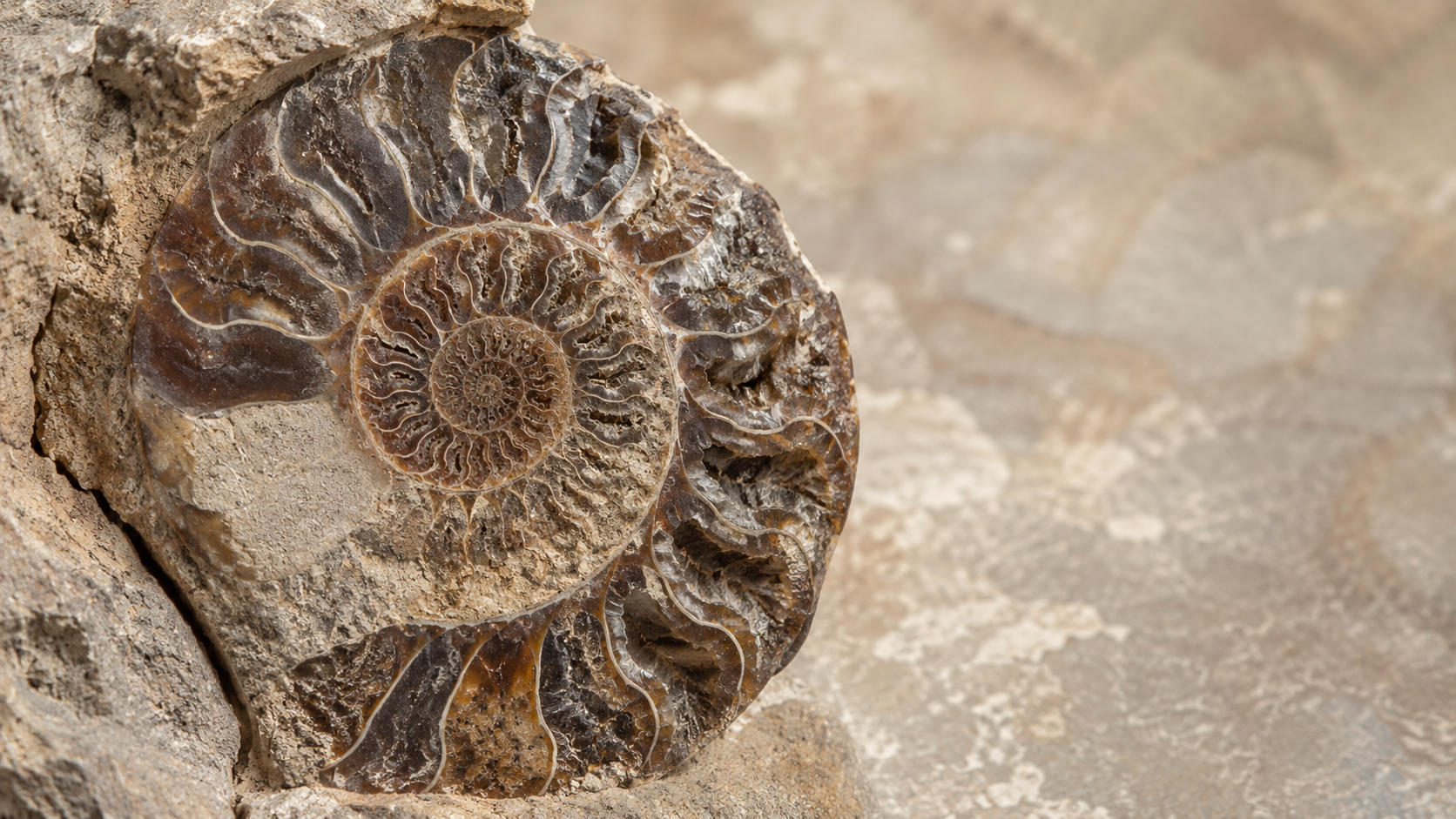
Ammonites are among the best-known fossils used in jewellery. These extinct marine cephalopods flourished through much of the Mesozoic Era and disappeared during the mass extinction at the end of the Cretaceous Period, around 66 million years ago. Their chambered shells grew as the animal grew, usually forming the distinctive coil that has made ammonites one of the most recognisable fossils in the world.
Straight-shelled cephalopods, often sold in the jewellery trade under the name “Orthoceras,” represent a different architecture of ancient marine life. In strict palaeontological terminology, not every fossil marketed as Orthoceras necessarily belongs to the genus Orthoceras itself, and many are better described more broadly as straight-shelled nautiloid or orthoceratoid cephalopods. The commercial name remains familiar, but the scientific distinction is useful because it reminds us that each fossil belongs to a particular evolutionary history.
If you are deciding between these two forms, Ammonite vs Orthoceras: Which Fossil Speaks to You? compares their natural shapes, visual character, and symbolic appeal. Our article Orthoceras Fossil: Meaning, History and Why People Wear It looks more closely at the straight-shelled form and its place in contemporary fossil jewellery.
Ammonites are among the best-known fossils used in jewellery. These extinct marine cephalopods flourished through much of the Mesozoic Era and disappeared during the mass extinction at the end of the Cretaceous Period, around 66 million years ago. Their chambered shells grew as the animal grew, usually forming the distinctive coil that has made ammonites one of the most recognisable fossils in the world.
Straight-shelled cephalopods, often sold in the jewellery trade under the name “Orthoceras,” represent a different architecture of ancient marine life. In strict palaeontological terminology, not every fossil marketed as Orthoceras necessarily belongs to the genus Orthoceras itself, and many are better described more broadly as straight-shelled nautiloid or orthoceratoid cephalopods. The commercial name remains familiar, but the scientific distinction is useful because it reminds us that each fossil belongs to a particular evolutionary history.
If you are deciding between these two forms, Ammonite vs Orthoceras: Which Fossil Speaks to You? compares their natural shapes, visual character, and symbolic appeal. Our article Orthoceras Fossil: Meaning, History and Why People Wear It looks more closely at the straight-shelled form and its place in contemporary fossil jewellery.
The Famous Ammonite Spiral
The ammonite spiral deserves special attention because it is one of the reasons these fossils are so visually compelling. Many ammonite shells can be approximated by logarithmic spirals, allowing the shell to expand as the animal grew while preserving a broadly similar overall form. This geometry creates an impression of continuity and ordered growth that has fascinated scientists, artists, collectors, and designers alike.
Popular accounts sometimes go further and claim that ammonites universally follow the exact golden ratio. That statement is too simplistic. A logarithmic spiral is not automatically a golden spiral, and ammonite shell proportions varied enormously between species. Different ammonites evolved different rates of expansion, chamber shapes, shell ornamentation, and overall proportions.
The scientific reality is more interesting than the myth. Evolution repeatedly produced elegant coiled shells that balanced growth, buoyancy, protection, and structural efficiency. Their beauty does not need to be explained by a single mathematical formula; it emerges from the interaction of biology, geometry, and adaptation across deep time.
Popular accounts sometimes go further and claim that ammonites universally follow the exact golden ratio. That statement is too simplistic. A logarithmic spiral is not automatically a golden spiral, and ammonite shell proportions varied enormously between species. Different ammonites evolved different rates of expansion, chamber shapes, shell ornamentation, and overall proportions.
The scientific reality is more interesting than the myth. Evolution repeatedly produced elegant coiled shells that balanced growth, buoyancy, protection, and structural efficiency. Their beauty does not need to be explained by a single mathematical formula; it emerges from the interaction of biology, geometry, and adaptation across deep time.
How Fossils Return to the Surface
A buried fossil cannot be found until geological processes bring its rock within reach. Tectonic uplift can raise sedimentary layers, erosion can remove overlying material, and wind and water can gradually expose strata that once lay far below the surface. In regions such as Morocco, these processes have created large areas where ancient fossil-bearing rocks are accessible today.
This reversal is one of the most striking chapters in the fossil journey. Material that began on an ancient seabed may eventually become part of an arid desert landscape. What was once underwater can be exposed beneath a dry sky, carrying with it the remains of organisms from worlds that no longer exist.
Finding fossils in such landscapes requires geological knowledge as much as patience. Experienced fossil workers learn to recognise promising strata, particular rock types, characteristic textures, and subtle signs that fossils may be present. Some specimens weather naturally from exposed surfaces, while others remain enclosed within rock and require careful extraction.
This reversal is one of the most striking chapters in the fossil journey. Material that began on an ancient seabed may eventually become part of an arid desert landscape. What was once underwater can be exposed beneath a dry sky, carrying with it the remains of organisms from worlds that no longer exist.
Finding fossils in such landscapes requires geological knowledge as much as patience. Experienced fossil workers learn to recognise promising strata, particular rock types, characteristic textures, and subtle signs that fossils may be present. Some specimens weather naturally from exposed surfaces, while others remain enclosed within rock and require careful extraction.
Extraction: Preserving What Time Has Saved
A fossil can survive hundreds of millions of years underground and still be damaged in minutes by careless extraction. Recovery therefore requires judgement, especially when the surrounding rock is brittle, fractured, or unusually hard. A useful specimen may need to be separated from its matrix without breaking the shell structures that give it both scientific and aesthetic value.
It is also important to distinguish between fossils suitable for decorative use and specimens of exceptional scientific importance. For researchers, a fossil’s value may depend not only on the object itself, but also on its precise location, rock layer, orientation, and association with other fossils. These contextual details can help reconstruct ancient environments, establish age, and clarify evolutionary relationships.
Responsible fossil jewellery should therefore rely on legally obtained, comparatively abundant material rather than rare or scientifically irreplaceable specimens. Respecting deep time also means recognising that some fossils belong in research collections or museums, while others can enter human culture through decorative use.
It is also important to distinguish between fossils suitable for decorative use and specimens of exceptional scientific importance. For researchers, a fossil’s value may depend not only on the object itself, but also on its precise location, rock layer, orientation, and association with other fossils. These contextual details can help reconstruct ancient environments, establish age, and clarify evolutionary relationships.
Responsible fossil jewellery should therefore rely on legally obtained, comparatively abundant material rather than rare or scientifically irreplaceable specimens. Respecting deep time also means recognising that some fossils belong in research collections or museums, while others can enter human culture through decorative use.
Fossil Preparation: Revealing Hidden Anatomy
Freshly recovered fossils often look very different from polished jewellery. They may remain partly enclosed in matrix, their surfaces may be dull or uneven, and important internal structures may be almost invisible. Preparation reveals what geological processes have preserved.
Depending on the specimen, preparation can involve removing surrounding rock, cleaning, stabilising vulnerable areas, cutting a surface to reveal internal structures, and progressively polishing the material. The exact method depends on the fossil’s mineral composition, condition, and intended use.
Polishing can produce one of the most dramatic transformations. An ammonite may reveal chamber after chamber curling around the centre, while a straight-shelled cephalopod may display a sequence of internal partitions along its length. These patterns can look almost architectural, yet they were not created by a designer. They are biological structures inherited from the original animal.
This is one of the central differences between conventional jewellery manufacture and the fossil jewellery process. In many forms of lapidary work, the craftsperson imposes a desired shape on raw material. With fossils, the most compelling design often begins by revealing and preserving a structure that already exists.
Depending on the specimen, preparation can involve removing surrounding rock, cleaning, stabilising vulnerable areas, cutting a surface to reveal internal structures, and progressively polishing the material. The exact method depends on the fossil’s mineral composition, condition, and intended use.
Polishing can produce one of the most dramatic transformations. An ammonite may reveal chamber after chamber curling around the centre, while a straight-shelled cephalopod may display a sequence of internal partitions along its length. These patterns can look almost architectural, yet they were not created by a designer. They are biological structures inherited from the original animal.
This is one of the central differences between conventional jewellery manufacture and the fossil jewellery process. In many forms of lapidary work, the craftsperson imposes a desired shape on raw material. With fossils, the most compelling design often begins by revealing and preserving a structure that already exists.
Why the Fossil Comes Before the Design
Natural fossils are never perfectly identical. Two specimens of the same general type may differ in size, shape, colour, mineralisation, completeness, surface texture, and the visibility of their internal structures. Their differences are produced by growth, burial, chemistry, geological alteration, erosion, and preparation.
For that reason, fossil jewellery often reverses the logic of industrial design. Instead of creating a fixed design first and then forcing identical components to fit it, the maker begins with the fossil itself. The specimen determines what is possible.
The designer must consider where the visual centre lies, which orientation reveals the shell most clearly, whether a natural edge should remain visible, whether the specimen is structurally strong enough to be drilled, and which accompanying materials will support rather than overwhelm it. The following article in this series, What Makes Every Fossil Unique?, explores how this individuality develops and why no two pieces of fossil jewellery can ever be perfectly alike.
For that reason, fossil jewellery often reverses the logic of industrial design. Instead of creating a fixed design first and then forcing identical components to fit it, the maker begins with the fossil itself. The specimen determines what is possible.
The designer must consider where the visual centre lies, which orientation reveals the shell most clearly, whether a natural edge should remain visible, whether the specimen is structurally strong enough to be drilled, and which accompanying materials will support rather than overwhelm it. The following article in this series, What Makes Every Fossil Unique?, explores how this individuality develops and why no two pieces of fossil jewellery can ever be perfectly alike.
When Fossils Meet Other Natural Materials
At Ampulla Temporis, fossils may be combined with materials such as pearl, baroque pearl, amber, agate, smoky quartz, spinel, and volcanic lava. From a natural-history perspective, each of these materials has a very different origin, which makes the combinations more than decorative.
Pearls are biological structures produced by molluscs. Amber begins as plant resin and is transformed over geological time. Agate develops as silica-rich material is deposited within cavities, often in volcanic rock. Quartz and spinel are crystalline minerals, while volcanic lava records rock that once existed in a molten state. The Ampulla Temporis Material & Energy Codex treats such combinations as dialogues between different kinds of matter and different forms of duration.
Even without symbolic interpretation, the geological contrast is compelling. A single piece of jewellery may bring together a fossilised animal, a biologically produced pearl, and a mineral formed through an entirely different process. The final composition is contemporary, but the materials represent multiple histories of Earth.
Pearls are biological structures produced by molluscs. Amber begins as plant resin and is transformed over geological time. Agate develops as silica-rich material is deposited within cavities, often in volcanic rock. Quartz and spinel are crystalline minerals, while volcanic lava records rock that once existed in a molten state. The Ampulla Temporis Material & Energy Codex treats such combinations as dialogues between different kinds of matter and different forms of duration.
Even without symbolic interpretation, the geological contrast is compelling. A single piece of jewellery may bring together a fossilised animal, a biologically produced pearl, and a mineral formed through an entirely different process. The final composition is contemporary, but the materials represent multiple histories of Earth.
From Ancient Material to Contemporary Craft
Once the fossil reaches a jewellery workshop, the scale of time changes abruptly. Geological processes have taken millions of years; human craftsmanship works through deliberate decisions made over hours or days. The maker now considers proportion, balance, weight, durability, movement, and how the finished piece will interact with the body.
Fossils require particular care because they can vary in strength. Some can be drilled safely, while others may fracture or need alternative mounting methods. Natural fissures are not necessarily defects, but they must be assessed structurally. Edges may need finishing for comfort, and heavier pieces must be balanced carefully within the overall design.
The challenge is to preserve the fossil’s identity while making it wearable. Too little intervention can leave a specimen impractical; too much can erase the qualities that made it extraordinary. The best fossil jewellery therefore does not disguise the fossil’s origin. It allows the ancient structure to remain visible while giving it a contemporary function.
Fossils require particular care because they can vary in strength. Some can be drilled safely, while others may fracture or need alternative mounting methods. Natural fissures are not necessarily defects, but they must be assessed structurally. Edges may need finishing for comfort, and heavier pieces must be balanced carefully within the overall design.
The challenge is to preserve the fossil’s identity while making it wearable. Too little intervention can leave a specimen impractical; too much can erase the qualities that made it extraordinary. The best fossil jewellery therefore does not disguise the fossil’s origin. It allows the ancient structure to remain visible while giving it a contemporary function.
Why Two Pieces Can Never Be Exactly the Same
Modern manufacturing encourages us to expect repetition. We assume that if one object exists, another identical object can be made. Fossils resist that expectation because their individuality was created long before any human design process began.
One ammonite may show unusually clear chambers, while another contains mineral veins that entered after burial. A third may preserve only part of the outer whorl. Two straight-shelled cephalopods may differ in chamber spacing, colour, mineralisation, and the way their internal structures appear after polishing.
These differences are not flaws. They are geological biographies, produced by a sequence of events that cannot be repeated exactly: growth, death, burial, mineralisation, geological change, erosion, discovery, and preparation. In this context, the word “unique” is not merely a marketing expression. It describes the material reality of the object.
Ampulla Temporis builds its positioning around this idea: each fossil jewel carries a fragment of ancient natural history that cannot be reproduced in precisely the same form.
One ammonite may show unusually clear chambers, while another contains mineral veins that entered after burial. A third may preserve only part of the outer whorl. Two straight-shelled cephalopods may differ in chamber spacing, colour, mineralisation, and the way their internal structures appear after polishing.
These differences are not flaws. They are geological biographies, produced by a sequence of events that cannot be repeated exactly: growth, death, burial, mineralisation, geological change, erosion, discovery, and preparation. In this context, the word “unique” is not merely a marketing expression. It describes the material reality of the object.
Ampulla Temporis builds its positioning around this idea: each fossil jewel carries a fragment of ancient natural history that cannot be reproduced in precisely the same form.
Does a Fossil Remain Scientifically Meaningful After Becoming Jewellery?
A fossil can remain scientifically interesting after entering jewellery, although its research value depends heavily on how much contextual information has been preserved. For palaeontology, provenance matters. A specimen with a documented locality and geological layer usually offers more scientific information than an isolated commercial fossil without stratigraphic context.
Even when that context is limited, however, the object can still retain genuine biological and geological information. The chambers of an ammonite are real anatomical structures, the partitions visible in straight-shelled cephalopods belonged to real animals, and patterns of mineralisation record events that occurred after death.
This is why fossil jewellery is most interesting when it encourages curiosity rather than replacing science with vague mystery. A fossil naturally raises questions: What animal was this? When did it live? How did its shell function? Why was it preserved? What happened to the sea in which it lived? How did that ancient marine world eventually become part of a desert landscape?
Jewellery can become an entry point into natural history. A small object worn on the body can lead directly into palaeontology, geology, evolution, and the study of deep time.
Even when that context is limited, however, the object can still retain genuine biological and geological information. The chambers of an ammonite are real anatomical structures, the partitions visible in straight-shelled cephalopods belonged to real animals, and patterns of mineralisation record events that occurred after death.
This is why fossil jewellery is most interesting when it encourages curiosity rather than replacing science with vague mystery. A fossil naturally raises questions: What animal was this? When did it live? How did its shell function? Why was it preserved? What happened to the sea in which it lived? How did that ancient marine world eventually become part of a desert landscape?
Jewellery can become an entry point into natural history. A small object worn on the body can lead directly into palaeontology, geology, evolution, and the study of deep time.
From an Ancient Ocean to the Human Body
At the end of the journey, something remarkable happens: the fossil begins to move again. For millions of years it remained enclosed in rock, but now it travels with a person through cities, homes, workplaces, galleries, and countries. A fragment of an ancient marine organism becomes part of a modern human life.
That contrast changes the way we perceive time. Numbers such as 100 million or 400 million years are difficult to imagine because they are far beyond ordinary human experience. A fossil makes those numbers tangible. It allows us to hold physical evidence that life existed in an environment that disappeared long before our species appeared.
The sequence is extraordinary in its simplicity. An organism lived in an ancient sea, died, became buried, entered the geological record, remained hidden while the world changed, returned to the surface through erosion, was discovered and prepared, and finally became part of a piece of jewellery. What appears in the present as a small object is actually the final stage of an immense chain of natural events.
That contrast changes the way we perceive time. Numbers such as 100 million or 400 million years are difficult to imagine because they are far beyond ordinary human experience. A fossil makes those numbers tangible. It allows us to hold physical evidence that life existed in an environment that disappeared long before our species appeared.
The sequence is extraordinary in its simplicity. An organism lived in an ancient sea, died, became buried, entered the geological record, remained hidden while the world changed, returned to the surface through erosion, was discovered and prepared, and finally became part of a piece of jewellery. What appears in the present as a small object is actually the final stage of an immense chain of natural events.
Jewellery Made From Deep Time
The finished jewel may be small enough to hold between two fingers, but its history extends far beyond any human timescale. Fossil jewellery connects transformations that usually remain invisible to us: life becoming fossil, sediment becoming stone, seabed becoming desert, buried anatomy becoming visible pattern, and geological material becoming something wearable.
Through all those transformations, one fact remains constant: the fossil was once alive. An ammonite spiral was not created to become a pendant; it was the shell of an animal navigating an ancient ocean. The chambers of a straight-shelled cephalopod were not designed as geometric ornament; they formed part of a functional biological structure.
That is what distinguishes genuine fossil jewellery from objects merely inspired by fossils. The beauty and the natural history are inseparable, and the jewellery becomes compelling precisely because the visible form carries a real history that no designer could invent.
At Ampulla Temporis, the philosophy begins with this relationship between time, material, and form. The purpose is not simply to reproduce ancient motifs, but to place genuine fragments of Earth’s history into contemporary jewellery. A fossil does not need an invented story to make it extraordinary. Its real story is already millions of years long, and the role of craftsmanship is to give that story a new way to travel.
For further reading, explore The Oldest Fossils Used in Jewellery: A Journey Through Deep Time, learn more about fossilized marine life, discover why Morocco produces some of the world’s finest fossils, or compare the different natural forms of ammonite and Orthoceras fossils.
Through all those transformations, one fact remains constant: the fossil was once alive. An ammonite spiral was not created to become a pendant; it was the shell of an animal navigating an ancient ocean. The chambers of a straight-shelled cephalopod were not designed as geometric ornament; they formed part of a functional biological structure.
That is what distinguishes genuine fossil jewellery from objects merely inspired by fossils. The beauty and the natural history are inseparable, and the jewellery becomes compelling precisely because the visible form carries a real history that no designer could invent.
At Ampulla Temporis, the philosophy begins with this relationship between time, material, and form. The purpose is not simply to reproduce ancient motifs, but to place genuine fragments of Earth’s history into contemporary jewellery. A fossil does not need an invented story to make it extraordinary. Its real story is already millions of years long, and the role of craftsmanship is to give that story a new way to travel.
For further reading, explore The Oldest Fossils Used in Jewellery: A Journey Through Deep Time, learn more about fossilized marine life, discover why Morocco produces some of the world’s finest fossils, or compare the different natural forms of ammonite and Orthoceras fossils.
Frequently Asked Questions
What is fossil jewellery?
Fossil jewellery is made with genuine fossilised remains of ancient organisms, such as ammonites or straight-shelled cephalopods.
How are fossils turned into jewellery?
Fossils are carefully cleaned, prepared, polished, and then incorporated into a design that works with their natural shape and structure.
Where do Ampulla Temporis fossils come from?
Ampulla Temporis uses fossils sourced from Morocco, a region famous for fossil-bearing rocks formed in ancient marine environments.
How old are fossils used in jewellery?
Depending on the species, fossils used in jewellery can be tens or hundreds of millions of years old.
Is Orthoceras a real fossil?
Yes. “Orthoceras” is a common trade name for straight-shelled fossil cephalopods, although not every specimen belongs to the exact genus Orthoceras.
Do ammonites follow the golden ratio?
Not always. Many ammonites form logarithmic spirals, but this does not mean every shell follows the exact golden ratio.
Why is every fossil jewellery piece unique?
Each fossil differs naturally in shape, mineralisation, colour, preservation, and visible internal structure.
Are fossils damaged when made into jewellery?
They are altered through careful preparation, but the aim is to preserve and reveal their natural structure.
Is fossil jewellery scientifically valuable?
It can retain scientific interest, although full research value depends on documented geological context and provenance.
Is fossil jewellery ethical?
It can be, when fossils are legally and responsibly sourced and rare or scientifically important specimens are kept for research.
Can fossil jewellery be worn every day?
Many pieces can be worn regularly, but fossils should be protected from strong impacts, harsh chemicals, and abrasive cleaning.
How should fossil jewellery be cleaned?
Use a soft, dry or slightly damp cloth and avoid ultrasonic cleaners, aggressive chemicals, and prolonged soaking.
Why are ammonites popular in jewellery?
Their distinctive spiral, natural individuality, and extraordinary geological age make them especially compelling as wearable fossils.
Why does Ampulla Temporis use fossils?
Ampulla Temporis uses genuine fossils to turn deep time into something tangible: a fragment of Earth’s ancient history that can be worn.
