
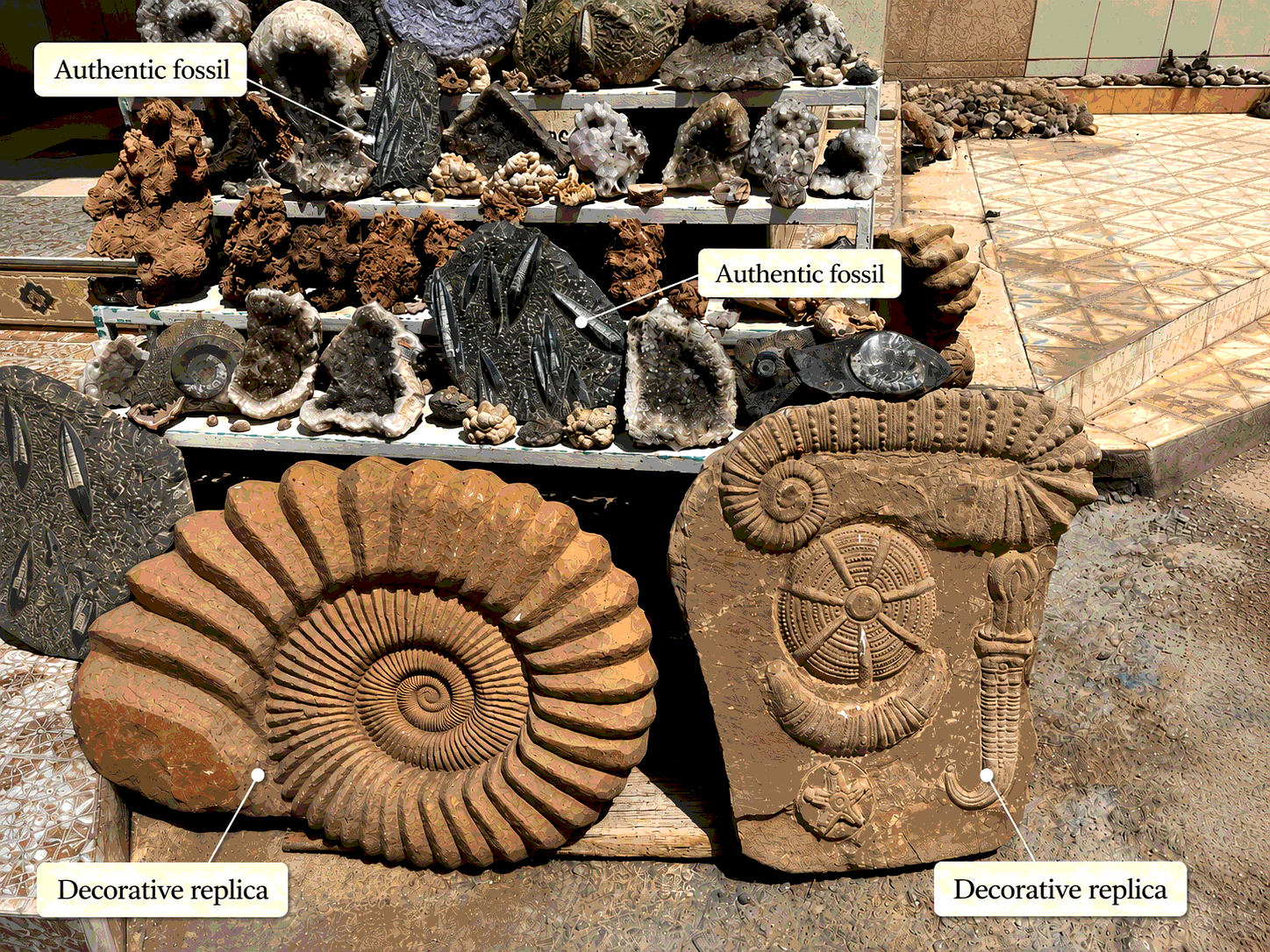
In recent years, fossil jewellery has evolved from a niche collector's interest into a growing category of luxury and artisanal jewellery. As demand increases, so does the number of replicas, casts, and imitations marketed as genuine fossils.
For buyers, distinguishing real fossil jewellery from reproductions can be challenging.
The difference matters because authentic fossil jewellery is not simply inspired by nature—it contains actual remains of organisms that lived hundreds of millions of years ago. Every genuine ammonite, orthoceras, or fossil shell represents a fragment of Earth's history preserved through deep geological time.
Understanding how to identify authentic fossils helps ensure that what you are purchasing carries the history, rarity, and uniqueness that make fossil jewellery extraordinary.
For buyers, distinguishing real fossil jewellery from reproductions can be challenging.
The difference matters because authentic fossil jewellery is not simply inspired by nature—it contains actual remains of organisms that lived hundreds of millions of years ago. Every genuine ammonite, orthoceras, or fossil shell represents a fragment of Earth's history preserved through deep geological time.
Understanding how to identify authentic fossils helps ensure that what you are purchasing carries the history, rarity, and uniqueness that make fossil jewellery extraordinary.
How Can You Tell if Fossil Jewellery Is Real?
You can identify real fossil jewellery by examining natural imperfections, checking weight and texture, looking for authentic fossil structures, verifying provenance, requesting authenticity documentation, and ensuring each piece shows the unique characteristics created by natural fossilization rather than artificial manufacturing.
What Is Real Fossil Jewellery?
Real fossil jewellery contains genuine fossilized remains.
These may include:
Unlike conventional gemstones, fossils were once living organisms that underwent natural mineralization over millions of years.
At Ampulla Temporis, fossils are viewed not as decorative elements but as material records of time itself—structures shaped through continuity, pressure, and geological transformation over immense spans of time.
These may include:
- Ammonites
- Orthoceras fossils
- Trilobites
- Fossil coral
- Fossilized wood
- Shark teeth
- Other ancient marine organisms
Unlike conventional gemstones, fossils were once living organisms that underwent natural mineralization over millions of years.
At Ampulla Temporis, fossils are viewed not as decorative elements but as material records of time itself—structures shaped through continuity, pressure, and geological transformation over immense spans of time.
Why Fake Fossil Jewellery Exists
Authentic fossils are finite.
They must be discovered, excavated, cleaned, stabilized, and prepared before becoming jewellery. This process requires expertise and often significant manual work.
As fossil jewelry gains popularity, some manufacturers create:
While some reproductions are clearly marketed as replicas, others are presented in ways that can confuse buyers.
Knowing what to look for is essential.
They must be discovered, excavated, cleaned, stabilized, and prepared before becoming jewellery. This process requires expertise and often significant manual work.
As fossil jewelry gains popularity, some manufacturers create:
- Resin replicas
- Plastic reproductions
- Stone casts
- Artificially aged molds
- Composite pieces containing little or no genuine fossil material
While some reproductions are clearly marketed as replicas, others are presented in ways that can confuse buyers.
Knowing what to look for is essential.
7 Ways to Identify Real Fossil Jewellery
1. Look for Natural Imperfections
Nature rarely creates perfect symmetry.
Authentic fossils usually display:
Replicas often appear overly uniform.
If every detail looks identical, smooth, and perfectly repeated, it may be a cast rather than a genuine fossil.
Interestingly, the imperfections that mass-market jewellery often seeks to eliminate are precisely what make natural objects valuable and unique.
Authentic fossils usually display:
- Tiny mineral inclusions
- Natural asymmetry
- Uneven coloration
- Geological textures
- Variations in preservation
Replicas often appear overly uniform.
If every detail looks identical, smooth, and perfectly repeated, it may be a cast rather than a genuine fossil.
Interestingly, the imperfections that mass-market jewellery often seeks to eliminate are precisely what make natural objects valuable and unique.
2. Check the Weight and Temperature
Real fossils are stone.
As a result, they typically feel:
When held in the hand, genuine fossil jewellery often has a substantial presence that immediately distinguishes it from lightweight reproductions.
This is particularly noticeable with ammonites and orthoceras fossils, which have undergone extensive mineral replacement during fossilization.
As a result, they typically feel:
- Cooler than plastic
- Denser than resin
- Heavier than synthetic materials
When held in the hand, genuine fossil jewellery often has a substantial presence that immediately distinguishes it from lightweight reproductions.
This is particularly noticeable with ammonites and orthoceras fossils, which have undergone extensive mineral replacement during fossilization.
3. Examine Internal Fossil Structures
One of the strongest indicators of authenticity is visible biological structure.
In ammonites, look for:
Ammonite shells developed chamber by chamber throughout the animal's life, creating a visible record of growth and expansion. Because these structures formed naturally, they are exceptionally difficult to replicate convincingly.
The more closely you inspect a fossil, the more evidence of its natural history should become visible.
In ammonites, look for:
- Chamber divisions
- Natural mineral infill
- Crystalline formations
- Growth patterns
Ammonite shells developed chamber by chamber throughout the animal's life, creating a visible record of growth and expansion. Because these structures formed naturally, they are exceptionally difficult to replicate convincingly.
The more closely you inspect a fossil, the more evidence of its natural history should become visible.
4. Ask for Provenance
Authentic fossil jewellery should come with a story.
A reputable jewelleer should be able to explain:
At Ampulla Temporis, many fossils originate from Morocco, where ancient seabeds now exposed in desert landscapes yield some of the world's most remarkable marine fossils.
Transparency is often one of the strongest signs of authenticity.
A reputable jewelleer should be able to explain:
- What species the fossil belongs to
- Where it was discovered
- Its approximate age
- How it was prepared
At Ampulla Temporis, many fossils originate from Morocco, where ancient seabeds now exposed in desert landscapes yield some of the world's most remarkable marine fossils.
Transparency is often one of the strongest signs of authenticity.
5. Verify the Species Information
A trustworthy seller should know exactly what fossil they are offering.
Questions worth asking include:
Vague descriptions such as "ancient fossil" without further information should encourage additional scrutiny.
Authentic fossil jewellery is rooted in natural history, and accurate identification is part of that value.
Questions worth asking include:
- Is this an ammonite or an ammonoid?
- What geological period is it from?
- How old is it?
- Where was it discovered?
Vague descriptions such as "ancient fossil" without further information should encourage additional scrutiny.
Authentic fossil jewellery is rooted in natural history, and accurate identification is part of that value.
6. Compare Similar Pieces
No two fossils are identical.
This is especially true for ammonites.
Because every ammonite grew individually, each specimen developed unique chamber patterns, mineralization, and preservation characteristics.
If dozens of pieces appear perfectly identical, they may be molded from a single original specimen.
One of the defining characteristics of genuine fossil jewellery is that every piece is inherently one of a kind.
For a deeper exploration of this concept, see Why Every Fossil Jewellery Piece Is One of a Kind.
This is especially true for ammonites.
Because every ammonite grew individually, each specimen developed unique chamber patterns, mineralization, and preservation characteristics.
If dozens of pieces appear perfectly identical, they may be molded from a single original specimen.
One of the defining characteristics of genuine fossil jewellery is that every piece is inherently one of a kind.
For a deeper exploration of this concept, see Why Every Fossil Jewellery Piece Is One of a Kind.
7. Request a Certificate of Authenticity
Many high-quality fossil jewelers provide:
Documentation adds credibility and allows buyers to understand the deeper story behind their jewelry.
At Ampulla Temporis, every piece is accompanied by a certificate, containing its unique number and information about the fossil's history and origin, reinforcing its connection to Earth's ancient past.
- Certificates of authenticity
- Geological information
- Species identification
- Fossil age estimates
Documentation adds credibility and allows buyers to understand the deeper story behind their jewelry.
At Ampulla Temporis, every piece is accompanied by a certificate, containing its unique number and information about the fossil's history and origin, reinforcing its connection to Earth's ancient past.
Common Types of Fake Fossil Jewellery
Understanding common imitations helps buyers avoid mistakes.
Resin Casts
Created from molds taken from real fossils and reproduced in synthetic materials.
Composite Fossils
Fragments of genuine fossils combined with artificial materials.
Artificial Stone Replicas
Modern carvings designed to imitate fossil structures.
Dyed or Treated Replicas
Artificial materials coloured to resemble natural mineralization.
Not all replicas are deceptive, but they should always be clearly identified as reproductions.
Resin Casts
Created from molds taken from real fossils and reproduced in synthetic materials.
Composite Fossils
Fragments of genuine fossils combined with artificial materials.
Artificial Stone Replicas
Modern carvings designed to imitate fossil structures.
Dyed or Treated Replicas
Artificial materials coloured to resemble natural mineralization.
Not all replicas are deceptive, but they should always be clearly identified as reproductions.
Is Real Fossil Jewellery Worth More?
In most cases, yes.
Authentic fossil jewellery derives value from multiple factors:
A replica may resemble an ammonite.
A genuine ammonite lived in an ancient ocean hundreds of millions of years ago.
That difference cannot be manufactured.
For many collectors, that history is the most valuable part of the object.
Authentic fossil jewellery derives value from multiple factors:
- Geological rarity
- Historical significance
- Natural uniqueness
- Craftsmanship
- Provenance
A replica may resemble an ammonite.
A genuine ammonite lived in an ancient ocean hundreds of millions of years ago.
That difference cannot be manufactured.
For many collectors, that history is the most valuable part of the object.
Where to Buy Authentic Fossil Jewellery
When purchasing fossil jewellery, look for brands that provide:
✓ Species identification
✓ Fossil origin information
✓ Authenticity documentation
✓ High-resolution photographs
✓ Transparent sourcing practices
A trustworthy jeweller should be proud to explain where their fossils come from and how they were transformed into wearable art.
The best fossil jewellery combines craftsmanship with geological authenticity.
✓ Species identification
✓ Fossil origin information
✓ Authenticity documentation
✓ High-resolution photographs
✓ Transparent sourcing practices
A trustworthy jeweller should be proud to explain where their fossils come from and how they were transformed into wearable art.
The best fossil jewellery combines craftsmanship with geological authenticity.
Why Authenticity Matters
The greatest luxury in fossil jewellery is not rarity alone.
It is reality.
A real ammonite existed before mammals walked the Earth.
A real orthoceras moved through ancient seas more than 400 million years ago.
A real fossil carries a story that no artisan, no matter how skilled, could ever recreate.
Authenticity transforms jewellery into something more than adornment.
It becomes a connection to deep time.
It is reality.
A real ammonite existed before mammals walked the Earth.
A real orthoceras moved through ancient seas more than 400 million years ago.
A real fossil carries a story that no artisan, no matter how skilled, could ever recreate.
Authenticity transforms jewellery into something more than adornment.
It becomes a connection to deep time.
Related Reading
To learn more about fossil jewellery and geological history:
Explore our Ammonite Jewellery Collection to discover authentic fossils transformed into wearable objects that carry the memory of ancient oceans.
- What Makes Fossil Jewellery Different from Traditional Jewellery?
- How Do Fossils Form? Step-by-Step Process Explained
- Fossils in Ancient Cultures: Symbols of Protection and Continuity
- Why Every Fossil Jewellery Piece Is One of a Kind
Explore our Ammonite Jewellery Collection to discover authentic fossils transformed into wearable objects that carry the memory of ancient oceans.
Frequently Asked Questions
Is fossil jewellery made from real fossils?
Authentic fossil jewellery contains genuine fossilized remains such as ammonites, orthoceras, trilobites, fossil coral, or fossilized wood that have been incorporated into wearable designs.
How old is real fossil jewellery?
Most fossils used in jewelry range from approximately 100 million to over 450 million years old, depending on the species and geological deposit.
Are ammonite necklaces real fossils?
High-quality ammonite necklaces contain genuine fossil ammonites—extinct marine mollusks that lived in ancient oceans hundreds of millions of years ago.
Is fossil jewellery valuable?
Yes. Authentic fossil jewellery combines rarity, geological history, craftsmanship, and uniqueness, making every piece distinct.
Can fake fossils look real?
Yes. Modern resin casts and stone replicas can closely resemble genuine fossils, which is why provenance, documentation, and careful examination are important when purchasing fossil jewelry.
Discover Authentic Fossil Jewellery
At Ampulla Temporis, every piece begins with a genuine fossil shaped by Earth's history over hundreds of millions of years. We believe the most meaningful jewellery is not created to imitate time—it is created from time itself.
