
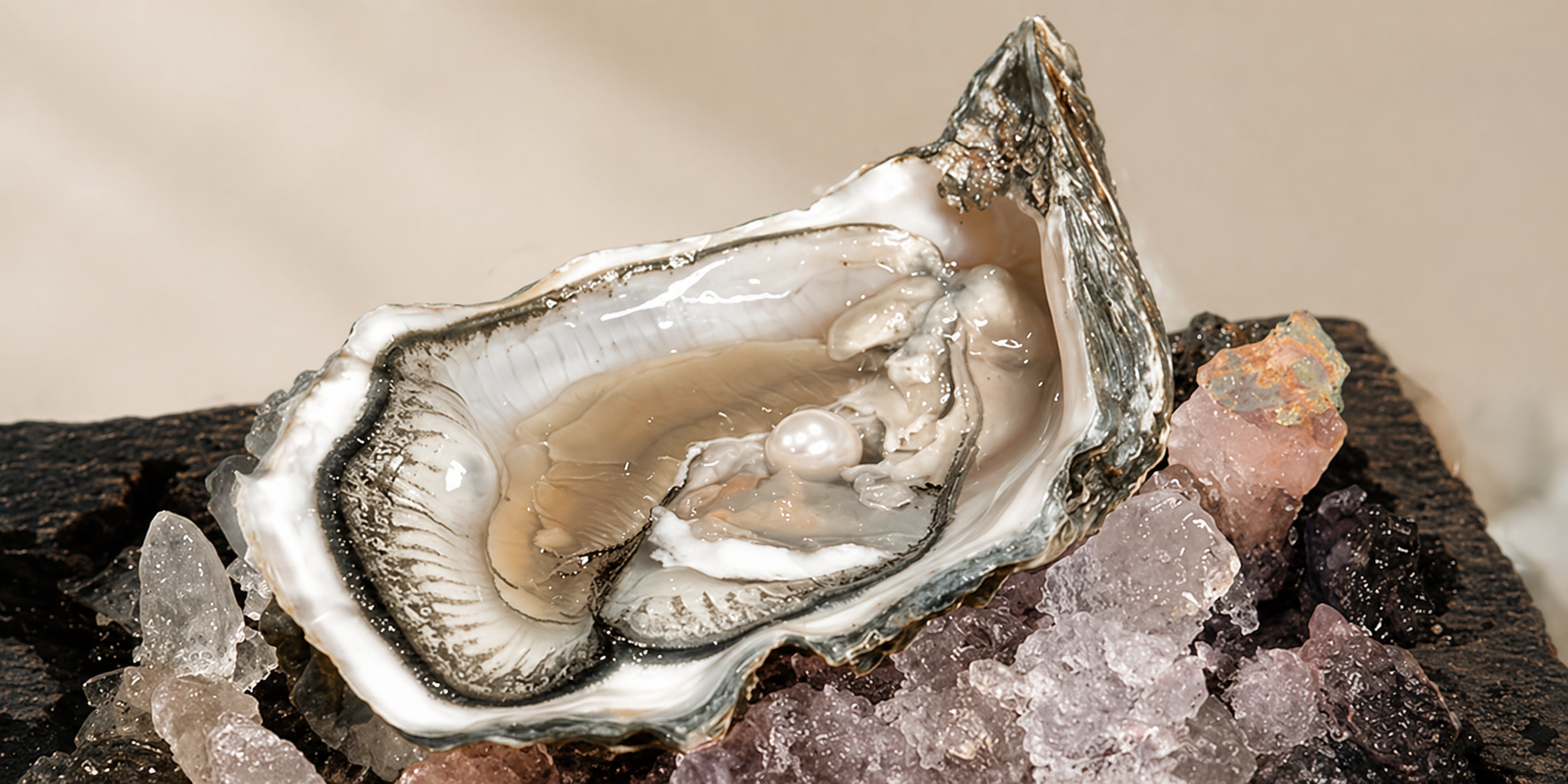
A pearl appears complete the moment we see it.
Smooth, luminous, self-contained. It sits among gemstones as if it belongs to the same world.
But a pearl does not begin as a stone.
It begins inside a living organism.
To understand what a pearl truly is, we must follow its formation — not its appearance.
Smooth, luminous, self-contained. It sits among gemstones as if it belongs to the same world.
But a pearl does not begin as a stone.
It begins inside a living organism.
To understand what a pearl truly is, we must follow its formation — not its appearance.
How a Pearl Begins
Pearls form inside molluscs, most commonly oysters.
When a foreign particle enters the shell — a grain, a fragment, something small — it disturbs the soft tissue of the organism.
Rather than expelling it, the mollusc responds.
It begins to coat the intruder with nacre — a substance composed of microscopic layers of calcium carbonate bound together by organic material.
This is not an isolated action, but a continuous process.
Layer by layer, the mollusc encloses the irritant until a pearl is formed.
When a foreign particle enters the shell — a grain, a fragment, something small — it disturbs the soft tissue of the organism.
Rather than expelling it, the mollusc responds.
It begins to coat the intruder with nacre — a substance composed of microscopic layers of calcium carbonate bound together by organic material.
This is not an isolated action, but a continuous process.
Layer by layer, the mollusc encloses the irritant until a pearl is formed.
The Formation Process
Pearl formation is gradual and precise.
Each layer of nacre is extremely thin, yet over time these layers accumulate, creating structure, depth, and the characteristic lustre.
This process can take:
The final result depends on multiple factors:
No two pearls are identical.
Each layer of nacre is extremely thin, yet over time these layers accumulate, creating structure, depth, and the characteristic lustre.
This process can take:
- several months for small pearls
- several years for larger, more complex ones
The final result depends on multiple factors:
- the species of mollusc
- water conditions
- mineral composition of the environment
- time
No two pearls are identical.
What Is a Pearl Made of?
A pearl consists primarily of:
This combination gives pearl its distinctive appearance — a soft, diffused glow rather than a sharp reflection.
Unlike minerals, which form through geological processes, a pearl develops through biological activity.
It is not crystallised.
It is deposited.
- calcium carbonate (in the form of aragonite crystals)
- conchiolin (an organic binding substance)
- trace amounts of water and other elements
This combination gives pearl its distinctive appearance — a soft, diffused glow rather than a sharp reflection.
Unlike minerals, which form through geological processes, a pearl develops through biological activity.
It is not crystallised.
It is deposited.
A Biological Material
Although pearls are used in jewellery alongside gemstones, they differ fundamentally in origin.
A pearl is an organic gemstone.
It is produced by a living organism, rather than formed within the earth.
Its structure is the result of growth, not external shaping.
There is no cutting or faceting involved.
The form develops naturally, from within.
A pearl is an organic gemstone.
It is produced by a living organism, rather than formed within the earth.
Its structure is the result of growth, not external shaping.
There is no cutting or faceting involved.
The form develops naturally, from within.
Pearl and Fossil: Two Expressions of Time
There is a meaningful connection between pearls and fossils.
A pearl forms within a living organism, in the present.
A fossil represents something different.
It is the preserved trace of life, transformed over time into mineral.
If you would like to explore this process in detail, see:
→ How Do Fossils Form? Step-by-Step Process Explained
These materials reflect different stages of a broader continuum:
For a broader introduction to fossils, you may begin here:
→ What Is a Fossil? Definition, Types and Examples
A pearl forms within a living organism, in the present.
A fossil represents something different.
It is the preserved trace of life, transformed over time into mineral.
If you would like to explore this process in detail, see:
→ How Do Fossils Form? Step-by-Step Process Explained
These materials reflect different stages of a broader continuum:
- a pearl is life in the process of formation
- a fossil is life preserved through geological time
For a broader introduction to fossils, you may begin here:
→ What Is a Fossil? Definition, Types and Examples
Why Pearls Are Unique in Jewellery
Most materials used in jewellery are shaped externally.
They are cut, polished, and refined.
A pearl is different.
Its surface is not imposed.
It is the direct result of natural growth.
This is one reason pearls are often combined with fossils in jewellery.
Together, they represent two distinct expressions of time:
To understand why people are drawn to such materials, see:
→ Fossil Jewellery: Why People Wear Fossils
They are cut, polished, and refined.
A pearl is different.
Its surface is not imposed.
It is the direct result of natural growth.
This is one reason pearls are often combined with fossils in jewellery.
Together, they represent two distinct expressions of time:
- one still forming
- one already preserved
To understand why people are drawn to such materials, see:
→ Fossil Jewellery: Why People Wear Fossils
A Material That Signals Life
Most materials used in jewellery are not unique to Earth.
Minerals such as quartz or diamond form through physical and chemical processes that can occur wherever the right conditions exist.
Crystalline structures are not rare in the universe — they are expected.
A diamond, for example, is composed of carbon arranged under extreme pressure.
Such conditions are not limited to our planet and are believed to exist far beyond it.
A pearl is different.
It does not form through pressure alone.
It requires a living organism.
The same is true for amber and fossils:
All three are not just materials.
They are evidence of biological processes.
At present, life as we know it has only been confirmed on Earth.
Which means materials like these carry something rare: not just structure, but the trace of life itself.
Minerals such as quartz or diamond form through physical and chemical processes that can occur wherever the right conditions exist.
Crystalline structures are not rare in the universe — they are expected.
A diamond, for example, is composed of carbon arranged under extreme pressure.
Such conditions are not limited to our planet and are believed to exist far beyond it.
A pearl is different.
It does not form through pressure alone.
It requires a living organism.
The same is true for amber and fossils:
- amber is fossilised tree resin
- fossils are preserved traces of ancient life
- pearls are formed within living molluscs
All three are not just materials.
They are evidence of biological processes.
At present, life as we know it has only been confirmed on Earth.
Which means materials like these carry something rare: not just structure, but the trace of life itself.
Conclusion
A pearl is not simply an object.
It is the outcome of a living process
Formed through response, built layer by layer within an organism, it carries something that cannot be reproduced by geology alone.
Alongside amber and fossils, it belongs to a small group of materials that do not just exist — they originate from life.
And perhaps this is why they feel different.
Not only shaped by time, but shaped by something that, so far, we have only found here.
It is the outcome of a living process
Formed through response, built layer by layer within an organism, it carries something that cannot be reproduced by geology alone.
Alongside amber and fossils, it belongs to a small group of materials that do not just exist — they originate from life.
And perhaps this is why they feel different.
Not only shaped by time, but shaped by something that, so far, we have only found here.
FAQ: Pearls and Their Formation
How are pearls formed?
Pearls form inside molluscs when a foreign particle enters the shell. The organism coats it with layers of nacre over time, gradually creating a pearl.
What is a pearl made of?
A pearl is made of calcium carbonate (aragonite) and conchiolin, an organic binding substance, arranged in thin layers that create its characteristic lustre.
Are pearls natural or cultured?
Both exist. Natural pearls form without human involvement, while cultured pearls are started with human assistance. In both cases, the pearl itself is formed by the mollusc.
How long does it take for a pearl to form?
Pearl formation can take from several months to several years, depending on the type, size, and environmental conditions.
Do pearls come from oysters?
Yes, most pearls come from oysters, although some are formed in other molluscs, such as mussels.
Are pearls real gemstones?
Yes, pearls are considered gemstones, but they are classified as organic gemstones because they are formed by living organisms.
Are pearls valuable?
Yes, pearls can be valuable depending on their size, shape, lustre, surface quality, and origin.
What is the difference between natural and cultured pearls?
Natural pearls form entirely without human interfere. Cultured pearls begin with a small inserted nucleus, but the formation process remains natural.
Why are pearls unique compared to other gemstones?
Unlike minerals such as diamonds, which form through geological processes, pearls are created by living organisms. This places them in a rare category of materials directly connected to life.
Can pearls be worn every day?
Yes, but they require care. Pearls are softer than most gemstones and should be kept away from chemicals, water exposure, and rough handling.
