
Short answer
Fossils are most commonly found in sedimentary rocks formed in ancient environments such as seas, lakes, and riverbeds. They are discovered worldwide in deserts, cliffs, river valleys, and uplifted seabeds.
Fossils are most commonly found in sedimentary rocks formed in ancient environments such as seas, lakes, and riverbeds. They are discovered worldwide in deserts, cliffs, river valleys, and uplifted seabeds.
Introduction
Fossils are not tied to one place.
They are tied to conditions.
What matters is not geography as we see it today — but what that place once was.
A desert may hide an ocean.
A mountain may hold a seabed.
A valley may preserve a river that no longer exists.
To understand where fossils are found, we need to read the Earth as layers, not landscapes.
To understand what fossils actually are, start here:
→ What Is a Fossil? Definition, Types and Examples
They are tied to conditions.
What matters is not geography as we see it today — but what that place once was.
A desert may hide an ocean.
A mountain may hold a seabed.
A valley may preserve a river that no longer exists.
To understand where fossils are found, we need to read the Earth as layers, not landscapes.
To understand what fossils actually are, start here:
→ What Is a Fossil? Definition, Types and Examples
The Key Rule: Fossils Follow Sedimentary Rock
The most important principle is simple:
Fossils are found in sedimentary rocks.
These rocks form from accumulated material:
Over time, these layers harden — preserving anything buried within them.
This is why fossil-rich areas are typically:
To learn how fossils form step by step, read:
→ How Do Fossils Form? Step-by-Step Process Explained
Fossils are found in sedimentary rocks.
These rocks form from accumulated material:
- sand
- mud
- silt
Over time, these layers harden — preserving anything buried within them.
This is why fossil-rich areas are typically:
- layered
- stratified
- geologically stable
To learn how fossils form step by step, read:
→ How Do Fossils Form? Step-by-Step Process Explained
Ancient Environments Where Fossils Form
Instead of focusing on specific species, it is more accurate to think in terms of environments.
1. Ancient Seas
Most fossils originate from marine environments.
For millions of years, large parts of Earth were covered by shallow seas.
These environments allowed:
Today, these ancient seas are often:
For millions of years, large parts of Earth were covered by shallow seas.
These environments allowed:
- rapid sedimentation
- low oxygen conditions
- stable burial
Today, these ancient seas are often:
- deserts
- plains
- inland regions
2. River Systems and Floodplains
Rivers constantly deposit sediment.
Floodplains create layers over time — ideal for preserving organic material.
These areas are especially important for:
Floodplains create layers over time — ideal for preserving organic material.
These areas are especially important for:
- terrestrial fossils
- plant remains
- animal tracks
3. Lakes and Calm Water Basins
Still water creates quiet conditions.
Fine sediment settles slowly, capturing delicate structures.
These environments can preserve:
Fine sediment settles slowly, capturing delicate structures.
These environments can preserve:
- soft details
- thin structures
- subtle impressions
Why Fossils Appear in Deserts Today
Deserts are not where fossils form — they are where fossils are revealed.
Key reasons:
Wind removes surface material, uncovering what was buried.
This makes deserts one of the best places to visually detect fossils.
Key reasons:
- minimal vegetation
- strong erosion
- exposed rock layers
Wind removes surface material, uncovering what was buried.
This makes deserts one of the best places to visually detect fossils.
Fossils in Mountains: Evidence of Moving Earth
Finding marine fossils in mountains is one of the clearest signs of geological change.
These fossils formed in ancient seas and were later lifted by tectonic activity.
This tells us:
Fossils are records of these changes.
These fossils formed in ancient seas and were later lifted by tectonic activity.
This tells us:
- continents move
- seabeds rise
- landscapes transform
Fossils are records of these changes.
Global Fossil Distribution: Key Regions
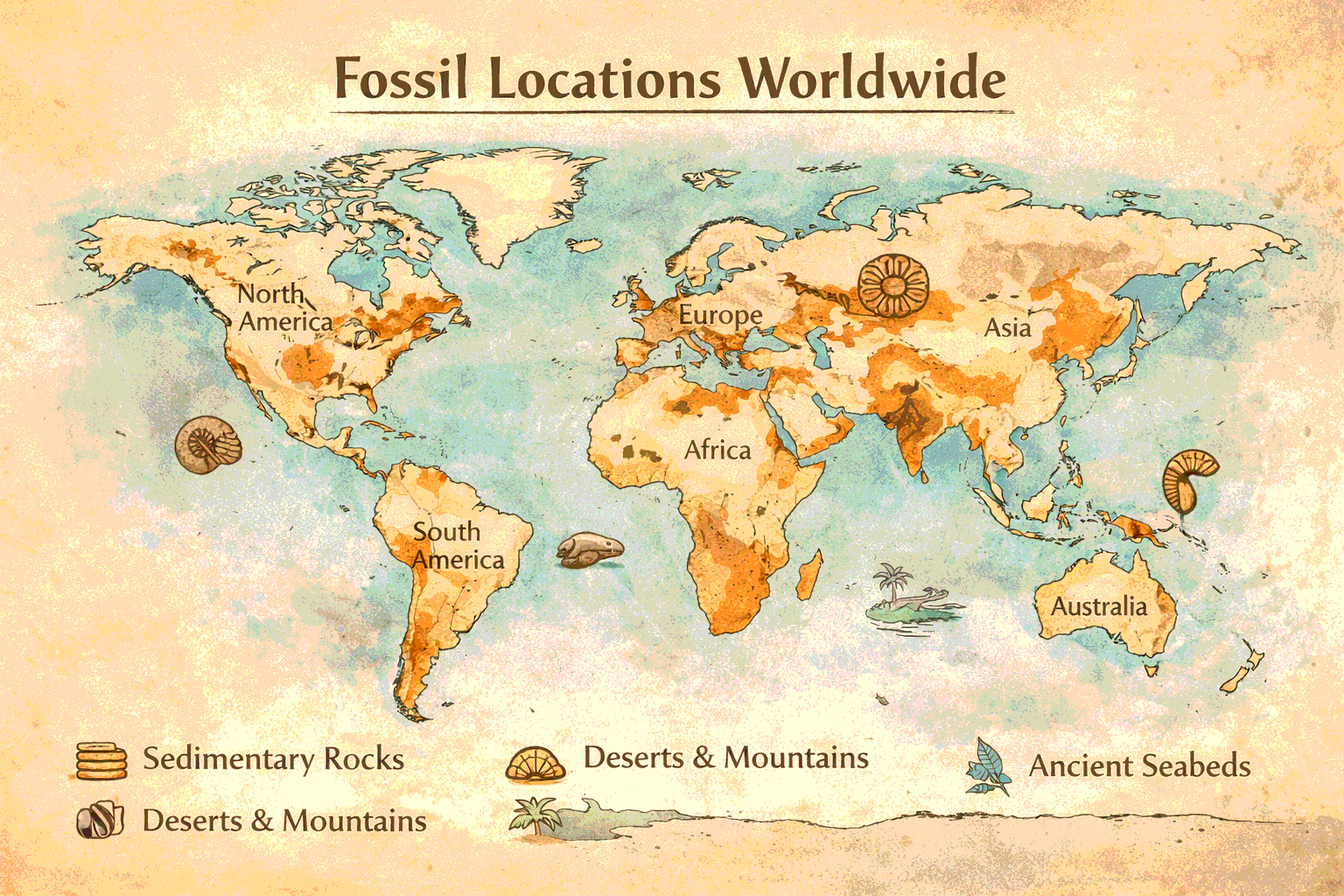
Fossils are found worldwide, but certain regions are especially rich:
Each region reflects a different ancient environment.
- North Africa — ancient marine deposits
- Central Asia — desert and dinosaur-bearing formations
- North America — large sedimentary basins
- Europe — layered limestone formations
- South America — diverse fossil ecosystems
Each region reflects a different ancient environment.
Where Fossils Are Rare or Absent
Fossils are rarely found in:
Igneous rocks
Formed from molten material — high temperatures destroy organic remains
Metamorphic rocks
Altered under pressure and heat — original structures are lost
These environments erase, rather than preserve.
Igneous rocks
Formed from molten material — high temperatures destroy organic remains
Metamorphic rocks
Altered under pressure and heat — original structures are lost
These environments erase, rather than preserve.
How to Recognize a Fossil-Rich Area
Key indicators:
These signs suggest that ancient layers are accessible.
- visible sedimentary layers
- erosion (wind, water)
- minimal plant cover
- exposed rock surfaces
These signs suggest that ancient layers are accessible.
Conclusion
Fossils are not confined to places.
They are traces of processes.
To find a fossil is to encounter a location that no longer exists in its original form.
A place that has changed — but did not forget.
They are traces of processes.
To find a fossil is to encounter a location that no longer exists in its original form.
A place that has changed — but did not forget.
