
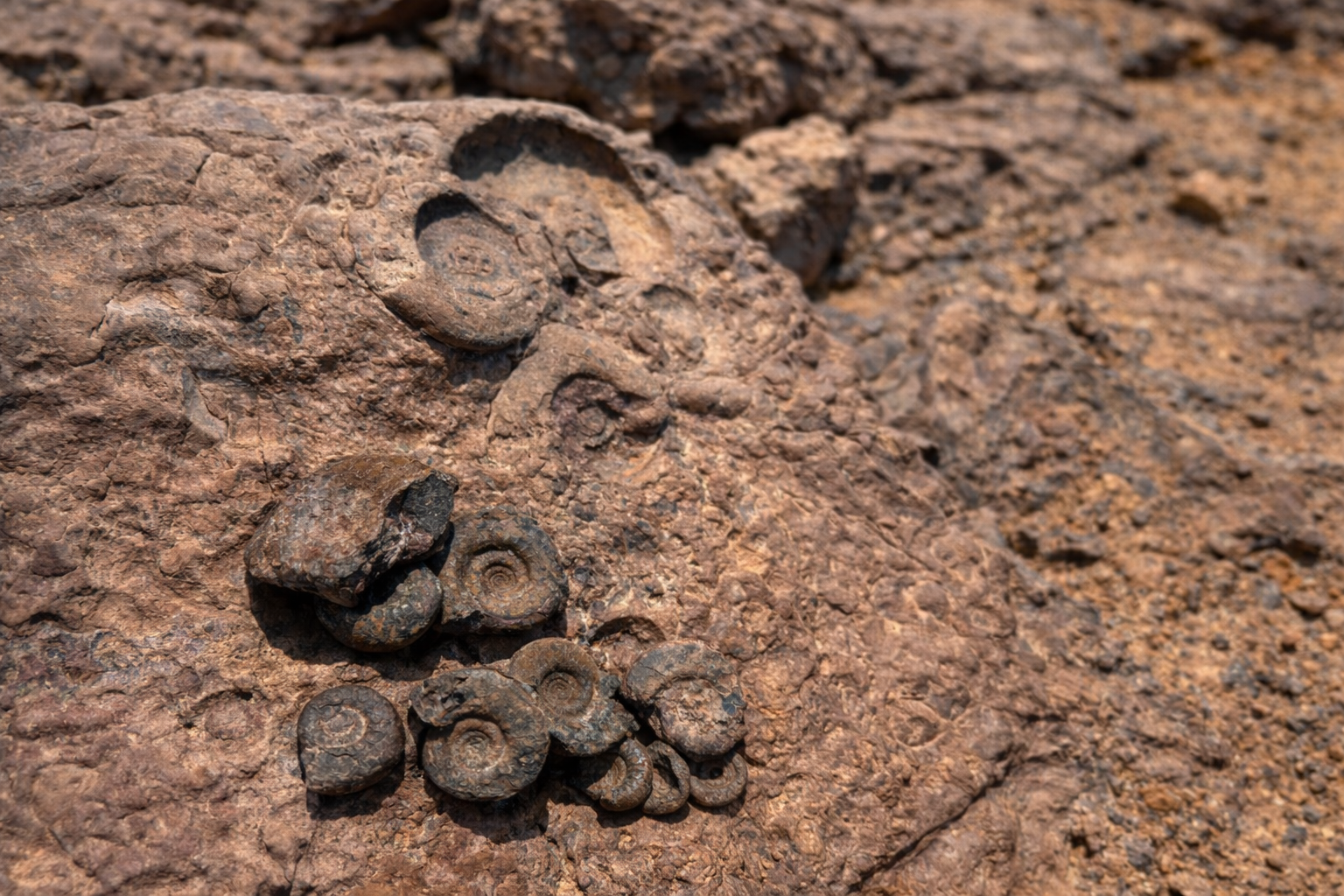
Ammonite fossils are among the most remarkable records of ancient life on Earth. These spiral shells, once part of living marine animals, have survived hundreds of millions of years thanks to a slow geological process known as fossilisation.
Understanding how ammonite fossils form reveals not only the history of these creatures but also the powerful natural forces that preserve traces of life across deep time.
To understand these ancient creatures better, read our guide What Is an Ammonite? Fossil Age, Meaning and Jewellery.
Understanding how ammonite fossils form reveals not only the history of these creatures but also the powerful natural forces that preserve traces of life across deep time.
To understand these ancient creatures better, read our guide What Is an Ammonite? Fossil Age, Meaning and Jewellery.
Life in Ancient Oceans
Ammonites were marine molluscs that lived in the world’s oceans for hundreds of millions of years. They belonged to the same broader group of animals as modern squid and octopus.
Their bodies were protected by a coiled shell divided into chambers. As the ammonite grew, it built new chambers while sealing off the previous ones. This created the characteristic spiral structure that makes ammonites instantly recognisable today.
When ammonites died, their shells often sank to the seafloor, beginning the long journey toward becoming fossils.
Their bodies were protected by a coiled shell divided into chambers. As the ammonite grew, it built new chambers while sealing off the previous ones. This created the characteristic spiral structure that makes ammonites instantly recognisable today.
When ammonites died, their shells often sank to the seafloor, beginning the long journey toward becoming fossils.
Burial Beneath Sediment
The first stage of fossil formation begins when the shell settles on the seabed.
Over time, layers of mud, sand, and fine sediment accumulate above it. This burial protects the shell from currents, scavengers, and physical destruction.
The sediments slowly compact under their own weight, forming sedimentary rock. Within these layers, the shell becomes sealed in an environment where fossilisation can occur.
Over time, layers of mud, sand, and fine sediment accumulate above it. This burial protects the shell from currents, scavengers, and physical destruction.
The sediments slowly compact under their own weight, forming sedimentary rock. Within these layers, the shell becomes sealed in an environment where fossilisation can occur.
Fossilisation: Turning Shell into Stone
As the sediments harden, groundwater rich in dissolved minerals begins to move through the rock.
During this stage, a process called mineral replacement takes place. The original shell material gradually dissolves while minerals such as calcite or silica fill the structure.
The result is a stone replica of the original shell. Its chambers, ridges, and spiral form can remain remarkably detailed even after hundreds of millions of years.
This transformation is what turns a biological structure into an ammonite fossil.
During this stage, a process called mineral replacement takes place. The original shell material gradually dissolves while minerals such as calcite or silica fill the structure.
The result is a stone replica of the original shell. Its chambers, ridges, and spiral form can remain remarkably detailed even after hundreds of millions of years.
This transformation is what turns a biological structure into an ammonite fossil.
Preservation Over Millions of Years
Once fossilised, ammonites may remain hidden within rock layers for immense periods of time.
Many of the fossils discovered today formed during the Devonian, Jurassic, and Cretaceous periods, meaning they are often between 360 and 65 million years old.
Geological movements such as erosion, uplift, and desert formation eventually expose these fossil-bearing rocks at the Earth’s surface.
In places like the Sahara Desert of Morocco, ancient seabeds have been lifted and weathered, revealing ammonites preserved in stone.
Many of the fossils discovered today formed during the Devonian, Jurassic, and Cretaceous periods, meaning they are often between 360 and 65 million years old.
Geological movements such as erosion, uplift, and desert formation eventually expose these fossil-bearing rocks at the Earth’s surface.
In places like the Sahara Desert of Morocco, ancient seabeds have been lifted and weathered, revealing ammonites preserved in stone.
Why Ammonites Fossilise So Well
Ammonites fossilise more frequently than many other organisms for several reasons:
Because of this abundance, ammonites are extremely valuable to scientists. They are known as index fossils, meaning their presence helps geologists determine the age of rock layers.
- Their shells were hard and mineral-rich
- They lived in large numbers in ancient seas
- Their shells were easily buried by sediment after death
Because of this abundance, ammonites are extremely valuable to scientists. They are known as index fossils, meaning their presence helps geologists determine the age of rock layers.
From Fossil to Object of Study
For scientists, ammonites provide clues about ancient oceans, evolutionary history, and geological time.
For collectors and designers, they represent something equally remarkable: a natural form shaped by life hundreds of millions of years ago.
When carefully prepared and polished, an ammonite fossil reveals the geometry of its spiral chambers — a structure that has fascinated both geologists and artists for generations.
For collectors and designers, they represent something equally remarkable: a natural form shaped by life hundreds of millions of years ago.
When carefully prepared and polished, an ammonite fossil reveals the geometry of its spiral chambers — a structure that has fascinated both geologists and artists for generations.
A Record of Deep Time
The formation of an ammonite fossil is a slow collaboration between biology and geology. What began as a living marine creature becomes, through sediment, pressure, and mineral transformation, a preserved trace of Earth's distant past.
Each ammonite fossil therefore carries two stories: the life of an ancient ocean organism, and the immense geological processes that allowed its spiral shell to survive across deep time.
Ammonite fossils are only one part of the story. Learn more about their age, meaning, and use in jewellery in our article What Is an Ammonite?
Each ammonite fossil therefore carries two stories: the life of an ancient ocean organism, and the immense geological processes that allowed its spiral shell to survive across deep time.
Ammonite fossils are only one part of the story. Learn more about their age, meaning, and use in jewellery in our article What Is an Ammonite?
